
A survey conducted across 14 countries
To compile its 2027 Trends Report, Hilton drew on international research including a quantitative survey carried out with Morning Consult between 18 May and 1 June 2026. The sample comprises 14,744 travellers aged 18 and over who plan to travel within the next 12 months, in the United States, Mexico, Brazil, Colombia, the United Kingdom, Germany, Türkiye, the United Arab Emirates, Saudi Arabia, Australia, China, India, Japan and Korea.
Analysis – By linking trust, loyalty status and human recommendation, the report reinforces the direct distribution strategy of the major groups, for which the loyalty programme remains a central lever against intermediaries and automated planning tools. The full report is available at stories.hilton.com/2027trends.
The margin of error is approximately 1% for the study as a whole and averages around 3% for each individual market. A year earlier, the group had placed traveller motivation at the heart of its 2026 Trends Report on the “Whycation”.
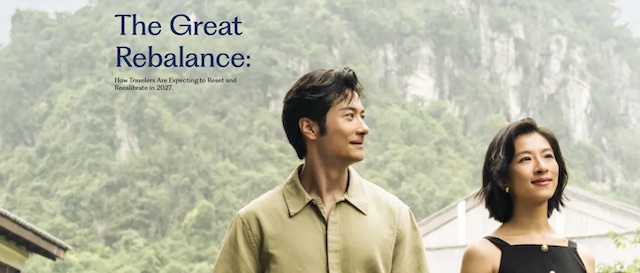
The 2027 edition portrays travellers who are redefining what it means to travel well, prioritising flexibility, recharging and experiences whose benefits continue long after they return home.
“We’re seeing that travelers are less interested in someone else’s definition of perfection and more focused on planning travel on their own terms,” said Chris Nassetta, president and chief executive officer of Hilton.
The end of the “perfect” trip
The first trend identified, the rise of “good-ish” travel, reflects travellers’ desire to free themselves from social pressure. More than half (54%) say they feel some pressure to have the perfect trip, and 24% say they go along with the group’s choices to keep the peace.
The report also notes the emergence of “solo-ish” travel, which combines independence with social connection. Almost a third of travellers (31%) have travelled alone to meet friends or family at their destination. Motto by Hilton reports that more than half of its worldwide reservations over the past year were for solo guests.
🔗 Also on LTH 2029, Japan | Hilton signs Japan’s first Motto by Hilton in Kyoto
Human expertise as a source of trust in the age of AI
As AI-assisted planning becomes widespread, Hilton sees human involvement as the ultimate differentiator. One in five travellers without children names their mother as their most trusted source of travel advice, twice the proportion among parents (8%).
Beyond the family circle, hotel staff enjoy a high level of trust: 70% of travellers trust them as a source for planning their stay, a direct lesson for guest-facing teams.
Loyalty as a status marker
Loyalty status now goes beyond the question of benefits alone and influences the credibility given to recommendations. Half of respondents (50%) say they are more likely to trust advice from someone who holds “status”, and 29% admit to being jealous of friends with a higher tier than their own.
This dynamic is driving members up the tiers. Since Hilton Honors evolved in January 2026 to make earning status more achievable and rewarding, members have reached elite status faster, with double-digit growth compared with the previous year. The group also uses the programme to drive its portfolio of all-inclusive resorts in Mexico and the Caribbean.
Travel as a driver of personal growth
The report describes travel as increasingly seen as a catalyst for personal development, with effects that begin even before departure. Three in four travellers (76%) say that having a trip on the calendar gives them something to work towards.
“Skillcations”, or learning-focused stays, are gaining ground: 42% of travellers say travel has helped them discover new interests or passions. Gen Z travellers are almost twice as likely as baby boomers to want to come home with a new hobby to pursue.
Hilton cites the example of Grand Wailea, a Waldorf Astoria Resort, in Hawaii, whose Kilohana Cultural Resource Center offers ukulele lessons, cultural tours and craft workshops. More than 6,000 travellers visited it in 2026.
Nature-focused wellbeing
Travellers are increasingly combining digital experiences with moments of disconnection. Almost two-thirds (65%) actively seek out experiences that soothe the body and the nervous system, and 76% feel that travel allows them to recharge in ways they cannot necessarily access at home.
Nature plays a central role: 79% consider fresh air and the outdoors essential to relaxing, and 54% spend more time outdoors when travelling than at home. At Conrad Orlando, the Water Garden, an outdoor hydrothermal experience designed to reflect Florida’s climate and landscapes, illustrates this demand, with outdoor thermal treatments up 60% year on year.
Micro-trips reshape demand
Time is becoming one of travellers’ most constrained resources, leading them to favour shorter, more frequent trips that fit more easily into everyday life. As a result, 67% enjoy planning trips that pack in as many experiences as possible in a short time, and 63% prefer to stay somewhere central with plenty of activities nearby.
What counts as a short trip, however, varies widely by market. In the United States, 42% of travellers consider a trip of under three to four days to be short, whereas in Japan (86%) and South Korea (59%) the threshold is under two days. Saudi Arabia (29%) and Germany (26%) take a broader view, extending to five or six days or more.
A 28-brand portfolio to meet these expectations
Hilton intends to respond to these shifts through its portfolio of 28 brands and more than 9,400 properties, complemented by partnerships with Intrepid Travel, Explora Journeys, AutoCamp and Small Luxury Hotels of the World. The group is banking on what it calls “phygital” innovations, bringing together physical environments, human contact and digital tools.
“As traveler expectations continue to evolve, it’s our phygital innovations, the seamless blending of physical environments and human touch with digital products, that will help guests make the most of their travel experience, while also building trust and loyalty,” said Chris Nassetta.
At a glance by The Hospitality Tribune
Hilton 2027 Trends Report – The Great Rebalance
Research base: 14,744 travelers across 14 countries, surveyed by Morning Consult (May-June 2026)
Five trends: perfect-ish travel, trust, personal growth, reconnection wellness, micro-trips
Trust: 70% of travelers trust hotel staff for trip planning; 50% trust advice from loyalty status holders
Loyalty: double-digit growth in elite status attainment since the January 2026 Hilton Honors update
Wellness: 79% say fresh air and outdoors are essential; outdoor thermal treatments up 60% at Conrad Orlando