


CAMO Hospitality, a hotel-branded room service infrastructure platform, announced on 18 August 2026 the closing of a €3.4 million seed funding round. The raise follows year-on-year revenue growth of more than 200% and is intended to accelerate the company’s expansion across the US market.
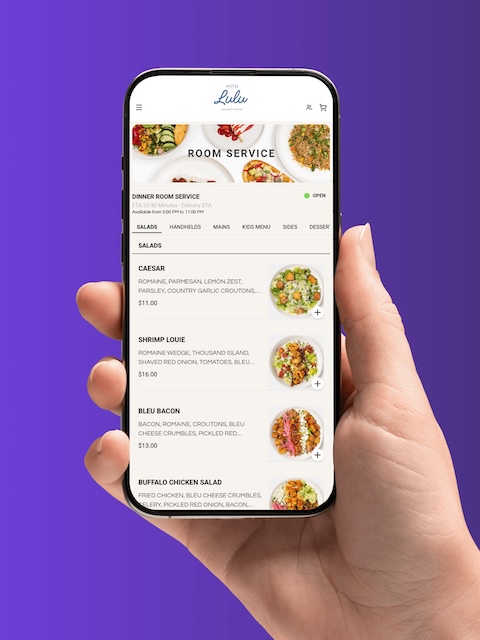
Based in Anaheim, California, CAMO provides hotels with a fully managed in-room dining service operated under their own brand, handling order technology, local kitchen preparation, delivery logistics and customer support. The model requires no kitchen build-out, no capital expenditure and no additional hotel-side hiring.

A €4.3 billion market largely captured by third parties
The funding responds to a clear market gap: American hotel guests spend more than €4.3 billion annually on food delivered directly to their rooms, even as roughly nine in ten hotels no longer offer traditional room service. A large share of that spend currently flows through third-party delivery platforms, leaving hotels without the resulting revenue, guest data or control over the experience.
This dynamic is not unique to the United States. In France, hoteliers’ efforts to reclaim the “last metre” of the guest experience from external delivery players are equally shaping group strategy, as previously illustrated by the Accor-SBE tie-up around ghost kitchens, designed to regain ground against platforms such as UberEats and GrubHub.

“Hotels have digitised everything except the transaction that happens inside the room,” said Anthony Lacavera, founder and chairman of Globalive, one of the round’s investors. He believes this represents a sizeable market with no established incumbent, and that CAMO is building the infrastructure needed to seize it.
A revenue-share business model
Orders placed through CAMO average around €39, and the majority of partner hotels generate between €860 and €4,300 in net monthly profit through the platform’s revenue-share model. Average delivery time is around 22 minutes.

Through CAMO’s hotel portal, properties gain access to order-level data covering purchase patterns, timing and how guest behaviour evolves over the course of a stay. Several hotels are channelling part of this revenue share into staff- and guest-facing initiatives, such as service-recovery credits, staff recognition schemes and local marketing activities that fall outside the usual operating budget.

Kevin Rohani, founder and CEO of CAMO, noted that guest demand for in-room delivery has never waned, but that the traditional room service model had become too costly and too complex for most hotels to operate. He said the new funding now allows the offering to scale across hotel brands and management companies.
Rollout already underway with several brands
CAMO currently operates in more than 60 properties across six US markets and is working with several major hotel brands and management companies on wider, portfolio-scale rollouts. Longer term, the company plans to extend its in-room commerce model beyond dining into other on-demand services such as wellness, transport and experiences.
“There is a layer of commerce inside every hotel room that no one has truly captured yet,” Kevin Rohani explained, pointing to dining, wellness, transport, experiences and services as transactions that today largely bypass the hotel. The stated strategy is to route each of these transactions through the property itself.
CAMO has also strengthened its advisory board with the addition of Paul Tuscano, former chief digital officer at KFC and former Marriott International executive; Mike Cohen, formerly of Square and Meta; and Alex Canter, founder of Ordermark and Nextbite. Paul Tuscano, who led on-property digital and mobile product development at Marriott, said that outsourcing the in-room moment to an external marketplace breaks the relationship between guest and brand, whereas CAMO keeps that experience within the hotel’s own ecosystem.
Other investors include Rajan Hansji, CEO of Hansji Corporation; Azim Jamal, CEO of Pacific Reach; Parsa Rohani, co-founder of Neudesic and Timu; Evan Weiss, co-founder of LWHA; and a group of hotel owners who are already users of the platform.
At a glance by The Hospitality Tribune
Funding: $4 million (approx. €3.4 million) seed round, closed August 18, 2026
Growth: Over 200% year-over-year revenue growth
Market opportunity: An estimated $5 billion (approx. €4.3 billion) spent annually on delivery to U.S. hotel rooms
Footprint: 60+ hotel properties across six U.S. markets
Unit economics: Average order ~$45 (approx. €39); hotels typically net $1,000-$5,000 (approx. €860-€4,300) in monthly profit
Next steps: Entry into additional U.S. markets, portfolio-wide brand rollouts, and expansion of the in-room commerce model beyond dining