

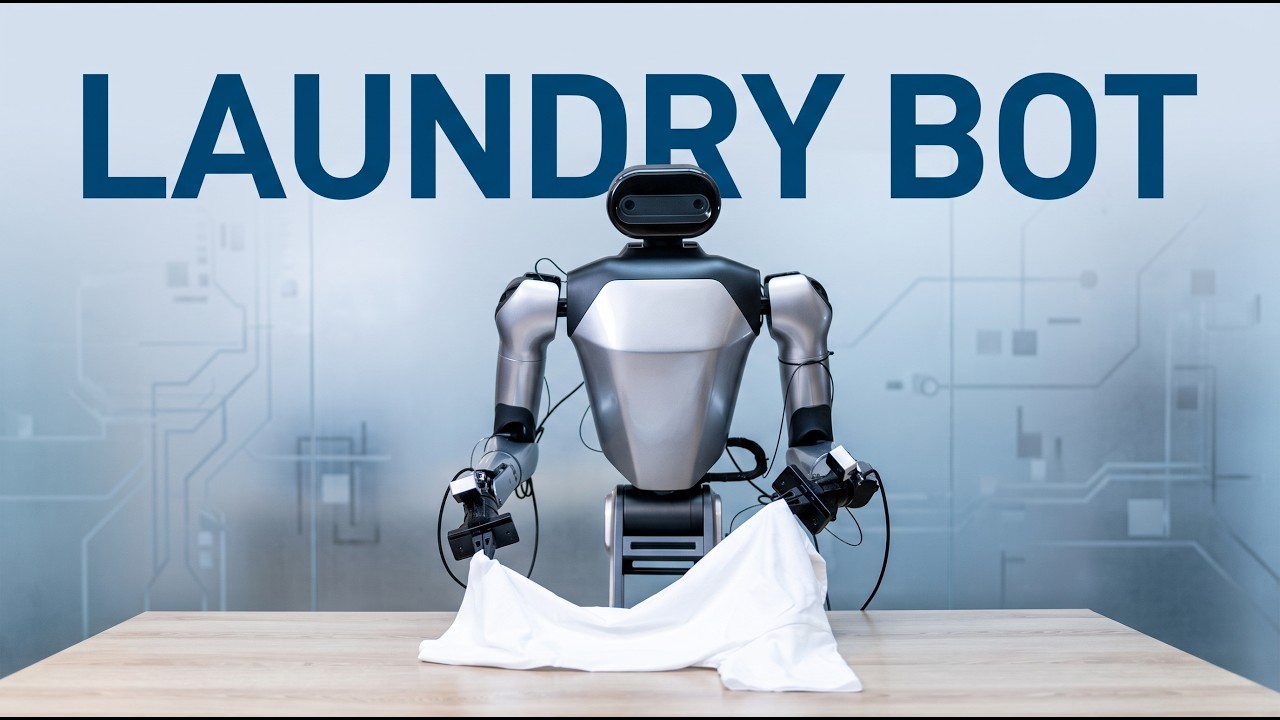


An end-to-end automated laundry workflow
ACE Robotics confirmed in an official post that it had carried out a hotel laundry demonstration using Mundo. The details were published on 13 November by Interesting Engineering and Pandaily, both citing the Chinese outlet QbitAI.
The robot collects the laundry baskets left outside guest rooms and takes them to the laundry room. There, it operates the washing machines and tumble dryers, then brings the clean clothes back. A scheduler called BotAgent breaks the task down into 53 elementary actions, grouped into 14 stages. It can combine more than 200 sequences depending on room locations, lift availability and waiting times at the machines.
A ‘dual brain’ split between the cloud and the robot
Mundo was developed with researchers from Nanyang Technological University in Singapore. Using photographs of rooms, corridors and service areas, it builds digital twins that replicate physical properties such as mass and friction. This allows the robot to rehearse its movements in simulation before performing them in the real world.

The architecture separates two roles. A cloud-based model, identified in press reports as GPT-Astra, searches for strategies within the digital twin and stores those that work as reusable skills. A model embedded on the robot then executes them under the control of BotAgent.
18.6 seconds: a figure to handle with care
According to company data, routing every decision through the cloud in real time took more than 30 minutes. Local execution takes 18.648 seconds. The reports do not specify exactly what this measurement covers.
This matters, because the same sources indicate that unloading the dryer alone takes between 170 and 210 seconds per cycle. The 18.6-second figure therefore cannot be read as the duration of the full laundry workflow.
Learning from failure, tested on a real robot
When an attempt fails, the cloud model analyses camera images and sensor readings, then proposes corrections. When the wrist camera was obstructed, the system switched to an overhead view. When a pair of jeans remained stuck in the drum, it adjusted the lifting trajectory and the angle of the gripper’s fingers.

Between attempts, the robot resets the scene by itself. A separate evaluator model assesses each trial, keeping the best versions and reverting less effective changes. Across 165 unloading trials conducted over 57 hours, the average share of jeans left in the drum fell from 48% to 32%, with a best result of 19%.
All of these performance figures were reported by the company and have not been independently verified.
ACE Robotics, ‘brains’ for robots
ACE Robotics (Daxiao Robot in Chinese) was founded in July 2025 in Shanghai. It is chaired by Wang Xiaogang, co-founder of SenseTime. The company develops AI models for robots and deploys them on humanoids from Chinese manufacturers such as Unitree, AgiBot and Fourier. Its fields of application range from unstaffed retail to hotel services.
In July, at the World Artificial Intelligence Conference in Shanghai, the company unveiled its Kairos 3.1 world model along with three commercial solutions: instant retail, hospitality and outdoor services. Wang Xiaogang stressed at the time that, while a model error in the digital world might produce a flawed image or paragraph, an incorrect action in the physical world can have real consequences.
Back-of-house, the next frontier for hotel robotics
Analysis – Handling soft textiles remains one of the key bottlenecks in service robotics, and ACE Robotics’ trials bear this out: on average, nearly a third of the jeans stay in the drum. The demonstration is still closer to an advanced prototype than to an operationally ready solution.
It nonetheless confirms an underlying trend. As LTH noted in its analysis Europe, the world’s leading hospitality market, is absent from the robotics that will equip it (in French), room and public-area upkeep is shaping up to be the first proving ground for hotel robotics, in a market dominated by Chinese players. For operators, questions of cost, commercial model and long-term reliability remain unanswered at this stage.
At a glance by The Hospitality Tribune
ACE Robotics demonstrates end-to-end hotel laundry automation
Shanghai-based ACE Robotics, chaired by SenseTime co-founder Wang Xiaogang, showcased its Mundo world model in a hotel laundry workflow
Robot collects baskets from guest rooms, runs washers and dryers, and returns clean clothes
Dual-brain setup: cloud planning (GPT-Astra) and on-robot execution of reusable skills via BotAgent
Company-reported 18.6-second local execution vs. 30+ minutes cloud-only; measurement scope unspecified
Dryer unloading: 165 trials, 170-210 s cycles, jeans left behind down from 48% to 32%; not independently verified