



A documented tax gap across three key markets
Transport & Environment (T&E) compared the taxes applied to a hotel night priced at €100 in France, Italy and Spain with those levied on cruises sold at similar rates. The finding is clear-cut: a night aboard a cruise ship is taxed considerably less than a night in a hotel.
In France, hotel guests pay 24% of the price in taxes, compared with just 9% for cruise passengers. In the NGO’s view, this gap cannot be justified given the environmental impact of the ships and the pressure they place on local infrastructure.
The burden weighs all the more heavily on French hoteliers as local taxation has risen sharply in recent years, as illustrated by the tripling of the tourist tax in Paris and Île-de-France in 2024.

THT Analysis – For hoteliers in Mediterranean coastal destinations, the study provides hard figures for the debate on tax fairness between forms of accommodation. Until now, that debate has focused mainly on short-term furnished rentals.
A legal loophole at the heart of the debate
Cruises are officially classified as a form of maritime transport, even though in practice they fall under tourist accommodation. According to T&E, this classification notably allows them to escape VAT and fuel taxes.

Fanny Pointet, head of maritime at T&E, argues that these “floating hotels” are not essential maritime infrastructure: cruises are not a means of transport to a destination, they are the destination itself, yet they enjoy the same advantages as freight shipping. In her view, taxing cruise ships at their fair value would help cities tackle pollution and respond to concerns about overtourism.
External costs estimated at up to €930 million
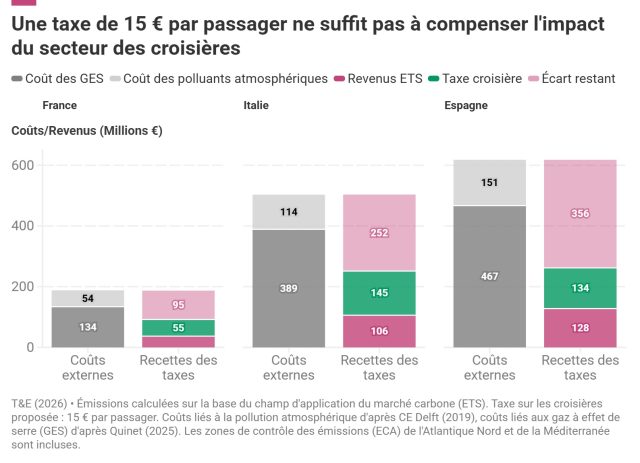
The study highlights that a large share of cruise ships’ negative externalities, stemming from greenhouse gas emissions and air pollutants, falls outside existing policies. In the Mediterranean regions of France, Spain and Italy, these external costs ranged from €550 million to €930 million in 2025.

This range is based on two alternative carbon values, calculated by CE Delft (2019) and Quinet (2025). According to T&E, the maritime carbon market (Maritime ETS) is insufficient to offset these costs, particularly as it is not designed to cover air pollution.
The NGO also draws on research by the ICCT, which found that a cruise passenger generates two to four times more CO₂ than a holidaymaker travelling by plane or car and staying in a hotel.
A €15 levy per passenger, worth €55 million a year in France
To close this gap, T&E’s first recommendation is the introduction of national taxes on cruise tickets. Within the European Union, only Greece currently applies such a scheme at national level, with a charge of between €5 and €20 depending on the season.
At local level, several cities, including Amsterdam, Barcelona and Dubrovnik, have already taken the plunge. The Catalan capital also plans to raise its tax on cruise passengers stopping over for less than 12 hours from €11 to €30 by 2030.
According to T&E’s simulations, a levy of €15 per passenger per call would raise €55 million a year in France. The revenue could go to the state budget, fund the protection of coastal ecosystems or support infrastructure such as shore power.
A broader package of measures
Taxation alone will not close the gap between the environmental cost of cruises and their financial contribution. Fanny Pointet concludes that a cruise ship tax should be seen as part of a broader set of regulatory measures, and that parallel supply-side policies are needed to fully mitigate the sector’s environmental footprint.
T&E therefore recommends strengthening the EU regulation on sustainable maritime fuels (FuelEU Maritime) and tightening energy-efficiency criteria. Traffic could also be restricted where necessary, for example through a cap on calls per day or per year – an approach already tested in Venice, which banned large cruise ships from its historic centre as early as August 2021.
Finally, the NGO believes that the VAT applied to cruise ships should be aligned with that of the conventional tourism sector.
At a glance by The Hospitality Tribune
T&E study: cruises taxed far less than hotels in Europe
Tax gap: a cruise night carries 40% less tax than a hotel night (France, Italy, Spain)
France: 24% of the price in taxes for hotel guests vs 9% for cruise passengers
Loophole: cruises classified as maritime transport, exempt from VAT and fuel taxes
External costs: €550m to €930m in 2025 across Mediterranean France, Spain and Italy
Proposal: a €15 per passenger per call levy would raise €55m a year in France