

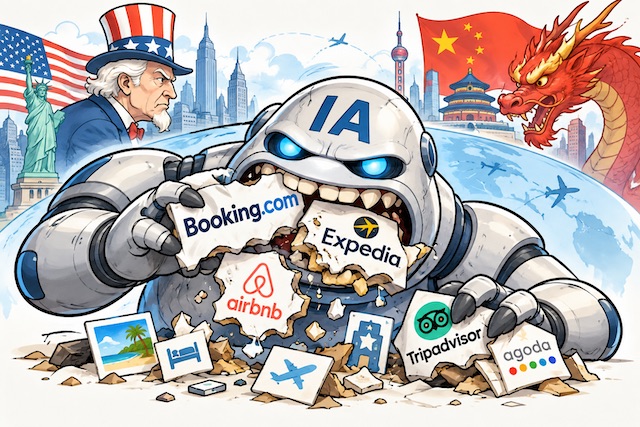


OTAs caught up by the revolution that created them
Online travel agencies built their power on the first great digital wave. They positioned themselves between travellers and suppliers, at the expense of traditional agencies and hoteliers. Through commissions, they weighed on the profitability, and therefore the value, of many businesses that rely on their services. Today, a new technological disruption threatens to give them a taste of the same treatment.
AI assistants are gradually becoming a new interface for planning a trip. The risk for booking platforms is being relegated to mere sources of inventory and data providers, operating in the background. For OTAs, the threat is no longer theoretical.

In May 2026, marking the group’s 30th anniversary, Ariane Gorin described artificial intelligence as the third major technological disruption in Expedia’s history, after the internet and mobile. She added that this era was only just beginning. The French-American executive has led the group since May 2024.
An internal memo marking a new era
The internal memo was sent in mid-August by Chief Product Officer Shilpa Ranganathan and Chief Technology Officer Ramana Thumu. It was revealed by US outlet GeekWire on 19 August. Its assessment is unequivocal: over the past year, the memo states, AI has radically changed what is possible, with work that once took weeks increasingly being done in hours.
To seize this opportunity, the two executives believe the group must fundamentally change the way it works, how it is organised and the technology it builds. The new organisation is built around small, cross-functional teams known as “squads”. Each has end-to-end ownership and is expected to embed AI and machine learning across all of its work.
The memo draws on lessons from several pilot teams. According to the memo, many of the obstacles to speed of execution are structural, and decisions are more effective when teams are closer to the ground and more autonomous. Used well, AI also helps close gaps and share knowledge in real time. Employees should therefore expect to spend less time coordinating and waiting.
Eight executives out, a redrawn organisation chart
The most visible sign of this shift is the departure of at least eight vice presidents and senior vice presidents, confirmed by Expedia. The most senior is Sachin Singh, SVP Book-to-Trip Technology. A former Amazon executive who joined in 2022, he sat on the CTO’s leadership team. The memo credits his work on checkout, payments, fraud prevention, customer service and AI.
His remit is now split between several executives. Fraud and risk move under Chief Information Security Officer Hilik Kotler, and self-service under Ryan O’Neill. Payments (product, technology and operations) go to Reena Patil and Debashis Saha.
Seven other executives are also leaving the group: Sara Beckmann, Ian Butcher, Matt Esler, Amitabh Ghosh, Emil Riccardi, Fiona Stevenson and Shao Xie. Their roles included pricing, lodging, data platforms and fraud.
The reorganisation brings data, AI and agentic platforms under Xavier Amatriain. The former Google executive was appointed the group’s first Chief AI and Data Officer in December. Rick Fast, SVP Platform Engineering, becomes Chief Architect. Technology teams are aligned with each brand’s product lead, and CRM moves from marketing to Product and Technology.
The memo also announces promotions. Debashis Saha becomes SVP Travel Foundations, while Rajat Arora, Ryan Hillman, Ashwita Kaur and Ambrish Srivastava are promoted to vice president. Asked by GeekWire, a spokesperson described the impact as limited, without specifying the number of roles cut. The memo nonetheless acknowledges that, in a small number of cases, the group made the difficult decision to eliminate certain roles.
Seattle: the second wave of cuts this year
A month later, the move took concrete form. According to MyNorthwest, Expedia Group filed a WARN (Worker Adjustment and Retraining Notification) notice with Washington State’s Employment Security Department. The notice announces 58 permanent layoffs at its Seattle campus, expected between 21 November and 1 December. They affect data scientists, software engineers, finance managers and senior executives.
This is the second wave this year. In January, 162 positions were officially cut at headquarters, mainly in technology teams, ranging from the vice president in charge of experience design to several directors, engineers and product managers. At the time, the group said it wanted to simplify its structure and reduce organisational layers, while opening roles for the skills it will need.
These adjustments are part of a longer sequence. According to its financial filings, Expedia recorded restructuring charges of $80 million (around €70 million) in 2024 and $107 million (around €93 million) in 2025. In the first half of 2026, they amounted to $69 million (around €60 million). These sums relate mainly to severance costs.
Headcount has fluctuated considerably. The group had more than 25,000 employees in 2019, fell to 14,800 during the pandemic, then rose back to 17,100 at the end of 2023. At the end of 2025, it employed around 16,000 people in nearly 50 countries. Roughly half work in technology roles, some 8,000 people at the heart of the new organisation.

A restructuring carried out amid growth
Yet this tightening comes at a time of solid results. In the second quarter of 2026, gross bookings rose 12% to $33.9 billion (around €29.5 billion). Revenue grew 14% to $4.315 billion (around €3.76 billion).
Operating income jumped 65% year on year, and net income reached $878 million (around €765 million). During the quarter, the group also bought back around $200 million (around €174 million) of its own shares.
Presenting these results, Ariane Gorin set the tone by describing AI as a force multiplier for innovating faster and operating more efficiently. The group recently opened a technology hub in San Jose and is recruiting AI engineers. According to the company, its customer service agent handles more than 143 million conversations a year and resolves more than half of travellers’ requests through self-service.
Securing a place in the new channels
Expedia is also establishing itself in these new environments to protect its position. The group was a launch partner when OpenAI opened ChatGPT to third-party apps, and this year it is buying advertising space within the assistant. It has also acquired Layla, an AI-native travel planning platform.
At the same time, Expedia is strengthening its B2B business, which is less dependent on the consumer-facing interface. Booking Holdings is following the same logic by merging the B2B activities of Booking.com, Agoda and Priceline.
In the United States and, by extension, the rest of the world, disruption is nonetheless advancing more slowly than expected. In March, OpenAI removed the Instant Checkout button from ChatGPT’s main interface and abandoned processing travel transactions directly. Shares in Expedia and Booking Holdings rose sharply as a result. The withdrawal was presented as technical, but was it really? Or was it a way of buying time for US companies, a form of understanding that dare not speak its name?
A battle that goes beyond travel
The stakes extend beyond the travel sector alone. By taking on the OTA model, the major AI players could trigger a form of economic cannibalism within US tech itself, at a time when the United States is seeking to maintain its lead over China.
The rivalry between the two powers also entered the debate this week. On 22 September, addressing the United Nations, Donald Trump rejected any international regulation of AI. Received at the White House, Xi Jinping, for his part, called for its development to remain under human control.
In the long run, integration from the top seems hard to avoid, but the balance of size does not favour the OTAs. They lack the financial firepower to absorb the major AI players. A more worrying question remains for them: why would those players spend billions acquiring OTAs if they can access their inventory and data through simple partnerships, then replicate their model? Just as OTAs contributed to the erosion of hotel business values by capturing hotels’ “customer capital”, AI could in turn capture the OTAs’ data, hollowing out their capital value…
This revolution will also affect the countries that currently host the platforms’ booking and support centres. In the face of AI, the wage advantage counts for less and less. Competition will increasingly be decided by access to computing capacity and cheap energy.
A window for hotel groups
If AI agents become the traveller’s first point of contact, the battle will shift to direct access to inventory, customer data and loyalty programmes. On this terrain, brand owners hold assets that intermediaries do not fully control. According to GeekWire, Marriott’s chief executive has said that AI booking agents would hurt online travel agencies more than hotels.
Hotel groups are already positioning themselves. Accor has just rolled out ALL Concierge, its conversational AI assistant, at scale, while Hilton is testing its AI Planner. Meanwhile, EVT Hotels & Resorts has integrated its offer directly into ChatGPT.
Accenture points in the same direction. Its report urges hotels, airlines and OTAs to connect payments, loyalty and customer data in order to remain visible to these assistants.
While nothing yet guarantees that the balance of power will shift, Expedia’s restructuring shows that the OTAs have grasped the risk. Having captured the value of the internet revolution, they must now prove they will remain indispensable in AI-driven booking.
At a glance by The Hospitality Tribune
Expedia Group reorganizes Product & Technology around AI
At least eight VPs and SVPs exit, including SVP Book-to-Trip Technology Sachin Singh
Data, AI and agentic platforms consolidated under Chief AI and Data Officer Xavier Amatriain
58 additional Seattle layoffs filed via WARN notice, effective Nov. 21 – Dec. 1, 2026
Q2 2026: gross bookings up 12% to $33.9bn, revenue up 14% to $4.315bn
AI agents seen as a threat to OTAs and an opening for hotel brands