

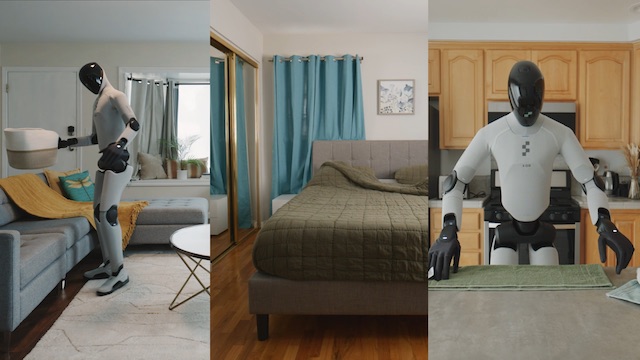


Figure, the Californian company specialising in humanoid robotics, unveiled Helix 2.5 on 17 September 2026, the latest generation of the neural network designed to drive its Figure 03 robot. The model enables the robot to perceive its surroundings, understand the task at hand and control its entire body autonomously, with no prior learning phase at the site of intervention.
An AI trained on human experience rather than on site
Until now, humanoid robots have had to learn the places where they would work, one environment at a time. Figure built Helix 2.5 to answer a different question: can a robot walk into a house it has never seen and get straight to work, using its whole body, autonomously?

To get there, the company pre-trained Helix 2.5 on Index, its global database of human behaviour, fed by eye-level videos shot by operators performing household chores. From this single foundation, Figure produced three distinct behaviours: tidying a living room, folding towels and making a bed.
30 unmapped homes, three household tasks
To validate the approach, Figure rented 30 homes in the San Francisco Bay Area and introduced its Figure 03 robots into them, with no data having been collected there beforehand. The robots had to cope with the furniture, sofas, beds and objects specific to each home, none of which had been encountered during training.
The evaluation protocol was strict: for tidying, the 13 to 15 toys scattered around the room had to be placed in the basket; for laundry, each towel had to be folded and placed in the basket; for the bed, the pillows and the corners of the duvet had to be positioned at the head of the bed, with a smoothed duvet. No partial credit was awarded: only full completion of the task counted.
Across all trials carried out in the 30 homes, the success rate came to 56%. A mixed result, but one that Figure presents as the most accomplished demonstration to date of autonomous generalisation without prior adaptation, at this scale, on a humanoid robot.
The decisive contribution of pre-training
To isolate the effect of pre-training on Index, Figure compared two versions of the same model trained on the same task-specific data, with identical architecture, optimisation and evaluation. The only difference lay in initialisation: one started from random weights, the other from the Helix 2.5 model pre-trained on Index.

The result is clear-cut: the model started from scratch succeeded in 9% of trials under unfamiliar conditions, against 56% for the model pre-trained on Index, a success rate more than six times higher. Figure concludes that most of Helix 2.5’s ability to generalise comes from this pre-training rather than from task-specific data.
Another finding: specifying a behaviour has become half as data-hungry while covering a scope thirty times broader. Helix 2.5 used half as much task-specific data as a comparable task under Helix 02, while generalising that behaviour to 30 unseen homes.
An investment trajectory ramping up sharply
Brett Adcock, Figure’s founder and chief executive, explains that Helix 2.5 was designed to answer a harder question: whether a humanoid robot can walk into a house it has never seen and get straight to work, using its whole body, autonomously. He adds that the company does not consider general-purpose humanoid robotics to be solved, but sees in Helix 2.5 the first proof that physical intelligence learned from human experience can be transferred to new environments rather than rebuilt each time.
Figure says its Index database now generates roughly 35 minutes of new human-experience data every second, and that the company has committed $3.5 billion, or around €3.05 billion at the 21 September 2026 exchange rate, of dedicated compute to training Helix. The company, founded by Brett Adcock – also the man behind Archer Aviation – has also measured a scaling law for human-to-humanoid-robot transfer, with enough precision to predict the loss of its largest training run to four decimal places before even launching it.
What does this mean for hospitality?
Figure itself acknowledges that its robots are not yet ready to enter homes commercially. The hotel sector is nonetheless following these advances closely: Chinese start-up Zerith Robotics is already selling a humanoid robot dedicated to cleaning hotel rooms, while players such as Pudu Robotics are developing semi-humanoid robots for reception and service.
Faced with the chronic shortage of housekeeping staff and pressure on payroll costs, any progress in autonomous domestic robotics is of direct interest to hotel operators, even though Figure is targeting the residential market first. A robot’s ability to operate without prior mapping of a site, a central condition for large-scale deployment across hundreds of properties with differing layouts, is precisely what is at stake.
Analysis – Across the sector, the trajectory recalls that of the car industry, where the robotisation of production lines, from the 1980s onwards, profoundly transformed the organisation of work. The parallel has its limits: a hotel room is neither standardised nor repetitive like a position on a production line, which is precisely why the ‘zero-shot’ generalisation demonstrated by Figure represents a technical milestone in its own right. But the underlying issue is comparable: automating physically demanding, repetitive movements – lifting loads, bending, handling bedding and linen – which are among the leading causes of musculoskeletal disorders (MSDs) and occupational illness among housekeeping staff. Successful robotisation of these tasks would ease the arduousness of the room attendant’s job, one of the roles most exposed to sick leave for MSDs in hospitality. In return, as in the car industry in its day, it would raise the question of employment levels in functions that remain among the largest sources of headcount in hotel groups, in a context already marked by staff shortages and rising payroll costs.
At a glance by The Hospitality Tribune
Figure unveils Helix 2.5, a zero-shot AI model for humanoid robots
Tested across 30 unmapped Bay Area homes with no prior data collection
Zero-shot success rate reached 56%, up from 9% without Index pretraining
Behaviors covered: room tidying, towel folding, bed making
Figure has committed $3.5B (about €3.05B) in compute to train Helix
Analysts see parallels with auto-industry robotization – easing physical strain on housekeeping staff while raising workforce questions