



Horwath HTL examines the mechanisms used to value third-party hotel management companies. Its analysis is considered alongside Cushman & Wakefield’s research into the changing hotel investment lifecycle and real estate value creation.
The fundamental distinction: The owner holds the real estate asset, while the manager earns the fees
Under the third-party hotel management model, the management company operates properties under agreements entered into with their owners.
It does not necessarily own the underlying real estate assets.

Its principal economic assets are its contractual rights to remuneration, its teams, its operating systems and its ability to manage a hotel portfolio sustainably.
This distinction forms the foundation of Horwath HTL’s study, Valuing a Hotel Management Company: Read the Hotels Behind the Fees, authored by Bryan Younge.
An increase in a hotel’s value does not directly benefit the management company through ownership of the asset. It may, however, strengthen its ability to earn fees, improve the owner’s financial position and increase the likelihood of the management agreement being renewed.
Conversely, a real estate asset whose valuation benefits from improved financing conditions may increase in price without any genuine improvement in the operator’s efficiency.

The management company’s value therefore depends on its ability to retain a sustainable share of the hotels’ economic performance, rather than on the value of the underlying real estate alone.
Base fees, incentive fees and services: Not all revenue is equal
The report distinguishes between several sources of revenue.
Base management fees are generally calculated as a percentage of hotel revenue. Incentive fees depend more directly on profitability, sometimes after the owner has received a priority return.
Horwath HTL cites figures published by DiamondRock Hospitality: across its portfolio, contractual base management fees range from 0.5% to 3.5% of gross hotel revenue. This range illustrates the diversity of contractual negotiations; it is not a universal fee schedule.
The report also notes that Marriott earned incentive fees from 69% of its managed hotels worldwide in 2025. In other words, these variable revenues should not be assumed to arise under every contract.
A management company may also charge for additional services, including accounting, procurement, information systems, revenue management and pre-opening support.
However, a distinction must be made between revenue genuinely retained by the company and the reimbursement of expenses incurred on behalf of hotels.
Applying a valuation multiple to revenue streams containing substantial expense reimbursements could significantly overstate the company’s economic value.
Transaction multiples: Benchmarks requiring careful interpretation
EBITDA multiples remain a common method of assessing the enterprise value of a hotel management platform.
Horwath HTL nevertheless emphasises that a multiple is meaningful only when the scope of activities, nature of revenue and reference periods are comparable.
Published transactions provide several examples.
| Transaction | Published figures | Horwath HTL’s interpretation |
|---|---|---|
| Hyatt / Two Roads Hospitality, 2018 | $405 million in base consideration and up to $96 million in additional consideration | Approximately 12 times projected stabilised 2021 EBITDA, including anticipated synergies and growth |
| Hyatt / Dream Hotel Group, announced in 2022 | $125 million in base consideration; approximately $12 million in stabilised management fees | Indicative ratio of 10.4 times projected fees, not an EBITDA multiple |
| Aimbridge / Interstate, 2019 | Financial terms not disclosed | No reliable transaction multiple can be inferred |
These transactions are not directly comparable with the acquisition of a regional independent hotel operator.
Some include brands, development prospects, franchise revenue or synergies specific to the acquirer.
The report highlights that major listed hotel groups have complementary businesses – loyalty programmes, distribution, licensing and franchising – which make their consolidated valuations difficult to apply to a pure-play management company.
Assessing the performance of the hotels behind the fees
One of the study’s most valuable contributions is its recommendation to begin with the individual hotels themselves.
For each property, the analyst should examine its competitive positioning, RevPAR trends, operating profitability, refurbishment requirements and economic outlook.
The RevPAR Index, which compares a property’s RevPAR with that of its competitive set, provides a useful indicator.
An index of 100 indicates performance equivalent to that of the selected competitive set.
However, Horwath HTL stresses the need to distinguish between the level of performance and its trajectory.
A hotel whose index rises from 70 to 90 has improved by 20 index points, representing a relative increase of 28.6%. Nevertheless, its RevPAR remains 10% below that of its competitive set.
The operator may therefore have delivered tangible improvements while still having scope for further progress.
Conversely, a historically strong-performing hotel whose indices are deteriorating may reveal declining operational effectiveness or weakening market positioning.
The analysis must also identify the manager’s actual contribution, distinguishing the effects of a market recovery, owner-funded refurbishment, a brand change or improvements in operational management.
From RevPAR to real estate value: Measuring value creation for the owner
Revenue growth alone is insufficient to demonstrate that an operator is creating value.
The report recommends examining how additional revenue translates into gross operating profit (GOP), particularly through flow-through.
Revenue growth achieved at the expense of excessive commercial expenditure, disproportionate cost increases or deteriorating service quality may deliver limited economic benefit.
Labour productivity, costs per occupied room and the quality of earnings after accounting for expenditure required to maintain the property must also be assessed.
The analysis should then extend to the owner’s economic cash flows, after management fees, property-related expenses and CAPEX requirements.
A manager may improve hotel operating profit without necessarily creating an equivalent increase in value for the owner if that improvement requires disproportionate investment.
Similarly, a successful hotel sale does not, in itself, demonstrate the operator’s effectiveness: changes in capitalisation rates, financing conditions or asset repositioning may explain part of the capital gain.
Horwath HTL therefore recommends examining operational performance alongside real estate value, without ever confusing the two.
Contract duration does not guarantee sustainable revenue
A portfolio of management agreements has a finite economic life.
Even when agreements are concluded for several years, their continuation depends on potentially complex contractual provisions: performance clauses, termination rights, changes of control, hotel disposals, renewal conditions and termination payments.
Some agreements include mechanisms allowing managers to remedy underperformance, particularly through compensatory payments known as cure payments.
These mechanisms may preserve the contract, but their cost must be incorporated into the valuation.
Expenditure incurred to secure new management agreements, particularly key money, must also be considered.
The report highlights a particularly significant risk: implicitly assuming that contracts will be renewed indefinitely.
A terminal value calculated on a going-concern basis is defensible only if the company has a credible, adequately funded organisation capable of renewing existing agreements and securing new ones.
Portfolio growth does not guarantee value creation if contract attrition and the cost of replacing lost mandates are not controlled.
An illustrative scenario: Contract losses reduce valuation by almost 18%
To illustrate his methodology, Bryan Younge presents an entirely hypothetical case.
A company manages ten hotels generating $100 million in annual hotel revenue.
It earns $3 million in base management fees, $500,000 in incentive fees and $500,000 in retained service revenue.
After $2.5 million in expenses, its normalised EBITDA reaches $1.5 million.
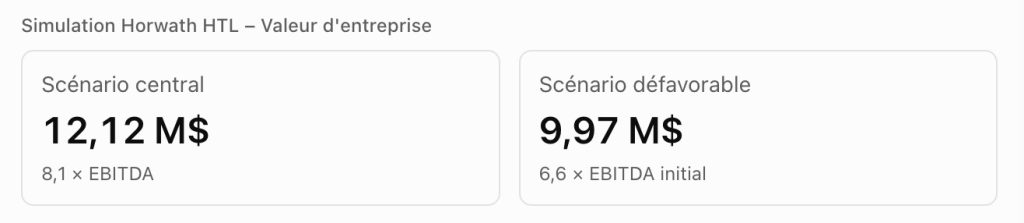
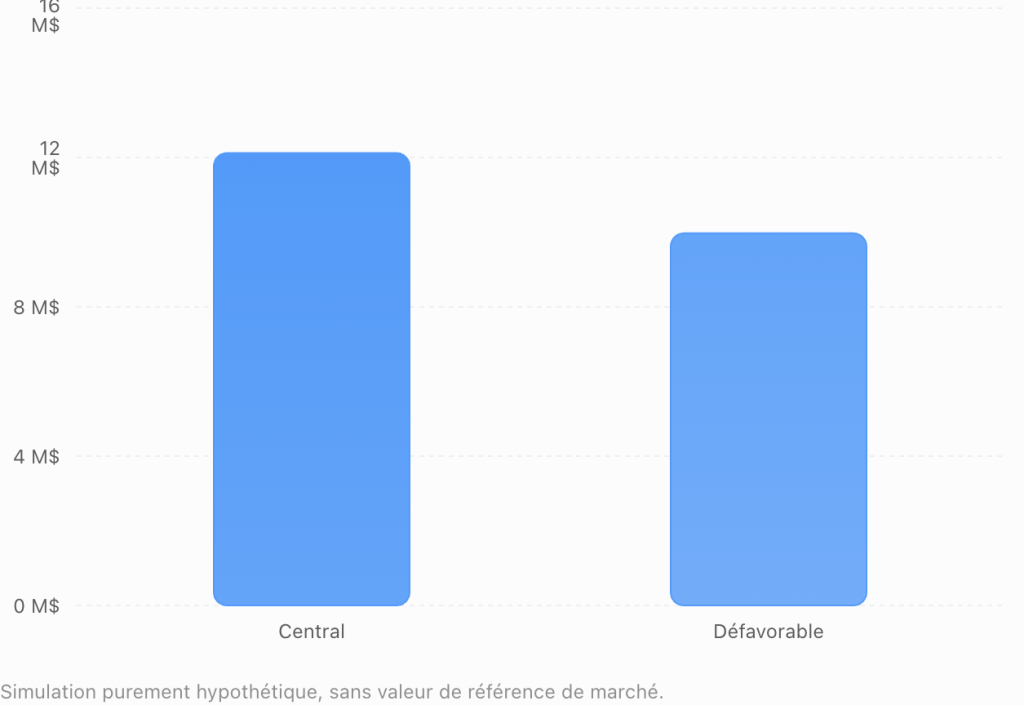
The base-case scenario applies a 14% discount rate to future cash flows and assumes terminal growth of 2.5%.
In the downside scenario, the sale of hotels belonging to a major owner results in the loss of $300,000 in annual cash flow from the second year onwards.
Enterprise value consequently falls from $12.12 million to $9.97 million, a decline of approximately 17.7%.
The report specifies that these figures are purely illustrative and do not represent multiples observed in the market.
Another finding is that approximately 61% of the base-case valuation comes from the terminal period.
This proportion highlights the valuation’s dependence on the platform’s future ability to renew contracts and sustain its activities beyond the explicit forecast period.
Is the best manager always the one charging the lowest fees?
The Horwath HTL study introduces another decisive criterion: the manager’s economic suitability from the owner’s perspective.
For each property, the available options should be compared: direct management, an independent operator, brand-managed operations or a franchise agreement combined with a third-party operator.
The optimal solution is not necessarily the one charging the lowest fees.
A more expensive manager may generate greater net value for the owner through stronger commercial performance, operational efficiency or an enhanced ability to preserve the asset.
This comparison must incorporate transition costs, contractual constraints and required investment.
Horwath HTL also emphasises the need for particular vigilance when the property owner and management company belong to the same group.
Within an integrated organisation, internal management fees do not automatically create consolidated economic value. They may simply transfer earnings between two entities.
The analysis must therefore verify that remuneration and performance reflect arm’s-length market conditions.
This distinction becomes particularly important when an owner is considering selling an asset, refinancing a portfolio or disposing of a management platform.
Cushman & Wakefield: The hotel investment lifecycle is no longer linear
This approach directly echoes the conclusions developed by Preston Puleo, Executive Director at Cushman & Wakefield, in his study The Hotel Investment Lifecycle Is No Longer Linear.
As we explained in our analysis published on The Hospitality Tribune on 17 October 2026, hotel investment can no longer be understood as a series of independent stages progressing from acquisition to disposal.
Decisions concerning financing, brand selection, operator agreements and refurbishment planning simultaneously influence a hotel’s performance and its future repositioning or disposal options.
The two studies complement one another, but they do not examine the same asset.
Cushman & Wakefield primarily examines value creation and strategic flexibility at the real estate asset level. Horwath HTL focuses on the economic value of the company operating that asset on the owner’s behalf.
The management agreement is where their perspectives intersect.
For the owner, a long, inflexible or difficult-to-terminate agreement may restrict repositioning opportunities and reduce the hotel’s attractiveness to certain buyers.
For the manager, the same agreement may secure fee income and support the value of its management platform.
There is therefore a potential tension between two legitimate objectives: the flexibility sought by the owner and the contractual visibility sought by the operator.
This interdependence confirms that negotiating a hotel management agreement is as much a financial and real estate investment decision as an operational choice.
LTH Analysis | Two assets, two valuations, one underlying operational performance
Bringing together the findings of Horwath HTL and Cushman & Wakefield highlights a fundamental distinction in today’s hotel economy: the real estate asset and the management company are two separate subjects of valuation, yet their economic trajectories remain closely interconnected.
For the owner, value depends in particular on the hotel’s future cash flows, the investment required to sustain them, financing conditions and asset liquidity. For the third-party operator, it depends on fees actually retained, their profitability and the probability of contract renewal.
This divergence of interests becomes particularly clear during a hotel disposal. The sale of a hotel may generate a capital gain for its owner while triggering the termination of the management agreement. Conversely, a contract that protects the operator may restrict repositioning or a change of manager, potentially affecting the investor’s exit conditions.
It also raises the question of vertical integration. Bringing real estate capital and operational expertise together can improve coordination between decisions, but it does not eliminate the need for independent performance assessment or an economic examination of related-party relationships.
Investors must therefore consider the value of the property, the quality of its operations and the consequences of contractual commitments simultaneously. For buyers of hotel management platforms, the challenge is to avoid confusing portfolio growth, rising fee income and sustainable value creation.
The conclusion shared by both studies is clear: operational performance lies at the heart of hotel value creation, but its allocation between owners, operators, brands and financiers depends on the contractual and financial structures in place.
At a Glance
Horwath HTL report: Valuing a Hotel Management Company: Read the Hotels Behind the Fees, by Bryan Younge.
Core distinction: Hotel property value belongs to the owner; the management company’s value rests on contractual fee rights and its operating platform.
Valuation methodology: Normalised earnings, contract-by-contract forecasts, comparable transactions, discounted cash flow and renewal risk.
Illustrative downside: Enterprise value falls from $12.12 million to $9.97 million when concentrated contract losses reduce future cash flows. These are hypothetical figures, not market benchmarks.
Cushman & Wakefield connection: Hotel investment decisions concerning brands, management contracts, financing and CAPEX increasingly influence one another throughout the holding period.
LTH perspective: The same hotel can create different economic outcomes for its owner and operator; contracts determine how value and risk are allocated.