

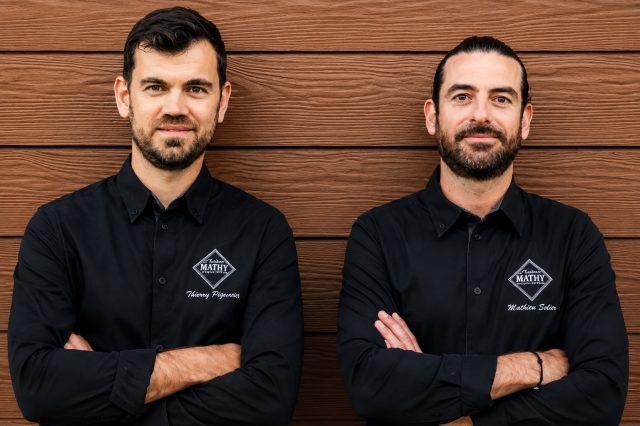

Meeting founders Mathieu Soler and Thierry Pignatta ultimately raises a broader question than ravioli itself: can part of a kitchen’s production be outsourced without industrialising what ends up on the plate?
A meeting in Mougins, at the heart of a now-structural issue
In Mougins, a region where fine dining and upscale hospitality have long been intertwined, Mathieu Soler and Thierry Pignatta set up their workshop with an idea born as much from family memories as from professional experience.

The two friends are trained chefs. The name Mathy blends their first names. But behind this seemingly simple story lies a far more operational issue for the hospitality and restaurant industry today.
Recruitment difficulties, particularly in kitchens, are no longer a marginal phenomenon. La Tribune de l’Hôtellerie recently reported that 93% of cafés and restaurants in the Île-de-France region that tried to recruit ran into difficulties, with kitchen staff among the most sought-after profiles.
In some establishments, the question is therefore no longer just who to hire, but how to keep producing when certain skills become hard to find.
Ravioli as a starting point, not an end goal
Behind Maison Mathy, however, lies something much more personal: the ravioli made by the two chefs’ grandmothers, tied to big family gatherings.
As they became professionals, Mathieu Soler and Thierry Pignatta noticed something: ravioli remains popular, but its use in professional kitchens often relies on standardised production.
“This dish marked us as children, it was part of our big family celebrations. As we became chefs, we realised we weren’t the only ones attached to it, and that the market mostly offered highly industrialised versions.” Mathieu Soler and Thierry Pignatta
Their response was to rebuild the product using restaurant-kitchen principles: thin egg-yolk pasta, knife-cut fillings to preserve texture and chunks, meat jus, fish stocks or bisques made in their workshop.
The ambition, then, is not simply to make a premium ravioli. It is to reproduce, in a dedicated workshop, the techniques and preparations normally found in a professional kitchen brigade.
Outsourcing without industrialising
This is probably where Maison Mathy becomes interesting for a hotelier.
Between production done entirely in-house, which requires time and skills, and buying a standardised processed product, a third path is emerging: outsourcing part of production to other kitchen professionals.
Maison Mathy positions itself precisely there.
“We work with more than 200 professional establishments, mostly restaurants and hotels along the Riviera, but not only. These are kitchens looking for a reliable artisanal product, either because they lack qualified staff to make everything in-house, or because they want to avoid sourcing partly through conventional specialist distribution.”
This approach obviously doesn’t claim to replace a kitchen brigade. It can, however, change how working time is allocated: should several hours of skilled staff time be spent on certain preparations when they can be entrusted to specialist cooks producing them nearby?
The question becomes particularly relevant in kitchens under strain. LTH has already reported cases of establishments forced to scale back activity for lack of staff, and recalled a specific difficulty voiced by one hotelier: in the kitchen, the core issue remains technical skill.
Production made by chefs
This distinction matters, because the model can only serve as an alternative to industrial products if genuine know-how is preserved.
At Maison Mathy, Mathieu Soler and Thierry Pignatta come from kitchens themselves. Their workshop transposes restaurant production methods into an organisation capable of supplying other professionals.
The filling is therefore not treated as a uniform component designed to ease a production line, but as a component of the dish whose textures must remain perceptible. Sauces are also made in the workshop.
This philosophy explains recipe choices such as beef daube, veal with olives, lobster or scallops, alongside newer additions featuring snails, frogs’ legs or monkfish, as well as vegetarian and vegan options.
For the past year, the company has also been producing its own gnocchi using French potatoes and flour.
Freezing as a preservation tool, not an industrial process
The use of frozen products might seem at odds with this artisanal claim. For the two chefs, it is, on the contrary, one of the conditions that allows production and use to be decoupled without altering the product.
Freezing takes place immediately after preparation. According to Maison Mathy, this notably allows them to work with a ratio of up to 70% filling to 30% pasta, while keeping the product stable over time.

“Freezing immediately after preparation lets us lock in freshness and flavour intensity at the exact moment the dish is at its best.”
For operators, the benefit is also practical: storage of up to nearly a year, consistency between orders, and quick preparation — six to seven minutes for ravioli and around three minutes for gnocchi.
The point is no longer just preservation. Freezing becomes the logistical means of decoupling the moment of artisanal production from the moment of service.
Producing locally to serve more widely
Another aspect of the model deserves attention: sourcing.
As volumes grow, claiming artisanal production is one thing; maintaining proximity to raw materials is another. Maison Mathy therefore favours local or French sourcing depending on the ingredient and its availability, notably for the potatoes and flour used in its gnocchi.
This pursuit of proximity should not, however, be turned into an absolute promise: some recipes inevitably require ingredients whose supply depends on seasonality, available volumes or origin.
This is precisely what makes the topic interesting. Once the locavore idea moves beyond marketing language and into professional production, it must contend with three simultaneous constraints: quality, consistency and volume.
For hotels and restaurants, this can also reshape how outsourcing is understood. It doesn’t necessarily mean moving production further away: it can also mean pooling it with a specialist regional workshop.
In Mougins, where the hotel landscape itself continues to evolve, notably with Le Mas Candille, this proximity between producers, restaurateurs and hoteliers takes on a particularly concrete dimension.
More than 200 establishments served
Eight years after its founding, Maison Mathy works with more than 200 professional establishments and offers more than 25 recipes. Its European health approval allows this artisanal production to meet the regulatory requirements expected by professional buyers.
Logistics have also been adapted for this clientele: products are shipped across France within 72 hours via ChronoFresh.
This shift in scale nonetheless raises a question faced by every artisanal business: how far can volumes grow without changing the very nature of what is being produced?
For Mathieu Soler and Thierry Pignatta, the answer lies in preserving the culinary technique and in a range designed to evolve with the seasons, notably through a monthly ravioli special.
Fewer hands doesn’t have to mean less cooking
By the end of this encounter, Maison Mathy ultimately tells a story that goes beyond ravioli’s gourmet revival.
Its model highlights a deeper shift in how professional kitchens are organised. Faced with a now-constant shortage of skilled staff, operators broadly have several levers available: reduce their offering, simplify their menus, rely more on processed products, automate certain tasks, or outsource part of their production.
This last option probably deserves closer attention.
Because outsourcing doesn’t necessarily mean industrialising. If a preparation leaves the hotel kitchen to be made a few kilometres away by other chefs, using identified ingredients and artisanal methods, the craft doesn’t disappear: it moves.
And that is perhaps the main lesson from this meeting in Mougins.
In an industry that has spent years figuring out how to operate with fewer available staff, the question may no longer be whether a kitchen brigade must produce absolutely everything itself.
It becomes, instead:
how do you preserve a professional kitchen when there are fewer and fewer professionals available to run it?
Maison Mathy offers one answer among others. But it has the merit of not pitting productivity against know-how.
At a Glance 👀
Maison Mathy was founded in Mougins in 2018 by chefs Mathieu Soler and Thierry Pignatta.
The company supplies more than 200 hospitality and restaurant businesses.
Its model positions artisanal outsourcing between in-house preparation and industrial processed food.
More than 25 gourmet ravioli and gnocchi recipes are currently produced.
Local and French sourcing is prioritised according to ingredients and availability.
Products are distributed throughout France through temperature-controlled logistics.