


Application under review at City Hall
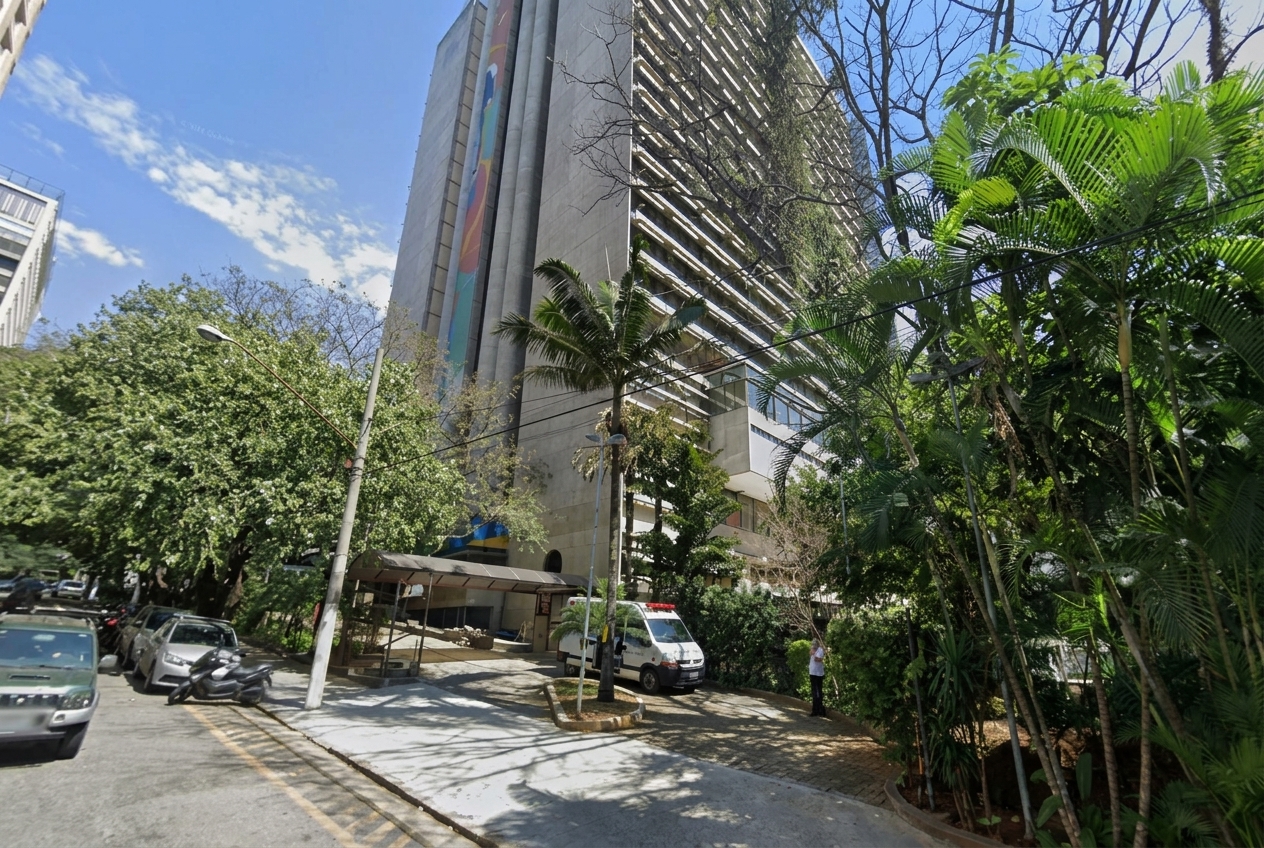
The 23-storey building that housed the Maksoud Plaza, on Rua São Carlos do Pinhal in the Bela Vista district, has stood empty since the hotel closed for good in December 2021, after 42 years in operation. An application for a renovation permit (Alvará de Aprovação de Reforma) is now being examined by the Municipal Department of Urban Planning and Licensing (SMUL).
According to the municipality, the application covers a scheme with six basement levels, a ground floor and 26 upper floors. The programme combines 398 residential units and 152 units given over to hospitality services, a total of 550 units. It also includes five street-fronting retail units at ground level and around 595 parking spaces, split between residential and non-residential uses.
The city has disclosed neither the filing date nor how long the review will take. The review will assess whether the project complies with current planning and building regulations. The owners have confirmed that the project exists, but have given no timetable for the start of works or the commercial launch.

A renovation rather than a rebuild
The application concerns a renovation, not a new building. The structure designed by architect Paulo Lúcio de Brito will therefore be retained. The building became known for its vast central atrium with a hanging garden, which visually links the floors, and for its panoramic lifts, billed as the first of their kind in Brazil.
The project has been entrusted to Metro Arquitetos Associados, as first reported by Exame magazine and later confirmed by the news portal g1. The practice, which designed the new building for Masp, the São Paulo Museum of Art, has confirmed its involvement. However, it says it cannot share any technical, conceptual or delivery details owing to a confidentiality agreement signed with its client.
An address that shaped luxury hospitality in São Paulo
Opened in December 1979, the Maksoud Plaza was São Paulo’s first five-star hotel. With 416 rooms, it welcomed more than 3 million guests over 42 years and established itself as a benchmark for upscale hospitality in the city. Its golden age came in the 1980s and 1990s.
Guests included Michael Jackson, Ray Charles, Axl Rose and the Rolling Stones, as well as Quentin Tarantino, Catherine Deneuve, Pedro Almodóvar, Prince Rainier and Prince Albert of Monaco, and Margaret Thatcher, then British Prime Minister. In 1981, Frank Sinatra performed in the hotel’s Salão Nobre. In 2015, the hotel paid tribute to him by opening the Frank Bar, which went on to feature in The World’s 50 Best Bars ranking.

The 150 Night Club also built the address’s reputation. One of Brazil’s most sought-after venues in the 1980s and 1990s, it hosted Tom Jobim, Julio Iglesias, Etta James, Buddy Guy and Dorival Caymmi.
From financial difficulties to closure
The decline began with the financial difficulties of Hidroservice Engenharia, a group company, and with debts owed to employees. These debts led to the building being sold at a judicial auction in 2011. Fernando and Jussara Simões, siblings linked to the logistics group JSL, acquired it for around 70 million reais, roughly €11 million at current exchange rates.
Following a dispute with the Maksoud group, an agreement signed in December 2021 recognised the validity of the sale and set the updated price at 132 million reais, around €21 million. In the meantime, the pandemic had worsened the hotel’s position, forcing it to close from March to September 2020. In September 2020, its operating company, HM Hotéis, filed for judicial recovery, with declared debts of around 81 million reais, nearly €13 million.
The hotel closed permanently on 7 December 2021. The Maksoud brand remained the property of the founding family.
The Maksoud family does not rule out a return
Henry Maksoud Neto is the founder’s grandson and former chairman of the Maksoud group. He says he is unaware of the new plans for the building, but believes a residential conversion can make sense at this address.
He would like to relaunch the hotel elsewhere, provided partnerships can be formed, at a time when, in his view, Brazil is going through a very difficult period for investment. He has also long been considering extending the family name into branded residences, a segment that is scaling up worldwide. He cites the Jardins, Itaim Bibi, Vila Olímpia, Moema and Pinheiros districts as possible locations for such a project.
Analysis – The conversion of the former Maksoud Plaza is part of a trend seen in several major cities: historic hotel properties are becoming mixed-use schemes, in which the residential component underpins the economics while the hospitality component preserves part of the original purpose. The same logic is at work in Toronto, where Manga Hotel Group is combining a luxury hotel and rental apartments in a single tower.
Analysis – Meanwhile, luxury hospitality in São Paulo is growing in the business districts in the west of the city. One example is Four Seasons’ return to Itaim Bibi, scheduled for 2030 with Iguatemi and Catuaí, in one of the very districts mentioned by Henry Maksoud Neto.
At a glance by The Hospitality Tribune
Former Maksoud Plaza, São Paulo: mixed-use conversion filed
São Paulo’s first five-star hotel (opened 1979, 416 rooms) has stood empty since December 2021
Renovation permit under city review: 398 residential units, 152 hospitality units, 5 retail units, c. 595 parking spaces
Design by Metro Arquitetos Associados, with the existing structure retained
Building bought at a 2011 judicial auction by Fernando and Jussara Simões, with the price updated to BRL 132m (c. €21m) in 2021
The Maksoud family, which still owns the brand, is considering a new hotel or branded residences elsewhere in the city