



A report grounded in the field (download it here)
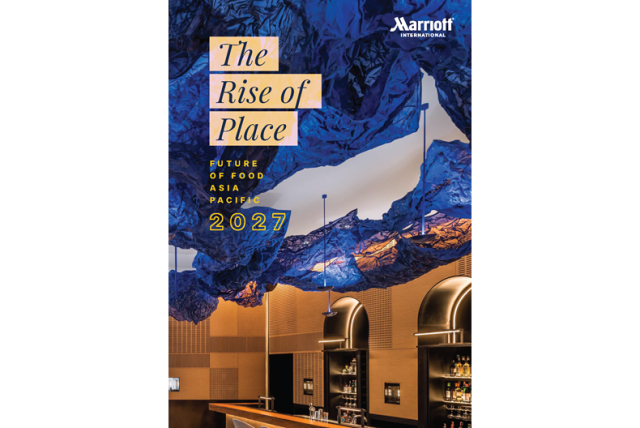
Marriott International has unveiled Future of Food 2027, its latest study of dining trends across Asia Pacific excluding China. The report combines interviews with chefs, hospitality experts and regional influencers with data gathered from the group’s properties in the region.
Its central conclusion can be summed up in a single phrase: ‘the rise of place’. Dining is moving beyond the traditional restaurant setting towards more fluid, more social formats. Guests, for their part, are seeking hyperlocal, authentic experiences closely tied to the destination.

The clearest signal concerns local signature dishes: 95% of surveyed properties identify them as the leading trend in their market. Bars, lounges, counters and flexible spaces are taking over from the classic dining room. The hotel is becoming a social and cultural venue that guests use throughout the day.
“Across Asia Pacific, we’re witnessing a shift toward intimate, locally-rooted experiences, where smaller, intentional spaces replace traditional formal dining models,” said Petr Raba, Vice President of Food & Beverage, Marriott International, Asia Pacific excluding China. “Hotels are becoming cultural storytellers, embedding regional talent, locally sourced ingredients and authentic connection into every aspect of the dining experience to create spaces that feel distinctly of their place.”
Smaller, more flexible spaces
The first trend identified concerns the organisation of space. Nearly half of surveyed properties report growing demand for casual venues such as lounges, bars and outdoor areas. New concepts favour intimate formats of 40 to 60 covers, each with its own distinct identity.
Vietnam is a good illustration of this shift: 71% of surveyed properties there report growth in bar and lounge dining. Technology is supporting the change discreetly. Artificial intelligence is being used in menu design, marketing, workforce management and guest insight, freeing teams to focus more on personalised service. In Thailand, every surveyed restaurant and bar already uses AI in its operations.
Local roots, the leading selection criterion
Local cuisine has become the deciding factor in choosing a restaurant. According to the report, demand for authentic signature dishes now outweighs value for money. Hotels are therefore building their menus around ingredients and stories specific to their destination.
The report cites the example of Hearth at The Ritz-Carlton, Perth, where a signature dish showcases Wagin duck and Western Australian produce in a seasonal, locally driven approach. Over the past year, four in five properties have introduced new local ingredients, from Kyoto vegetables to Kampot sea salt and indigenous Southeast Asian spices. Nearly three-quarters also report that these ingredients are appearing more frequently on drinks menus.
The trend is particularly strong in India and Indonesia, where demand for local signature cuisine reaches 71% and 67% respectively. It confirms Asia’s growing standing on the global gastronomic scene, already noted in the LaListe 2026 ranking and its key trends.

Fine dining in 99 minutes
Fine dining is markedly shortening its formats. Four-hour tasting menus of more than ten courses are giving way to five courses at most, served in under two hours. Across the region, 58% of properties say a fine-dining meal now lasts between 1.5 and 2 hours on average.
Singapore is among the fastest markets: 85% of restaurants there report an average duration of 1.5 hours. To adapt, venues are simplifying their menus, expanding their à la carte offer and focusing on a few standout moments rather than on the number of courses.
In South Korea, one in five properties has already reduced the number of courses served. In the Philippines, 30% of fine-dining restaurants have introduced an à la carte menu. In Australia, menus are shorter in both courses and duration, and thinking now centres on ‘wow moments’ rather than quantity.
Wellness, plant-forward and alcohol-free
Wellness has become a central consideration at the table. Ingredients drawn from the region’s culinary traditions are regaining their place with travellers. Today, 97% of surveyed Marriott properties in Asia Pacific excluding China serve dishes associated with health and longevity. This approach is also extending to minibars and turndown services.
Menus are becoming more expressive and multisensory, with texture taking on as much importance as flavour. Plant-forward cuisine is advancing rapidly. Marriott International will roll out its APEC Plant-Forward Program across the region in 2027, making it one of the first major global hotel groups to integrate plant-forward dining permanently into its operational foundation.
The low- and no-alcohol movement, long a niche, has become firmly established in hospitality. Some 42% of surveyed Marriott restaurants and bars in the region report rising sales of non-alcoholic drinks. From premium spirits to alcohol-free food pairings, guests expect sophisticated alternatives with no compromise on quality.
Dining that belongs to each destination
According to Marriott International, the hotels and restaurants that succeed in 2027 will be those that understand their place in depth – its ingredients, its culture and its people – and build the experience on that foundation. The report describes smaller, more distinctive spaces in which technology supports service, and a regional scene that looks less like variations on a global model than a collection of experiences rooted in their own culture.
LTH analysis – For owners and operators, these findings have practical implications: the programming of F&B space, the sizing of outlets, the organisation of fine-dining service and the growing weight of non-alcoholic drinks. The approach aligns with the experience strategy the group is deploying across its luxury portfolio in the region, as shown by ‘The Art of Knowing’ programme launched with Sotheby’s in Hong Kong. Asia Pacific also remains one of the group’s growth engines, with RevPAR up by more than 5% in the second quarter of 2026.
Based in Bethesda, Maryland, Marriott International (Nasdaq: MAR) had more than 10,000 properties across 148 countries and territories as at 30 June 2026. Its portfolio spans the luxury, premium, select, midscale, extended-stay and all-inclusive segments.
At a glance by The Hospitality Tribune
Marriott International – Future of Food 2027 (Asia Pacific excl. China)
Local first: 95% of surveyed properties cite authentic local signature dishes as the top market trend
Spatial shift: demand for casual venues rising; new concepts favour 40-60-seat formats; 71% bar and lounge growth in Vietnam
99-minute fine dining: 58% report average fine-dining durations of 1.5 to 2 hours; 85% at 1.5 hours in Singapore
Wellness and alternatives: 97% serve health and longevity dishes; 42% report higher non-alcoholic sales
Next step: APEC Plant-Forward Program rolling out across the region in 2027