

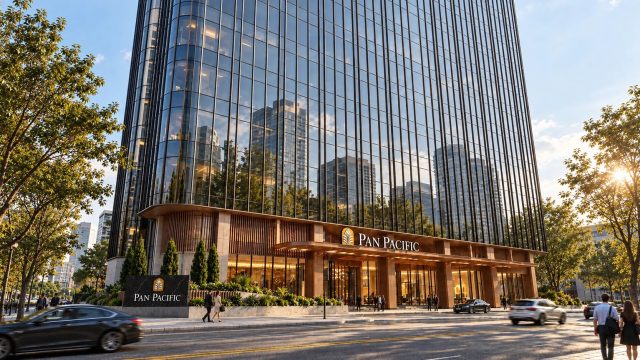

More than half the portfolio transformed since 2020
Pan Pacific Hotels Group unveiled the latest phase of its transformation strategy, known as Version 2, on 30 September 2026.
Launched in 2020, the initiative goes beyond a conventional hotel refurbishment programme.
It aims to rethink properties, their commercial positioning, guest experiences, environmental infrastructure and technological systems simultaneously.

According to the group, more than 50% of its portfolio has now been newly built, redesigned or significantly refurbished since 2020.
Early examples of this transformation included Pan Pacific London and PARKROYAL COLLECTION Marina Bay, Singapore.
The programme subsequently extended to several markets, including Singapore, Kuala Lumpur, Penang, Jakarta, Hanoi, Tokyo, Kyoto, Melbourne, Perth and Sydney.
The ambition is to modernise the hotel product while strengthening the commercial relevance of each brand.

Ten development and refurbishment projects planned for 2027
The year 2027 is expected to mark a further acceleration, with ten projects announced across Southeast Asia.
The programme combines new developments with major refurbishments.
| Property | Destination | Project type |
|---|---|---|
| Pan Pacific Phnom Penh | Phnom Penh, Cambodia | New development |
| PARKROYAL Siem Reap | Siem Reap, Cambodia | New development |
| Siam Pan Pacific Bangkok | Bangkok, Thailand | New development |
| Pan Pacific Serviced Suites Thonglor | Bangkok, Thailand | New development |
| PARKROYAL Hanoi | Hanoi, Vietnam | New development |
| PARKROYAL Serviced Suites Manila Bay | Manila, Philippines | New development |
| PARKROYAL Jakarta | Jakarta, Indonesia | New development |
| PARKROYAL Serviced Suites Kuala Lumpur | Kuala Lumpur, Malaysia | Major transformation |
| PARKROYAL Gurney Bay Penang | Penang, Malaysia | Major transformation |
| PARKROYAL COLLECTION Pickering | Singapore | Major refurbishment |
In this announcement, the group has not disclosed the total investment amount, the number of rooms involved or the financing arrangements for individual projects.
It is also important to distinguish new developments from existing properties undergoing modernisation.
Pan Pacific strengthens its luxury positioning
The Pan Pacific brand is the group’s principal vehicle for development in the luxury segment.
Two projects illustrate this direction: Siam Pan Pacific Bangkok and Pan Pacific Phnom Penh.
Their locations in the Thai and Cambodian capitals are intended to strengthen PPHG’s presence in two strategic Southeast Asian markets.
The group aims to develop an offering built around contemporary design, wellbeing and a service experience tailored to the expectations of international travellers.
This approach builds on several landmark properties.
In London, Pan Pacific London, designed by Yabu Pushelberg, combines luxury hospitality, wellbeing and integration into its urban surroundings.
In Singapore, Pan Pacific Orchard, which opened in 2023, has received international recognition for its architecture, notably through the Prix Versailles and distinctions awarded by the Council on Tall Buildings and Urban Habitat (CTBUH).
These examples demonstrate the importance of architecture and design in the group’s differentiation strategy.
PARKROYAL and PARKROYAL COLLECTION: Two complementary positions
The development of PARKROYAL is intended to support the group’s growth in the upscale segment.
Projects announced in Hanoi, Siem Reap, Jakarta and Penang aim to strengthen its presence in urban and leisure destinations.
Meanwhile, PARKROYAL COLLECTION continues to position itself around nature, sustainability and wellbeing.
The refurbishment of PARKROYAL COLLECTION Pickering in Singapore forms part of this strategy.
The property is particularly associated with biophilic architecture, which seeks to integrate vegetation and natural elements into the built environment.
For PPHG, the two brands are intended to meet distinct expectations without competing directly through identical value propositions.
Choe Peng Sum, the group’s Chief Executive Officer, emphasises the importance of preserving a distinct identity for each brand rather than attempting to offer a single concept to every customer segment.
Serviced residences as a diversification opportunity
The group’s serviced accommodation portfolio represents another component of its Version 2 strategy.
Two projects are scheduled for 2027:
- Pan Pacific Serviced Suites Thonglor, Bangkok.
- PARKROYAL Serviced Suites Manila Bay, Manila.
These will be complemented by the transformation of PARKROYAL Serviced Suites Kuala Lumpur.
This segment responds to changing travel patterns, particularly demand for extended stays, business mobility and the growing combination of work and leisure.
For operators, serviced residences offer an opportunity to diversify lengths of stay and customer segments.
However, they require an adapted operational and commercial structure, different from that of a traditional hotel with high guest turnover.
Changing traveller expectations at the heart of Version 2
PPHG attributes its programme to several structural shifts in demand.
The group highlights changing traveller demographics, the growing importance of wellbeing, demand for personalised experiences and the development of bleisure travel, combining business trips with leisure activities.
According to an Agoda study cited by PPHG, 76% of business travellers surveyed in Asia-Pacific plan to combine work and leisure, rising to 92% in Thailand and 86% in Vietnam.
The group also draws on research concerning younger generations, affluent travellers and sustainability-related consumer behaviour.
These findings provide indicators of broader trends but should be interpreted in the context of the methodologies used and the populations surveyed.
They cannot be treated as direct forecasts of demand for the group’s properties.
Technology and sustainability: Modernising without losing the human touch
The Version 2 transformation also includes investment in environmental infrastructure and service technologies.
PPHG aims to reduce friction throughout the guest journey, particularly through digital tools, while enabling employees to devote more time to hospitality.
This approach reflects a wider industry shift.
Travellers increasingly expect simpler and faster procedures, but continue to value personalised human interaction, particularly in upscale and luxury properties.
The group is therefore seeking to combine operational efficiency with service quality.
On the environmental front, Version 2 aims to incorporate more sustainable solutions into buildings and operations.
However, the announcement does not provide consolidated indicators to measure energy savings, emissions reductions or productivity gains associated with these investments.
Southeast Asia as the main driver of the next phase
The concentration of projects in Southeast Asia in 2027 reflects the region’s tourism growth prospects.
According to figures cited by PPHG, Southeast Asia is estimated to have welcomed approximately 144 million international visitors in 2025, representing a year-on-year increase of 13.4%.
The tourism sector is also estimated to support approximately 42.5 million jobs across the region.
The group intends to benefit from this momentum while adapting its portfolio to the diversity of individual markets.
Bangkok, Phnom Penh, Hanoi, Jakarta, Manila and Siem Reap do not share identical demand profiles or levels of hotel market maturity.
PPHG’s strategy therefore involves combining several brands and accommodation formats to respond to these specific characteristics.
LTH Analysis | Portfolio refurbishment becomes a competitive strategy
Pan Pacific Hotels Group’s Version 2 strategy deserves particular attention because it combines the development of new properties with a substantial effort to reposition existing assets.
In international hospitality, growth is frequently measured by the number of openings, additional rooms or entry into new markets.
PPHG is highlighting a different indicator: the proportion of its portfolio that has undergone significant transformation.
This approach reflects a fundamental concern for owners and operators: a hotel’s competitiveness depends as much on the relevance of its product as on its location or brand affiliation.
A property may retain an excellent location while gradually losing its appeal if its spaces, facilities and guest experience no longer meet market expectations.
Modernisation then becomes an investment in repositioning rather than merely a maintenance expense.
Nevertheless, the strategy raises several financial considerations.
The first concerns the return on invested capital.
A major refurbishment should translate into measurable improvements in performance: average daily rate, revenue per available room, guest satisfaction, productivity or operating cost control.
The second concerns portfolio coherence.
By more clearly differentiating Pan Pacific, PARKROYAL, PARKROYAL COLLECTION and its serviced residences, the group is seeking to avoid diluting the individual value propositions of its brands.
The third concerns execution capability.
Managing new developments and major refurbishments simultaneously requires coordination between owners, architects, operators and commercial teams.
Finally, the emphasis on wellbeing, sustainability and technology will need to be assessed against tangible operational results, beyond stated strategic intentions.
The central question for PPHG will therefore be whether it can demonstrate that transforming more than half its portfolio delivers sustained improvements in competitiveness and value creation for owners.
At a Glance
Group: Pan Pacific Hotels Group (PPHG).
Strategy: Version 2 portfolio transformation.
Progress: More than half of the portfolio newly built, redesigned or significantly renovated since 2020.
2027 programme: Ten new-build and major refurbishment projects in Southeast Asia.
Key markets: Cambodia, Thailand, Vietnam, the Philippines, Indonesia, Malaysia and Singapore.
Luxury development: Siam Pan Pacific Bangkok and Pan Pacific Phnom Penh.
Upscale development: PARKROYAL projects across major regional destinations.
Serviced accommodation: New and refurbished serviced-suite properties.
Strategic priorities: Brand differentiation, wellbeing, sustainability, design and technology-enabled service.
LTH perspective: Portfolio renewal as a long-term competitiveness and asset-value strategy.