

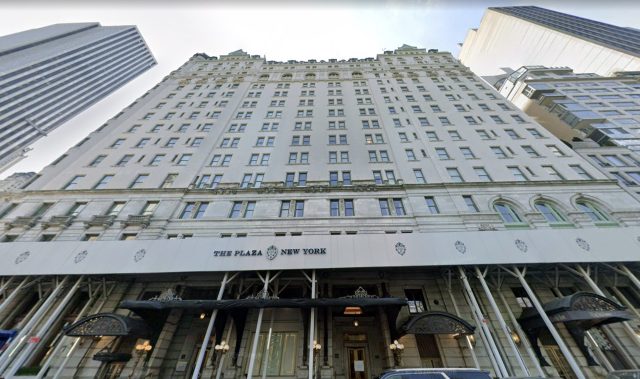


An exceptional closure announced for January 2027
The Plaza Hotel in New York, located at the corner of Fifth Avenue and Central Park South, is preparing to suspend operations for at least four years. On 14 October 2026, the property announced a programme of repairs and restoration to its historic façade, requiring a complete closure from January 2027.
The decision represents an exceptionally lengthy interruption for a hotel that opened in 1907 and whose architecture and history are closely intertwined with those of Manhattan.
In its official statement distributed through Business Wire, management explained that the scale of the work, heritage preservation requirements and anticipated disruption to operations make the prolonged closure necessary.

The detailed construction schedule is still being developed. No specific reopening date has been announced.
A landmark-protected façade at the centre of a complex restoration project
Designed by architect Henry Janeway Hardenbergh, The Plaza Hotel is one of New York’s most recognisable architectural landmarks.
Its façade is subject to heritage protection, imposing specific requirements concerning repairs, materials and the preservation of historic features.
The work will need to be coordinated with the relevant heritage preservation authorities and the various parties involved with the building.

Beyond architectural considerations, management has also cited the safety of guests, employees and the public.
The precise nature of the defects, the restoration techniques selected and the overall budget have not been detailed in the announcement.
The absence of technical information makes it impossible, at this stage, to assess the exact scale of the investment required or distinguish between the different phases of the project.
A luxury hotel asset taken out of operation for several years
The property comprises 282 hotel rooms and suites, alongside 181 privately owned condominium residences within the building.
Operating under the Fairmont Hotels & Resorts brand, part of Accor’s brand portfolio, The Plaza occupies a distinctive position in New York’s luxury hospitality market.
The closure will not affect accommodation alone. According to reports in the American press, the hotel’s event spaces and the renowned Palm Court, particularly famous for its afternoon tea service, will also be affected by the suspension of operations.
For the operator, a closure lasting at least four years means the interruption of room, food and beverage, and events revenue, while certain property maintenance and management obligations may remain in place.
The actual financial impact will nevertheless depend on the contractual arrangements between owner and operator, maintenance costs during the closure and the financing provisions established for the restoration project.
Employment implications for The Plaza’s workforce
The decision also raises questions about the future of employees during the restoration works.
According to reports in the American press, the Hotel & Gaming Trades Council represents 378 unionised employees at The Plaza. These employees would retain the right to return to their positions at their existing pay levels when the hotel reopens, while assistance in finding temporary employment would be organised during the closure.
The interruption presents a particular challenge for a property whose service standards depend on experienced teams and the continuity of specialist expertise.
Once the restoration is completed, rebuilding the workforce and restoring operational standards will represent an important phase of the hotel’s return to business.
Consequences for New York’s luxury hotel market
The Plaza’s closure will temporarily remove a historic property with strong international recognition from New York’s hotel market.
The hotel occupies a distinctive position in luxury accommodation, private receptions and high-end events.
Its prolonged absence could redirect some of this demand towards other Manhattan properties, particularly hotels with comparable event facilities.
This prospect comes against a backdrop in which the renovation of historic luxury hotel assets is becoming increasingly complex, both from a heritage preservation and financial perspective.
In New York, the transformation of the Waldorf Astoria has already illustrated the financial and operational constraints associated with the restoration of a major historic hotel.
The Plaza case nevertheless has a particular characteristic: the announced programme primarily concerns the façade, yet its consequences require the suspension of all hotel operations for several years.
Reopening cannot be envisaged before 2031
With closure scheduled from January 2027 for a minimum of four years, hotel operations could not resume before 2031 on the basis of the announced timetable.
However, this represents a theoretical timeframe rather than a confirmed reopening date.
Management has stated that several aspects of the preparation and execution of the works remain under review.
The property will notably need to coordinate heritage conservation requirements, construction site safety and the consequences of closure for its various stakeholders.
The financing of the works, together with the definitive timetable, therefore remains central to assessing the conditions under which The Plaza can resume operations.
LTH Analysis | When heritage preservation requires a hotel asset to cease trading
The Plaza Hotel’s closure illustrates one of the major constraints of investing in heritage hotel properties: preserving real estate value may require a prolonged suspension of operations, irrespective of the hotel’s commercial performance. For the owner, the financial equation combines a potentially substantial CAPEX programme, the absence of hotel revenue over several financial years and continuing holding costs. For the operator, the challenge lies in managing contractual commitments, protecting the brand and rebuilding the workforce when the hotel reopens. The announced minimum duration makes this a particularly significant example of the trade-off between heritage preservation and business continuity. Long-term value creation will depend as much on the quality of the restoration as on controlling the timetable and costs.
At a Glance by The Hospitality Tribune
The Plaza Hotel to close for at least four years
Location: Fifth Avenue and Central Park South, New York City, USA.
Property: Historic luxury hotel opened in 1907, with 282 hotel rooms and suites.
Closure: From January 2027, for a minimum of four years.
Purpose: Repair and restoration of the landmark-protected historic façade.
Operator: Fairmont Hotels & Resorts, part of Accor’s luxury brand portfolio.
Reopening: No confirmed date; 2031 is the earliest indicative year based on the announced minimum closure period.