


One property, two commercial positioning strategies
Having operated in Asia for more than 15 years, ROBINSON, TUI Group’s premium holiday club brand, is now seeking to strengthen its awareness directly among Vietnamese and South Korean travellers.
The brand, which already operates in the Maldives, Thailand and Vietnam, has commissioned Ogilvy to develop two campaigns tailored to the characteristics of these markets.
Both campaigns share one objective: promoting ROBINSON NAM HOI AN, a resort in Vietnam’s Da Nang region that opened in 2024.

What differs is how the experience offered by the same resort is presented.
Rather than replicating a standardised international marketing message, ROBINSON has chosen to adapt its messaging, media channels and content creator partnerships to the specific motivations of each customer segment.
“ROBINSON has been successfully operating in Asia for more than 15 years. Through these campaigns, we are introducing our brand directly to Vietnamese and South Korean travellers,” explains Friso Janmaat, Marketing Director at ROBINSON.
According to Janmaat, initial feedback supports the decision to adopt locally tailored communications based on travellers’ expectations in each market.
Vietnam: Reinventing the experience of a familiar destination
In Vietnam, the campaign starts from a simple observation: the Da Nang and Hoi An region is already familiar to many domestic travellers.
The challenge is therefore not so much to introduce the destination as to offer a new way of experiencing it.
ROBINSON has developed the ROBINSON FIRST TIME concept, presented as a passport encouraging guests to enjoy a series of first-time experiences within the resort.
The campaign combines on-site activities with digital content and influencer partnerships.
This approach aims to renew the appeal of an established destination by shifting attention towards the hotel experience itself.
For ROBINSON, the objective is to differentiate its property in a market where familiarity with the destination does not necessarily translate into awareness of the brand.
South Korea: Focusing on relaxation and all-inclusive holidays
In South Korea, the campaign adopts a different positioning.
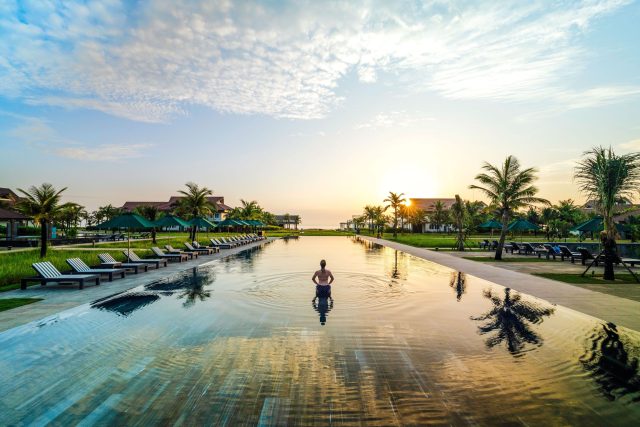
ROBINSON NAM HOI AN is presented as a premium retreat offering relaxation in natural surroundings, away from Da Nang’s busiest tourist areas.
The marketing message emphasises three elements:
- The resort’s natural setting and atmosphere.
- Relaxation and the opportunity to escape busy tourist areas.
- The all-inclusive concept that characterises the ROBINSON offering.
This proposition aims to make the product more appealing and easier to understand for travellers seeking a relaxing stay with simplified holiday arrangements.
The resort is therefore marketed not merely as accommodation in Vietnam, but as a complete holiday experience.
Thirteen influencers and platforms tailored to each market
The two campaigns, running since July 2026, combine locally produced content, digital media and influencer marketing.
A total of 13 influencers are involved across the two markets.
ROBINSON uses several international platforms, including YouTube, Facebook, Instagram and TikTok.
The brand complements these channels with platforms specifically suited to local digital habits:
| Vietnam | South Korea |
|---|---|
| Traveloka | MyRealTrip |
| Facebook, Instagram, TikTok, YouTube | Naver, YouTube and other social media platforms |
| Experiences and resort discovery | Premium relaxation and all-inclusive holidays |
This differentiation applies both to advertising content and to the digital environments in which travellers research their holidays.
By selecting local platforms, ROBINSON is moving beyond an approach based exclusively on major international social media networks.
More than 40 million views in Vietnam
According to the initial results reported by ROBINSON, influencer-generated content has attracted more than 40 million views in Vietnam.
The brand also reports that campaign materials exceeded their main performance targets, although it has not disclosed the specific metrics involved.
In South Korea, ROBINSON reports feedback from guests who booked ROBINSON NAM HOI AN after watching a YouTube video published by travel content creator Sherlock HJ.
These results demonstrate the visibility generated by the campaigns and provide initial indications of commercial conversion.
However, they do not yet allow their precise contribution to the property’s revenue, occupancy rate or revenue per available room to be measured.
No advertising budget, customer acquisition cost or total number of bookings attributable to the campaigns has been disclosed.
Developing regional source markets: A priority for Asian resorts
ROBINSON’s approach forms part of a broader strategy to diversify source markets.
Historically positioned towards an international clientele, the brand is seeking to increase its visibility among travellers living in the countries where it operates properties or in neighbouring markets.
This strategy could help broaden a resort’s demand base and reduce its dependence on certain long-haul source markets.
However, it requires commercial propositions, advertising messages and distribution channels to be adapted accordingly.
The ROBINSON NAM HOI AN example demonstrates that a single property can be marketed around substantially different holiday motivations without changing the fundamental characteristics of its product.
LTH Analysis | Marketing localisation becomes a driver of commercial performance
The significance of ROBINSON’s approach lies less in its use of influencers than in its segmentation of travel motivations.
In Vietnam, the campaign seeks to renew interest in a familiar destination. In South Korea, it emphasises the promise of a premium, relaxing, all-inclusive holiday.
This differentiation allows two distinct commercial narratives to be developed around a single hotel asset.
For operators, the decisive issue remains conversion: the audiences generated must translate into profitable bookings.
The reported 40 million views provide an indication of reach, but reveal nothing about return on investment.
The performance of these campaigns should therefore be assessed through incremental bookings, customer acquisition costs and the actual contribution of both markets to the property’s revenue.
At a Glance
Brand: ROBINSON, part of TUI Group.
Positioning: Premium club resorts.
Campaign markets: Vietnam and South Korea.
Featured property: ROBINSON NAM HOI AN, Vietnam.
Hotel opening: 2024.
Creative agency: Ogilvy.
Campaign launch: July 2026.
Vietnam strategy: ROBINSON FIRST TIME, promoting new experiences at a familiar destination.
South Korea strategy: Premium relaxation, natural surroundings and all-inclusive holidays.
Influencer partnerships: 13 across both markets.
Digital platforms: YouTube, Facebook, Instagram, TikTok, Traveloka, MyRealTrip and Naver.
Reported Vietnam reach: More than 40 million influencer-content views.
South Korea feedback: Bookings reported following a YouTube video by travel creator Sherlock HJ.
Marketing executive: Friso Janmaat, Marketing Director at ROBINSON.
LTH perspective: Market-specific messaging can strengthen regional demand generation, but commercial effectiveness ultimately depends on conversion and acquisition costs.