

A partnership aimed at mobilising wealthy Asian and African investors
Rwanda is continuing its strategy of attracting international capital.
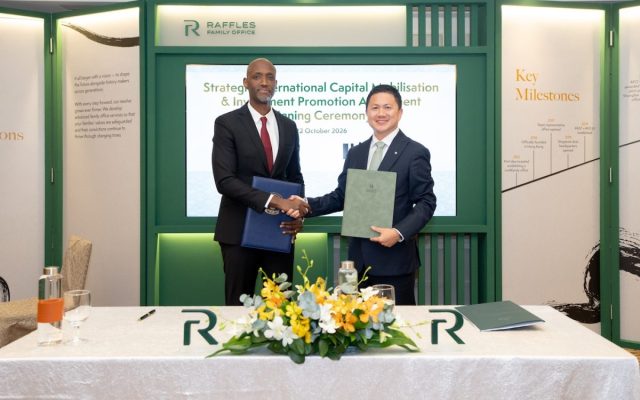
On 22 October 2026, the Rwanda Development Board (RDB), the public agency responsible for investment promotion, signed an agreement with Raffles Family Office (RFO), a wealth management firm with a network of private investors and high-net-worth families.
The stated objective is to mobilise several hundred million US dollars over the coming years to support projects in priority sectors of Rwanda’s economy.

The agreement covers, in particular:
- Aviation and transport infrastructure;
- Hospitality and tourism;
- Entertainment and events;
- Real estate and development projects;
- Infrastructure and services.
The identified opportunities are concentrated primarily in Kigali, Bugesera and Musanze, three locations with distinct economic and tourism profiles.
However, it is important to distinguish the capital mobilisation target from investment actually committed: the amount cited represents a funding ambition, not capital already invested or contractually guaranteed.
Kigali, Bugesera and Musanze: Three development hubs
The geographical distribution of the proposed investments reflects the Rwandan authorities’ intention to establish several complementary development hubs.
Kigali, the country’s capital and principal economic centre, accounts for a significant share of business activity, hotel infrastructure and international events.
The city therefore represents a priority market for accommodation projects, commercial real estate and business-related services.
Bugesera, south of Kigali, occupies a strategic position in the country’s infrastructure plans, particularly through the development of the new international airport.
Potential investments could contribute to the creation of an economic and tourism ecosystem around this infrastructure.
Musanze, in northern Rwanda, is an important tourism hub, notably because of its proximity to Volcanoes National Park.
The development of hotel accommodation and tourism services in this region responds to different priorities from those in Kigali: nature-based tourism, upscale accommodation and the promotion of local resources.
Formula 1 as a driver of international appeal
The agreement also comes against the backdrop of Rwanda’s ambitions to host a Formula 1 Grand Prix in Africa.
According to the information released, the Grand Prix is described as confirmed, although the date of the inaugural race and the detailed construction timetable have yet to be announced.
Jean-Guy Afrika, CEO of the RDB, presents Formula 1 as a catalyst for a broader economic ambition extending beyond the development of a motor racing circuit.
The objective is to attract investment in aviation, hospitality, tourism, real estate and services.
For investors, such a project could enhance the destination’s appeal, provided it materialises and the country succeeds in translating the event into recurring economic activity.
However, the timetable, financial commitments and definitive contractual status of the Grand Prix will need to be independently confirmed.
Rwanda’s tourism generates US$685 million in receipts in 2025
The investment attraction strategy is supported by growth in tourism activity.
According to Rwanda Development Board figures cited in the announcement, the country recorded US$685 million in tourism receipts in 2025, representing a year-on-year increase of approximately 6%.
Rwanda reportedly welcomed 1.49 million visitors during the year.
| Indicator | 2025 result |
|---|---|
| Tourism receipts | US$685m |
| Growth in tourism receipts | Approximately +6% |
| Visitor arrivals | 1.49 million |
| Business and events tourism receipts | US$94.7m |
| International and regional events hosted | 165 |
| Investments registered by the RDB | US$2.62bn |
| Number of registered investment projects | 799 |
These figures illustrate the growing role of tourism in Rwanda’s economic strategy.
The country is seeking to combine leisure tourism, upscale stays, business travel and international events.
Growth in tourism receipts is an encouraging signal for hotel investors, but it does not, on its own, establish the profitability of individual projects.
Profitability depends, in particular, on destination-level performance, development costs, seasonality and the commercial positioning of individual properties.
Business tourism and events: A strategic market
Business tourism is an important component of Rwanda’s tourism policy.
In 2025, activities associated with business meetings and international and regional events reportedly generated US$94.7 million across 165 events.
For Kigali, this segment helps sustain demand for accommodation, restaurants and event-related services.
It can also encourage visitor flows that are less dependent on traditional tourism seasons.
The ambition to host additional international sporting events forms part of this diversification strategy.
However, creating sustainable hotel demand requires infrastructure developed for these events to attract regular use outside major event periods.
Raffles Family Office already established in Kigali
Raffles Family Office already has a local presence, having opened a representative office in Kigali earlier in 2026.
The firm has reportedly begun discussions with several prospective investors.
It also plans to organise investment missions to present available opportunities and facilitate relationships between international investors and local partners.
This approach could help diversify funding sources for Rwandan projects, particularly by connecting local investment requirements with Asian private capital.
The announcement does not identify individual hotel projects, sector-specific capital allocations or the proposed investment structures.
LTH Analysis | Rwanda seeks to institutionalise its appeal to tourism investors
The partnership between the RDB and Raffles Family Office illustrates a shift in Rwanda’s strategy: moving beyond destination promotion towards establishing structured international investment channels.
For hospitality, the opportunity lies in the complementary profiles of Kigali, Bugesera and Musanze, combining business activity, infrastructure development and nature-based tourism.
Mobilising family offices could provide new financing opportunities, but it guarantees neither project completion nor profitability.
The key considerations will be the underlying depth of demand, asset performance and investors’ exit options.
As for Formula 1, any potential economic spillover will need to be assessed against the investment required and the sustainable visitor demand generated.
The success of this strategy will be measured less by announced capital targets than by the number of projects actually financed, delivered and proven economically viable.
At a Glance
Country: Rwanda.
Announcement date: 22 October 2026.
Public agency: Rwanda Development Board (RDB).
Investment partner: Raffles Family Office (RFO).
Objective: Mobilise several hundred million US dollars in private capital over the coming years.
Target sectors: Aviation, hospitality, tourism, entertainment, real estate, infrastructure and services.
Key locations: Kigali, Bugesera and Musanze.
2025 tourism receipts: US$685 million, up approximately 6%.
2025 visitor arrivals: 1.49 million.
2025 business and events tourism receipts: US$94.7 million.
International and regional events: 165 in 2025.
2025 registered investments: US$2.62 billion across 799 projects.
RDB CEO: Jean-Guy Afrika.
Formula 1: Rwanda’s ambitions form part of the wider investment narrative; the status of a confirmed Grand Prix agreement requires independent verification.
LTH perspective: The partnership may strengthen private-capital access for hospitality and tourism projects, but announced targets must be distinguished from committed investment.