

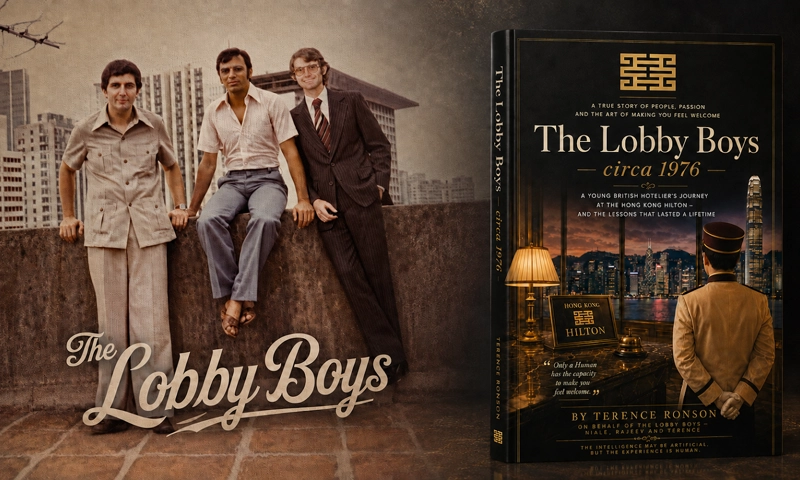


Terence Ronson, Rajeev Ratti and Niale McLoughlin
Three former assistant managers of the Hong Kong Hilton, now scattered across three continents, have committed fifty years of shared memories to print and to a companion podcast. Their book, “The Lobby Boys: Hong Kong Hilton, 1976”, traces the workings of one of Asia’s busiest hotel lobbies at a time when computers, guest profiles and booking algorithms had no place in the industry.
A Lobby Without a Computer, at the Height of Its Business
In 1976, Terence Ronson, Rajeev Ratti and Niale McLoughlin were in their twenties and ran the day-to-day operations of the Hong Kong Hilton’s lobby, a five-star property with more than 800 rooms that was booked to capacity almost continuously. “Manual” overbooking of rooms was a daily wager against no-shows, while the team also had to manage a US Seventh Fleet shore-leave influx and an overnight security operation around a stranded Israeli philharmonic orchestra.

The narrative draws chiefly on Ronson’s voice—now a Hong Kong-based hotel technology and artificial intelligence consultant—supplemented by first-person passages from Ratti and McLoughlin. At a time when Hilton is rolling out an AI-powered digital concierge to guide guests before they even arrive, the contrast with the entirely human front desk of 1976 carries particular weight for industry readers.
The Whitney Rack: Institutional Memory Before the Algorithm
At the heart of the book is the Whitney Rack, the hotel’s fully paper-based room management system, a forerunner by several decades of today’s property management systems. With no database or automated guest history, continuity of service rested on the memory and instinct of the front-desk teams.
“For decades we shared fragments of it—over dinners, at industry conferences, with younger colleagues who found it hard to believe a hotel could run without a computer,” the authors write in the preface. “Eventually we realised: if the three of us didn’t put it in writing, it would all eventually evaporate, as so often happens in working life.”

Fifty Years On, a Reunion Put Into Words
Ronson, Ratti and McLoughlin reunited half a century after their time together at the Hilton to document that period, each having since built a career on a different continent. The book, dedicated “to the industry”, is driven more by a desire to pass something on than by pure nostalgia: it aims to preserve the record of a way of working that has since disappeared, as the generations who knew it leave the industry.
What AI Still Owes to Human Judgement
The book’s foreword closes with an argument aimed squarely at today’s hotel industry: while the tools of the trade have changed radically since 1976, the judgement underpinning good service, the authors argue, has not. It’s a question that echoes debates currently playing out in the sector, as players such as Mews invest in so-called “agentic” hospitality while insisting they want to put humans back at the centre of the guest experience.
“Strip away the terminals, the apps and everything now quietly doing the work our newspaper stands used to do, and you find this job hasn’t changed as much as people think,” the authors write. “At bottom, it is still about someone deciding—quickly, sincerely, without preparation—that a stranger’s evening matters.”
This conclusion chimes with a trend observed elsewhere in the industry, where some networks explicitly claim to want to automate the predictable in order to better humanise the exceptional, rather than let machines replace human judgement.
At a glance by The Hospitality Tribune
Book: “The Lobby Boys: Hong Kong Hilton, 1976” – a memoir by three former assistant managers
Authors: Terence Ronson, Rajeev Ratti and Niale McLoughlin, now based across three continents
Setting: The Hong Kong Hilton, a 800+ room five-star hotel run entirely on paper in 1976
Central device: The Whitney Rack, a fully paper-based room management system predating modern PMS technology
Theme: What today’s AI-driven hotels still owe to human instinct and judgment
Author profile: Terence Ronson is now a Hong Kong-based hotel technology and AI consultant