


A structural, not cyclical, shortfall
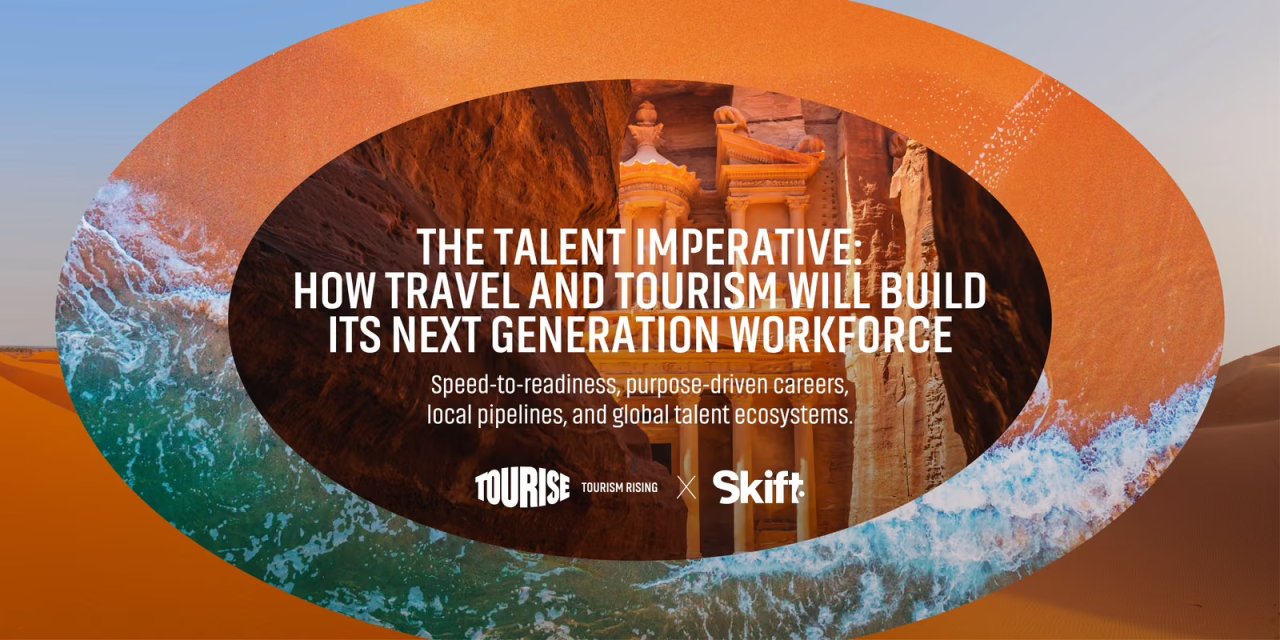
The white paper The Talent Imperative: How Travel and Tourism Will Build Its Next Generation Workforce draws on WTTC data. In 2025, travel and tourism supported a record 366 million jobs and generated 9.8% of global GDP. The 91 million additional roles expected by 2035 would account for one third of net job creation worldwide.
The flip side is just as stark. If current trends continue, labour supply would fall 16% short of demand in 2035, a gap of more than 43 million workers. Hospitality alone would face an estimated shortfall of 8.6 million people.
Mature economies are the most exposed. Japan would post a relative shortfall of 29%, the highest among major economies, ahead of Germany at 26%, while the European Union would be short of 6.4 million workers. The contrast with Saudi Arabia is striking: 71% of its population is under 35, and the median age is 23.5.


In his foreword, Ahmed Al Khateeb, Saudi Minister of Tourism and Chairman of TOURISE, writes that this is not simply a labour shortfall but a strategic imperative that will shape the resilience, competitiveness and sustainability of the global tourism economy for decades to come. In his view, investment in destinations and infrastructure must be matched by equivalent investment in the people who make them work. The observation echoes an earlier LTH opinion piece on a shortage that has become structural.
Hire for attitude, train for skill
According to Skift Research surveys, customer-facing roles remain the hardest to fill, with 50% of hiring managers describing them as difficult. Technical and engineering profiles follow closely, at 48%. Generation Z ranks flexibility (26%), company values (19%) and rapid progression (16%) as its top expectations. Yet only 31% of industry leaders consider 18- to 28-year-olds a priority segment.
Recruitment remains largely local: 57% of employers often or always draw on communities near their sites. Partnerships with schools and academies involve 24% of respondents, rising to 67% in the cruise sector. Laura Hingel, Vice President, Talent Acquisition and Management at Raffles and Fairmont Hotels and Resorts, notes that the industry has always been guided by the principle of hiring for attitude and training for skill.
At AirAsia MOVE, Ben Jie Lim, chief people and partnerships officer, does not see a lack of skills as the main difficulty. In his view, the real obstacle is cultural fit, in an organisation he describes as neither domestic nor a classic multinational, but distinctly Southeast Asian. With fewer young graduates applying, the group has chosen narrower targeting, recruiting notably through student organisations such as AIESEC.

Marriott: an abundant talent pool, career paths to rebuild
The Marriott International case adds nuance to the prevailing narrative on shortages. Jessica Lee, global officer of talent acquisition and associate development, says the group’s data show it is not experiencing a talent shortage, with its careers site receiving an average of 2 million unique visitors. The constraint then shifts to how roles are structured and to the ability to turn initial interest into a lasting career.
The group has created hybrid “guest experience expert” roles, able to work both in the lobby and at the front desk. At Moxy, check-in takes place in the bar-lounge rather than behind a traditional counter: the same team member serves a snack, checks the guest in and recommends the hotel’s activities. In parallel, the Elevate programme enables team members to move sideways or gain promotion, within their region or beyond.
Marriott also relies on a chatbot named Olivia to schedule job interviews. These now take place within 2.9 days, which, according to Jessica Lee, translates into a 40% faster time-to-hire.
The hidden cost of turnover
Flexible hours (24%) and pay (22%) top the list of retention levers. Conversely, burnout (16%), inflexible rotas (14%) and low pay (14%) are the main reasons for leaving. In tours and activities, burnout accounts for nearly a quarter of recorded resignations.
The financial stakes are considerable. A Center for American Progress review cited in the report puts the cost of replacing an employee at between 5.8% and 213% of annual salary depending on role and seniority, with a “typical” figure of around 21%. Ben Jie Lim argues that pay is only one lever, and not the most effective: everything comes down to culture, meaning inspiring leadership, clear roles and clear direction.
The report advocates job offers that present the role as an entry point into a structured system: predictable rotas, shift-swap rules, clear career paths, internal mobility and funded training. Several players are also dropping degree requirements. In the United States, the American Hotel and Lodging Association’s foundation helped launch the first hospitality apprenticeship recognised by the Department of Labor.
Shortening time to competence
This is arguably the most telling indicator for operators. While 64% of hiring managers fill a role within one to four months, 42% say it then takes four to six months for a new hire to reach full productivity. For a hotel opening or a seasonal peak, even a team that is complete several weeks before opening must still allow time to learn systems and service procedures.
In Saudi Arabia, the Riyadh School of Tourism and Hospitality has chosen to compress its programmes. Its managing director, Fabien Fresnel, explains that the school is moving from a two-year model to a six-month model because, in the coming years, the market will need 50,000 to 100,000 new entrants. He points out that Saudisation rates in hospitality and tourism range from 30% to 70%, and that 70% to 80% of hotel roles are operational or frontline supervisory positions. The school uses AI simulations so that trainees can rehearse sensitive situations before taking up their posts, an approach that echoes the opening in Riyadh of the Atheel hotel, operated exclusively by Saudi talent.
Artificial intelligence is gaining ground across organisations more broadly. According to Skift Research, 57% of talent leaders say they are ready to integrate it, 40% are already seeing productivity gains and 53% expect repetitive tasks to disappear. At Expedia Group, every employee has been set an AI-related objective, and the group has opened EG Playground, an internal lab where teams test language models and build their own agents.
Internal promotion remains a central lever: 37% of employers use it frequently and 55% occasionally. At Marriott, onboarding rests on a simple rule set out by Jessica Lee: 80% of content is relevant worldwide, while 20% must be adapted to the local market.
Six public policy levers
The report devotes an entire chapter to the role of governments. On visas, it cites Spain’s digital nomad visa, open to non-EU remote workers earning more than €2,646 a month, and Portugal’s D8 visa, which has a threshold of €3,480 a month. Both offer a pathway to long-term residence.
Germany’s dual apprenticeship system (Ausbildung) covers chefs, hotel specialists and restaurant service staff. An apprentice costs the employer around €18,000 a year, of which nearly €12,000 is recouped through the apprentice’s productive contribution, leaving a net cost of around €6,000. France is exploring a similar approach, as illustrated by FIPA’s guide to in-house apprenticeship training centres (CFAs).
The United Kingdom offers a more nuanced case study. The National Living Wage has stood at £12.71 an hour since April 2026 (around €15.10), while 21.6% of UK hospitality employees were paid the minimum in 2023-24. PwC identified the rising minimum wage as British hoteliers’ biggest operating-cost challenge in 2024, leading to cuts in hours and hiring. The report recommends that any rise in the wage floor be accompanied by tax relief and training subsidies.
Finally, the authors cite the Philippines’ national TESDA certification, aligned with ASEAN mutual recognition arrangements, and the Swiss model embodied by EHL. QS has ranked EHL the world’s leading institution for hospitality management for seven consecutive years, and it has 30,000 alumni in 150 countries. In the UK, under the Growth and Skills Levy, which replaced the Apprenticeship Levy in April 2026, SMEs will pay nothing for apprentices under 25 from August 2026.
Staff housing and mobility: the new infrastructure
Staff accommodation is re-emerging as a prerequisite rather than a perk. Martin Nydegger, CEO of Switzerland Tourism, is blunt: today, if you cannot offer a room to your staff, you will not get that employee and the contract will not be signed, so hotels must house their teams.
Internal mobility is also becoming a tracked metric. This year, Raffles and Fairmont launched a programme that gives priority to internal applicants, with a measured target for promotions within and between properties. At IHG, Elie Maalouf stresses culture, observing that people stay longer and, even when they leave, often want to come back.
The report urges groups to publish HR dashboards covering the share of local hires, internal mobility, certification rates and early-tenure retention. It sets out a 180-day plan, running from an audit of rotas to the signing of regional pacts with destinations. For Rafat Ali, founder and CEO of Skift, employers’ ability to capture the expected growth will depend on how well they develop skills and offer careers in which employees want to stay.
Analysis – Published by a platform backed by Saudi Arabia’s Ministry of Tourism, the report unsurprisingly showcases the Saudi model, as both a young demographic reservoir and a testing ground for accelerated training. For European owners and investors, the most practical lesson lies in one of its projections: training infrastructure and staff housing capacity will weigh increasingly on location decisions, alongside costs. The shift is already visible in the Middle East, where the geography of hotel leadership is being redrawn in the wake of the first TOURISE Summit, held in Riyadh in November 2025.
At a glance by The Hospitality Tribune
Skift x TOURISE – The Talent Imperative
Travel and tourism supported a record 366 million jobs in 2025 and is set to add 91 million by 2035
WTTC projects a labour shortfall of more than 43 million workers by 2035, with 8.6 million in hospitality alone
42% of hiring managers say new hires need four to six months to reach full productivity
Marriott reports 2 million unique visitors to its careers site and a 40% faster time-to-hire with its AI scheduling agent
Report calls for staff housing, visa fast lanes and portable micro-credentials to be treated as core infrastructure