



Luxury leads on RevPAR growth
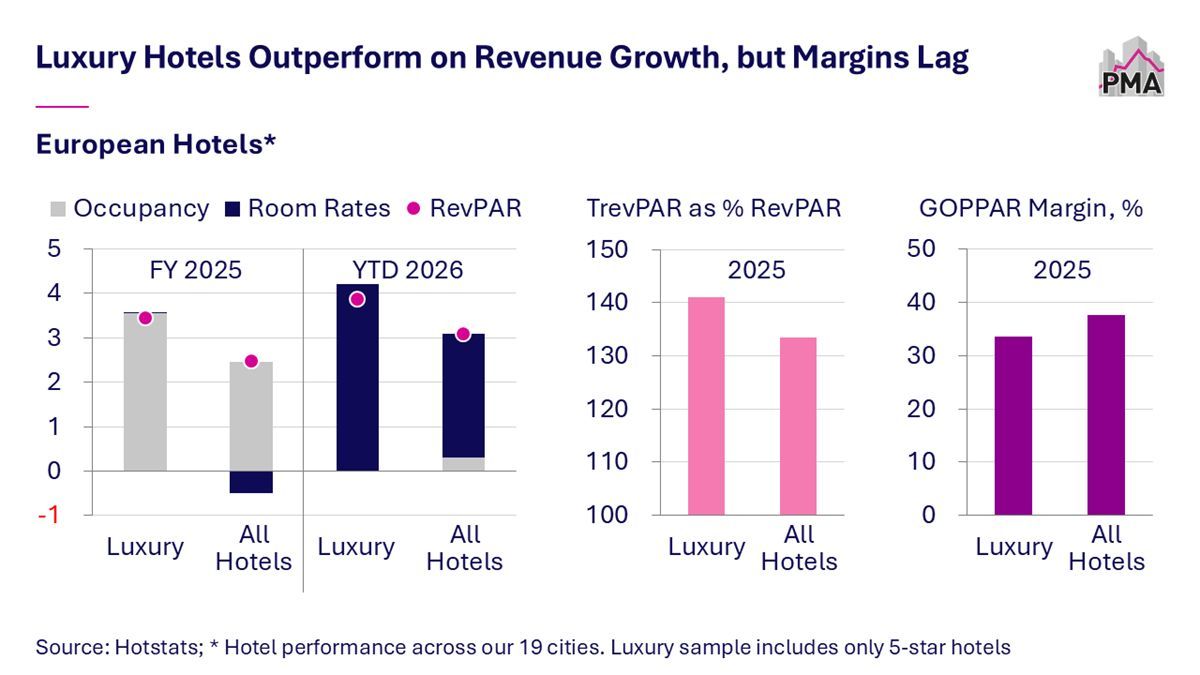
The Hotstats data compiled by Property Market Analysis covers 19 European cities. The luxury sample comprises five-star properties only. Over the 2025 financial year, these hotels saw revenue per available room rise by around 3.5%, compared with close to 2.5% for the wider sample.
The gap held in 2026. Year to date, RevPAR growth in the luxury segment is approaching 4%, against slightly more than 3% for the market as a whole.
From occupancy to average rates
The drivers of this growth shifted from one year to the next. In 2025, rising occupancy underpinned the gains made by luxury hotels, with average rates virtually flat. Across all hotels, rates even edged down slightly, with occupancy making up the difference.

In 2026, the trend has reversed: average rates have become the main lever, in luxury as across the rest of the market, while occupancy has stalled. According to ActivumSG, the upper segment’s outperformance is being confirmed just as the post-Covid catch-up effect on travel demand is fading.
More revenue, less margin
The study also highlights the weight of non-rooms revenue. In 2025, total revenue per available room (TRevPAR) stood at around 140% of RevPAR in luxury hotels, compared with around 133% for all hotels. Food and beverage, wellness and events therefore account for a larger share of five-star hotels’ revenue.
This advantage does not carry through to profitability. The GOPPAR margin of luxury hotels stood at around 33% in 2025, compared with nearly 38% for the market as a whole.
Tighter management, kept out of sight
Analysis – The gap stems first and foremost from the cost structure at the top end of the market. Staffing ratios are high, restaurants, spa and room service must operate whatever the occupancy rate, and maintenance standards are demanding. Fixed costs therefore weigh far more heavily than elsewhere. Every point of margin is won through operational precision: rosters matched to activity, profitability tracked outlet by outlet, purchasing, energy.

This rigour does, however, have a limit. Luxury now draws its growth from its pricing power, and any saving the guest can perceive undermines what justifies its rates. Discipline must therefore target the costs the guest does not see, and never the guest experience. The further up the market, the more precise management must be, and the less visible it should be.
A lower margin does not, however, mean a lower result. Applied to a markedly higher RevPAR, a lower margin rate can still generate higher gross operating profit per room in absolute terms.
Why ActivumSG is highlighting these figures
ActivumSG has invested €1.8bn of equity in European real estate since 2007. The fund is using the data to support its strategy: acquiring well-located upscale hotels paired with leading brands and operators. Spain was one of its first proving grounds for this investment approach. Its past and current deals there include the Fairmont La Hacienda Costa del Sol, acquired for €175m in 2025, as well as Nobu Hotel Barcelona, SLS Barcelona, Hard Rock Hotel Madrid and Palacio Solecio in Málaga.
The fund also draws a conclusion on profitability from the study. Because luxury generates lower margins than the rest of the market, it is the quality of asset management and operations that makes the difference. Beyond hotels, ActivumSG invests in residential and in hybrid assets such as branded residences and serviced apartments. The acquisition of Centralis in 2025 is one example.
At a glance by The Hospitality Tribune
European luxury hotels: stronger RevPAR, thinner margins
PMA data (Hotstats) covering 19 European cities, luxury sample limited to 5-star hotels
RevPAR growth: c. 3.5% for luxury vs c. 2.5% for all hotels in 2025, c. 4% vs c. 3% YTD 2026
Occupancy drove 2025 growth, room rates have taken over in 2026
TRevPAR at c. 140% of RevPAR for luxury, but GOPPAR margin c. 33% vs c. 38% market-wide
ActivumSG has invested €1.8bn of equity in European real estate since 2007