



A national barometer as the starting point
Nearly 200 participants from healthcare, public institutions, associations, local authorities and businesses attended the first Rencontres Santé & Inclusion (Health & Inclusion Meetings) on 17 November at Lyon City Hall. The shared conclusion was that health inequalities extend beyond the walls of care facilities, and that reducing them requires mobilisation well beyond the medical world.
The launch draws on the National Health & Inclusion Barometer, conducted by Ipsos bva with Sanofi and AFL Diversity. The study compares the care pathways of under-represented groups (women, people with disabilities, people from ethnic minorities or non-majority backgrounds, and LGBTQIA+ people) with those of the rest of the population.
The most striking figure concerns disability: 83% of people with disabilities say they have experienced at least one instance of inappropriate medical care, compared with 59% of people without a disability. The same gap appears for people from a non-majority ethnic background (73% vs 62%), LGBTQIA+ people (72% vs 63%) and women (68% vs 58% of men).

The barometer also measures the perception of treatment linked to identity. 64% of people with disabilities feel that their disability affected the way they were cared for, as do 43% of people from an ethnic minority and 33% of LGBTQIA+ people. Trust suffers as a result: only 58% of people with disabilities believe the healthcare system treats people like them as well as it treats others, compared with 71% of people without a disability.
The survey was conducted online from 15 to 28 September 2026 among 2,501 people aged 18 and over: a nationally representative sample of 2,000 people, built using the quota method, plus a booster sample of 501 people to sharpen the analysis by group.
Christelle Foucault, Global Head of Integrated Patient Engagement at Sanofi, explained that negative experiences, which are more frequent among under-represented populations, undermine trust. Some patients then forgo care, which can worsen their health. As a healthcare player and founding partner, she said, Sanofi wants to contribute to a collective mobilisation so that every patient is listened to and their needs are taken into account.
Lyon kicks things off
Hosted by Camille Aumont Carnel, this first edition had three priorities: better identifying discrimination in access to care, giving a voice to all the stakeholders concerned, and mobilising organisations in favour of inclusion in healthcare. The Hospices Civils de Lyon, the Caisse nationale de l’Assurance Maladie (France’s national health insurance fund), France Assos Santé, APF France Handicap and the Interministerial Delegation for Combating Racism, Antisemitism and Anti-LGBT Hatred contributed, alongside businesses and local authorities.

Carrefour, BD, Oui Care, Jazz Pharmaceuticals and Care News also took part, alongside Sanofi and the City of Lyon. The Mayor of Lyon, Grégory Doucet, framed the hosting as a political commitment: by welcoming these first Meetings and signing the Health & Inclusion Pact, he said, Lyon is pledging to make inclusion a criterion in all its health policies. He called on other cities to join the initiative.
Raymond Le Moign, Chief Executive of the Hospices Civils de Lyon, pointed out that equal access to care does not mean giving everyone the same response; it also means knowing how to adapt practices to each person’s needs, pathways and vulnerabilities. He added that because health inequalities also take shape outside the hospital, action must be taken together with all partners.
Thirteen signatories, four commitments
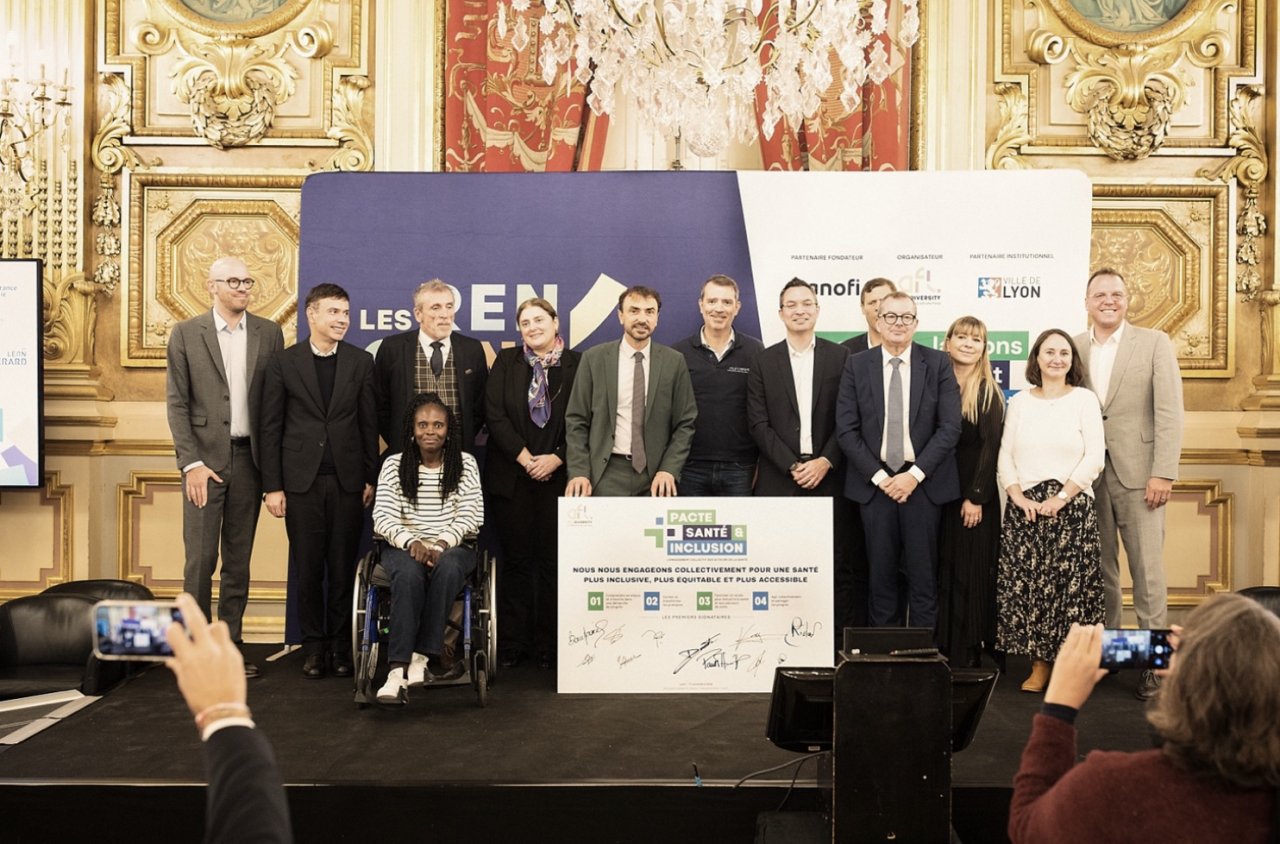
The day concluded with the collective signing of the Health & Inclusion Pact, in the presence of the Mayor of Lyon. The first signatories are APF France handicap, BD, Carrefour, the Caisse nationale de l’Assurance Maladie, the Fidev association, the Hospices Civils de Lyon, Oui Care, Sanofi, Ipsen, the Centre Léon Bérard, Thermes de Balaruc-les-Bains, the Donner des Elles à la Santé association and the City of Lyon.
The Pact is free of charge and open to all organisations, whatever their size or sector. It sets out four commitments: understanding the issues and embarking on a process of improvement; training and changing practices; promoting more inclusive access to healthcare and care pathways; and acting collectively by sharing the progress made.
An operational annex suggests courses of action for each of these commitments. It does not impose a single model: each organisation sets its own priorities and moves forward at its own pace, according to its remit and resources, in a spirit of continuous improvement.
Analysis – Thermes de Balaruc-les-Bains is among the signatories, which shows that the issue also concerns thermal spa and wellness players, at the crossroads of health and hospitality. Several hospitality players are already working on welcoming guests with disabilities, from Thalazur Bandol, which took part in DuoDay 2025, to Best Western Hotels & Resorts France and its partnership with Sourdline for its customer service.
Quarterly webinars, then Lille in 2027
To keep the initiative alive, AFL Diversity is organising “Les Rendez-vous Santé & Inclusion”, quarterly webinars bringing together experts, care professionals, businesses, associations and institutions to share experience and practical solutions. Open to signatories and future signatories alike, they serve as a preliminary step towards signing the Pact. The first will take place on Tuesday 26 January 2027.
The Rencontres Santé & Inclusion will then continue in other French cities. The City of Lille will host the second edition in 2027. In the meantime, signatories will implement their commitments and share their progress at the Rendez-vous.
Founded in 2021 by Adrien and Fabien Figula Letort, AFL Diversity supports businesses, public organisations and associations on diversity, equal opportunity and inclusion. Together with Ipsos bva, it created Inclusion+, an independent measurement and certification tool, as well as the Grand Prix AFL Diversity, awarded every year since 2022. It donates 5% of its revenue to associations fighting discrimination.
With the launch of the national Health & Inclusion movement, the two founders explain, they are applying to healthcare what works in business: measuring, training, committing together and reporting on progress. On the hospitality side, this approach echoes initiatives such as Accor’s partnership with Handiwork for the inclusion of people with disabilities.
At a glance by The Hospitality Tribune
AFL Diversity and Sanofi launch France’s Health & Inclusion Pact in Lyon
Launched on 17 November 2026 at Lyon City Hall, with around 200 participants
13 founding signatories, including Thermes de Balaruc-les-Bains, Centre Léon Bérard and the City of Lyon
Ipsos bva survey: 83% of people with disabilities report inadequate medical care, vs 59% without
Free pact open to all organisations, built on four commitments and an operational annex
Quarterly webinars from 26 January 2027; second edition in Lille in 2027