



Construction progresses, but the timeline is revised
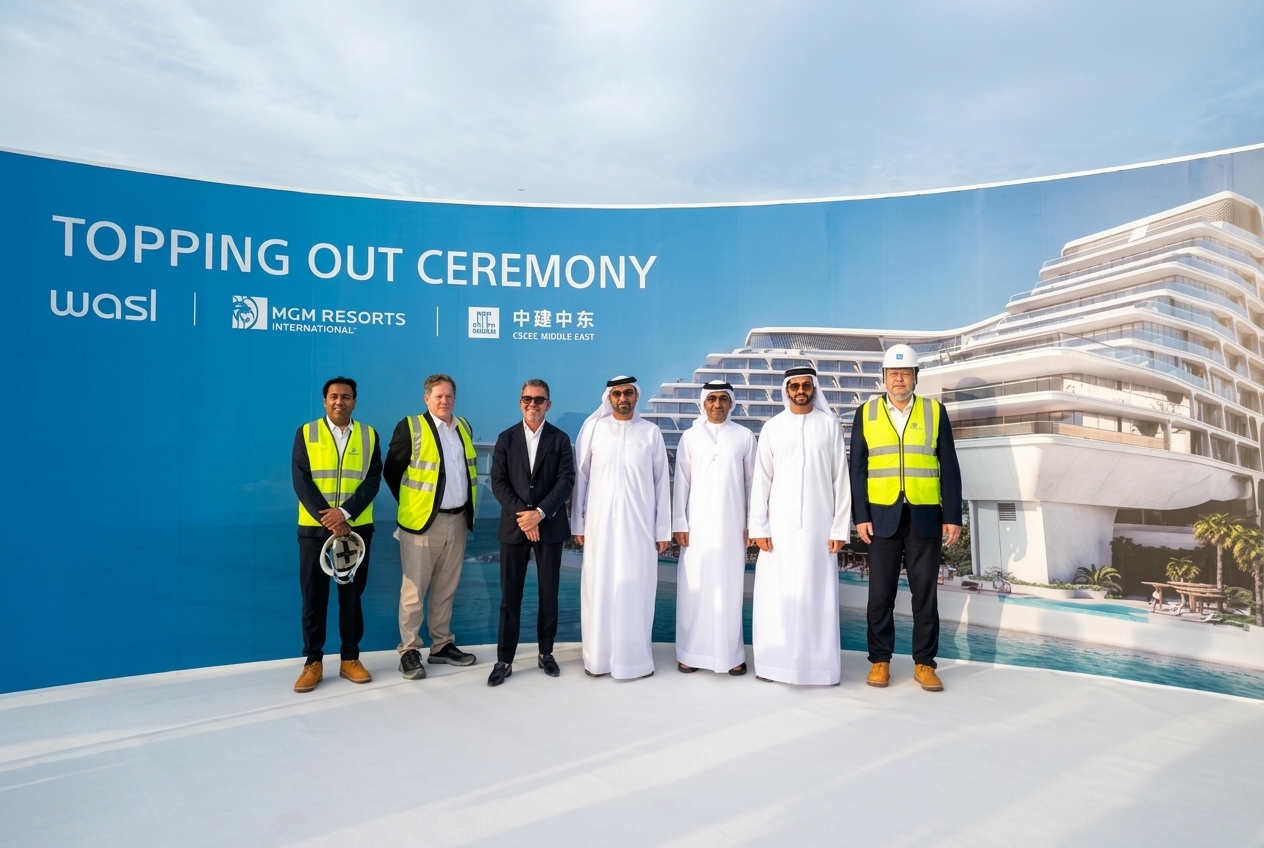
In mid-November 2026, Wasl Group announced the structural topping-out of the future MGM Dubai, one of the largest hospitality and leisure projects currently under development in the emirate.
This milestone marks the end of the main structural works. It does not, however, mean that interior fit-out, technical systems or the facilities needed for operation have been completed.
The project, located on an artificial island of some 279,000 m² off Umm Suqeim and Jumeirah, close to the Burj Al Arab, is now expected to welcome its first guests in early 2029.

This new horizon replaces a previously announced target of March 2028. The slippage therefore represents a delay of around ten months or more, depending on the actual opening date in 2029.
The November announcement gives no detailed explanation of the reasons behind the revised timeline.
MGM, Bellagio and ARIA: three brands, 1,500 rooms
MGM Dubai will bring together three MGM Resorts International brands within a single destination:
- MGM, the American group’s flagship brand;
- Bellagio, a luxury brand associated in particular with Las Vegas;
- ARIA, positioned in contemporary upscale hospitality.
The scheme provides for a total of 1,500 rooms and suites, complemented by 40 food and beverage outlets, a beach club, a theatre, retail space, wellness facilities and a range of leisure and entertainment amenities.

The complex aims to become a destination in its own right, capable of attracting both international hotel guests and Dubai residents.
This concentration of brands and activities illustrates MGM Resorts’ strategy of exporting part of its integrated-destination expertise beyond its traditional markets.
A single-phase opening planned
According to statements by Mustafa Al Hashimi, CEO of Wasl Hospitality and Leisure, reported by the Khaleej Times, the complex is expected to open in a single phase.
This approach is an important factor in assessing the timeline.
Bringing all the components of a complex of this size into operation simultaneously requires, among other things, coordinating finishing works, technical testing, permits, recruitment, training and pre-opening operations.
It may also allow a complete destination to be presented from launch, rather than opening the hotels and facilities progressively.
The final timeline will nonetheless depend on the actual progress of each of these stages.
Wasl and MGM Resorts reaffirm their ambitions
The topping-out ceremony brought together representatives of Wasl Group, MGM Resorts International and China State Construction Engineering Corporation (CSCEC), the project’s construction partner.
Hesham Al Qassim, Group Chief Executive Officer of Wasl Group, presented the milestone as a contribution to Dubai’s tourism and real estate development strategy.
For his part, Ari Kastrati, Chief Content, Hospitality & Development Officer at MGM Resorts, emphasised the group’s ambition to create a destination combining hospitality, dining and entertainment, while confirming the target of an early 2029 opening.
The project is built on a partnership between a local real estate developer and an international hotel operator with recognised brands.
However, publicly available information does not specify the detailed economic terms of this collaboration, notably the split of investment and any management or licensing agreements covering the various brands.
Wynn Al Marjan Island: a widening competitive lead
The delay to MGM Dubai comes as its American rival Wynn Resorts steps up preparations for Wynn Al Marjan Island in Ras Al Khaimah.
According to the latest guidance from Wynn Resorts in November 2026, the resort remains scheduled to open in September 2027, some sixteen to eighteen months ahead of MGM Dubai, depending on the latter’s final launch date.
The two projects are comparable in scale and international ambition, but differ on one decisive point: gaming.
Wynn Al Marjan Island holds the first federal licence issued in the United Arab Emirates to operate a land-based casino. To date, Wynn remains the only operator listed in this category on the public register of the General Commercial Gaming Regulatory Authority (GCGRA).
MGM Dubai, for its part, has no announced gaming licence. The American group has, however, never concealed its interest in this emerging market.
As early as 2023, Bill Hornbuckle, President and CEO of MGM Resorts International, raised the possibility of including in the Dubai complex a space of around 150,000 square feet, or nearly 14,000 m², that could later be converted into a casino if the regulatory framework allowed. This possibility constitutes neither an authorisation nor a commitment to open one.
The competition between the two groups therefore goes beyond selling rooms.
By opening first, Wynn could gain a head start in building its international customer base, recruiting specialist talent and positioning its brand in the regional market for integrated resorts with casinos.
For MGM, the postponement to 2029 raises the stakes on differentiation. The group will need to rely on its three brands, its food and beverage offer and its entertainment infrastructure to attract international and regional guests, independently of any future gaming authorisation.
The balance of power nonetheless remains asymmetric: Wynn already holds a casino licence and has a nearer opening date, while MGM retains a potential, but unauthorised, strategic option on gaming in Dubai.
This difference could weigh on the revenue prospects and respective valuations of the two investments.
The two projects compared
| Indicator | MGM Dubai | Wynn Al Marjan Island |
|---|---|---|
| Location | Dubai | Ras Al Khaimah |
| Planned opening | Early 2029 | September 2027 |
| Capacity | 1,500 keys | Around 1,530 suites and villas |
| Positioning | Three hotel brands and entertainment | Luxury integrated resort with casino |
| Casino licence | No | Yes |
| Investment | Total amount not confirmed | Around US$5.7bn |
Strategic analysis | A delay that shifts the value-creation horizon
For investors, owners and operators, the move from an announced March 2028 opening to an early 2029 target is a more significant development than the physical progress on site alone.
First issue: the revenue timeline.
A delayed opening mechanically pushes back the start of commercial activity, room revenue and ancillary income. It may also alter the ramp-up assumptions used in the original financial models.
Second issue: the carrying cost of the investment.
For a real estate development of this scale, a longer timeline can increase exposure to financing costs, pre-opening expenses and possible budget revisions. On its own, however, it does not justify concluding that MGM Dubai is facing a cost overrun.
Third issue: the complexity of bringing the resort into operation.
With three brands, 1,500 keys and an especially extensive food, beverage and leisure offer, operational readiness is a major undertaking in its own right. A simultaneous opening requires close coordination between hotel, technical and commercial teams and the various service providers.
Fourth issue: the competitive environment.
Arriving in 2029 rather than 2028 will change the complex’s position in Dubai’s pipeline of new hotel supply. Market conditions, international demand and the competing offer could shift considerably in the meantime.
Beyond the opening date, the central question will therefore be the project’s ability to generate returns commensurate with the scale of the investment committed.
The structural topping-out is tangible progress. The technical, regulatory and operational stages that will turn this real estate achievement into a fully functioning commercial destination still lie ahead.
At a Glance
Project: MGM Dubai, developed by Wasl Group
Location: Artificial island off Jumeirah and Umm Suqeim, Dubai, UAE
Brands: MGM, Bellagio and ARIA
Capacity: 1,500 hotel keys and 40 dining venues
Opening schedule: Previously targeted for March 2028; now early 2029
Development milestone: Structural topping-out completed in November 2026; single-phase opening planned