



Dubai and the Caribbean: Apartment Collection expands beyond the United States
Hilton has announced the first international signings for its Apartment Collection by Hilton brand, with two projects located in the United Arab Emirates and the Turks and Caicos Islands, respectively.
These developments mark another milestone for the group’s furnished accommodation offering, designed to cater to both short stays and extended stays.
Hilton reports that more than 60 deals are currently at various stages of negotiation across US and international markets. These are therefore not 60 fully contracted properties, but rather a commercial pipeline still taking shape.

Another significant development is that Hilton has secured its first development agreements with partners other than Placemakr, its launch partner. This diversification demonstrates interest in the concept from additional owners and developers.
Dubai: a first international property featuring 388 apartments
Business Bay, Dubai — scheduled opening in December 2026
The first announced property in the Middle East will be located on Marasi Drive in Dubai’s Business Bay district, close to the Dubai Water Canal.
It will offer 388 apartments, ranging from studios to one-, two- and three-bedroom units.
The property will feature amenities including a swimming pool, fitness centre and children’s play area.

Its location near Downtown Dubai, the Burj Khalifa and Dubai Mall is intended to appeal to several customer segments: business travellers, families, tourists and temporary residents.
Dubai appears well suited to the brand’s positioning. The city attracts substantial international demand and has a property market combining residential developments, tourist accommodation and mixed-use projects.
For Hilton, the location also provides an opportunity to test its residential hospitality model in a market where serviced apartments are already an established accommodation category.
Turks and Caicos Islands: first Caribbean property expected in 2028
The second international signing concerns Grace Bay in the Turks and Caicos Islands, with an opening anticipated in 2028.
This Caribbean tourism destination will allow Hilton to position Apartment Collection in a market quite different from Dubai, with a stronger focus on leisure stays.
However, the announcement does not specify the number of apartments, the investment amount or the identity of the property’s owner or developer.
The development could enable Hilton to assess the appeal of its concept among guests seeking more space, independence and flexibility than a traditional hotel room provides.
Placemakr: the partner behind the launch of the US model
Apartment Collection was initially developed through a partnership with Placemakr, a US operator specialising in apartment-style accommodation.
Several properties have joined the Hilton network during 2026, illustrating the range of locations and property types suitable for the concept.
| Property | City | Announced timetable |
|---|---|---|
| Scout Living PCM – Placemakr | Atlanta | Spring 2026 |
| Placemakr Salt Lake City Downtown | Salt Lake City | Spring 2026 |
| Placemakr Austin Downtown | Austin | July 2026 |
| Placemakr Pittsburgh Downtown | Pittsburgh | September 2026 |
| Anthem House – Placemakr | Huntsville | September 2026 |
| Placemakr Tempe | Tempe | December 2026, projected |
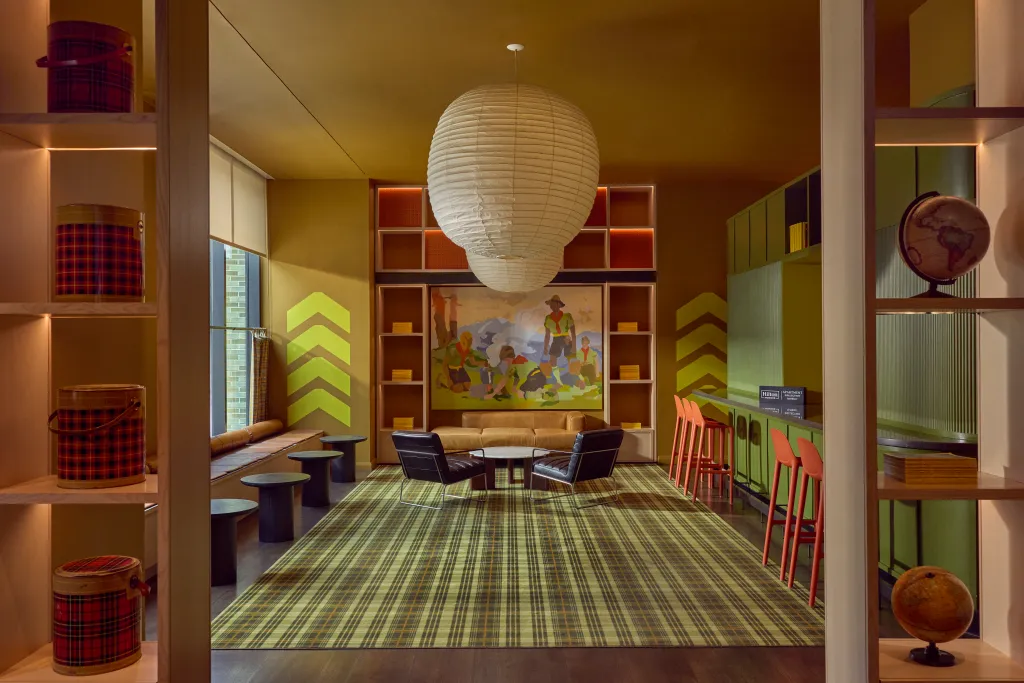
In Atlanta, Scout Living PCM is located within Ponce City Market, in the historic Old Fourth Ward neighbourhood. The property offers amenities including a rooftop swimming pool and coworking spaces.
In Pittsburgh, the concept occupies The Pennsylvanian, a landmark downtown building, illustrating the potential for converting existing assets.
In Tempe, the forthcoming property is expected to form part of the new South Pier district, overlooking Tempe Town Lake.
These locations demonstrate the property flexibility Hilton is seeking, with projects potentially accommodated within residential developments, mixed-use schemes or repositioned buildings.
A residential offering backed by hospitality standards
Apartment Collection by Hilton occupies a position between furnished residential apartments and traditional hotels.
The accommodation features fully equipped kitchens, separate living areas and, depending on the property, amenities such as fitness facilities or leisure areas.
The concept also includes:
- On-site staff available 24 hours a day, seven days a week.
- In-unit laundry facilities.
- Housekeeping every seven days for extended stays.
- Access to Hilton’s commercial capabilities, distribution network and brand recognition.
This operating structure aims to combine the independence of residential accommodation with selected service and commercial standards associated with branded hospitality.

Michael Snapkoski, Global Brand Leader of Apartment Collection by Hilton, emphasises that the brand represents an important step in broadening Hilton’s offering within the extended-stay market.
According to Snapkoski, the model enables owners and developers to combine residential-style assets with the group’s distribution capabilities, brand recognition and commercial support.
Strategic Analysis | Hilton seeks to capture a new category of property assets
Beyond the announced openings, the development of Apartment Collection holds particular significance for hotel owners and investors.
1. Expanding property conversion opportunities
One of the principal considerations is the ability to incorporate assets that do not necessarily meet the physical specifications of a conventional hotel.
Residential buildings, mixed-use developments and properties undergoing conversion may therefore offer development opportunities.
For investors, this approach could create opportunities to enhance the value of certain assets through a structured hospitality operation, without necessarily undertaking a complete conversion into a traditional hotel.
However, feasibility remains dependent on local regulations, operating permits and the technical characteristics of each building.
2. Diversifying customer segments and lengths of stay
The concept targets several demand segments: business travellers on extended assignments, families, groups, travellers combining work and leisure, and individuals requiring temporary accommodation.
This diversity could help reduce dependence on a single customer segment.
The ability to accommodate different lengths of stay also creates opportunities to develop distribution and pricing strategies tailored to the characteristics of individual markets.
3. A potentially different operating model
Fully equipped kitchens and less frequent housekeeping services can alter the operating cost structure compared with a traditional hotel.
Such a model could offer opportunities for cost optimisation, particularly in certain daily services.
However, it also introduces other operational requirements, including the upkeep of residential equipment, apartment maintenance, utilities management and the adaptation of services to different lengths of stay.
Profitability cannot therefore be assumed to exceed that of a conventional hotel. It will depend, among other factors, on property costs, occupancy rates, average length of stay and operating expenses.
4. The commercial strength of major hotel brands as an argument for owners
One of the model’s distinguishing features is the combination of residential assets with the commercial infrastructure of a major hotel group.
For an owner, access to Hilton’s distribution network and brand recognition may represent an attractive proposition, particularly when compared with independent serviced apartment operators.
This approach reflects a broader industry trend: major hotel groups are seeking to extend their presence beyond the traditional hotel room by incorporating accommodation formats suited to different uses.
In this respect, the transition from an initial partnership with Placemakr to multiple independent development agreements is a significant indicator.
The next step will be to establish whether developers’ commercial interest translates into actual openings and, subsequently, sustainable financial performance.
For investors, the key indicators to monitor will include the rate at which negotiations convert into signed contracts, asset conversion costs, operating performance and the concept’s ability to establish itself across different international markets.
At a Glance
Brand: Apartment Collection by Hilton, an apartment-style extended-stay offering.
International expansion: First signings in Dubai, UAE, and Grace Bay, Turks and Caicos Islands.
Dubai project: 388 apartments, scheduled to open in December 2026.
Caribbean project: Grace Bay property expected to open in 2028.
Development pipeline: More than 60 deals at various stages of negotiation globally.
Strategic positioning: Residential-style accommodation supported by Hilton’s distribution, brand recognition and commercial infrastructure.