
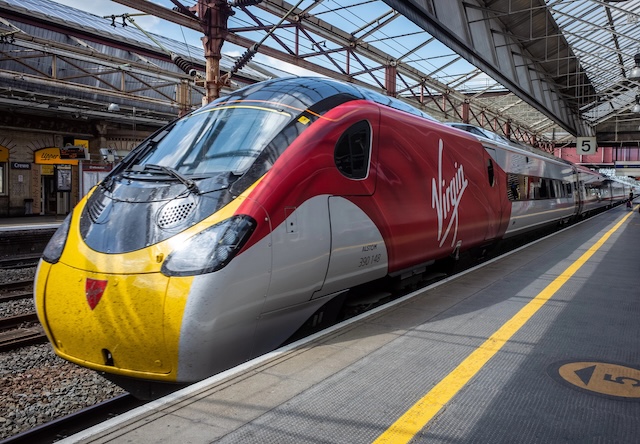


A firm €650-700m order with Alstom
Virgin has taken a further step in its plan for high-speed services between London and the continent. The group has already raised funding, secured access to the Temple Mills maintenance depot in east London and obtained authorisation to run on HS1, the high-speed line linking the British capital to the tunnel. In September, it signed a firm order with Alstom for 12 Avelia Stream trainsets, worth between €650 million and €700 million.
Capable of running at 300 km/h, the trains will be delivered and maintained by Alstom. They will be leased to the operator by an entity owned in equal shares by Virgin and an Italian investment fund. Speaking to BFM Business, Virgin Group CEO Josh Bayliss said he was confident of a 2030 launch, while acknowledging that everything is twice as difficult in the tunnel. Virgin is due to receive one trainset a month from that date.

Andrew DeLeone, President of Alstom’s Europe Region, said that travellers across Europe are increasingly looking for smoother cross-border high-speed rail connections, and that this project will help meet precisely that demand. The manufacturer will support Virgin throughout the project’s entire life cycle, from entry into service to long-term operation.
Paris-London first, then Brussels and Amsterdam
Virgin plans to run 13 daily return services between Paris and London from 2030. According to the company, this represents 4.75 million seats a year on the route. Brussels and Amsterdam will then be connected to the British capital, bringing the total to 20 return services a day and close to 7.5 million seats a year.
The timetable will combine direct services with journeys calling at Calais, Ashford and Ebbsfleet. The project is expected to create up to 1,000 jobs. According to Josh Bayliss, the aim is not to take market share from Eurostar, but to grow rail’s share against air travel.
He said he was convinced that more journeys between the UK and Europe will be made by train, adding that Virgin is adding capacity for millions of additional international rail journeys every year, thereby growing the market as a whole.
Virgin hospitality brought to rail
Virgin intends to apply to rail the formulas it has proven in its other businesses, targeting business and leisure travellers alike. Virgin Atlantic’s Clubhouses will serve as the benchmark for social spaces, both before departure and on board. Passengers will have greater flexibility to work, relax or socialise. The food and beverage offer will draw on Virgin Voyages’ expertise, while seating comfort and interior layout will follow the codes of Virgin Hotels, the brand now led by Joe Margison, confirmed at the helm of Virgin Hotels Collection.
Unlike Eurostar’s trains, Virgin’s will be single-deck. Josh Bayliss believes customers do not want to buy an upper-deck seat. The specifications include larger windows and more luggage space. The group also hopes to offer Starlink connectivity on board.
Josh Bayliss said Virgin has always stood out for its ability to challenge the status quo, create exceptional moments for its customers and simplify their journey. He added that the group will apply the same philosophy to the cross-Channel route, reinventing the customer experience so that the journey becomes as appealing as the destination itself.
🔗 Read more on LTH Virgin Atlantic restructures its executive committee: Suzanne Roddie promoted to Chief Operating Officer
Gare du Nord in the spotlight
The experience will not stop at the train. Josh Bayliss considers that Gare du Nord does not currently offer a satisfactory experience. He has announced a redevelopment project, to be completed before 2029, in partnership with Gares & Connexions, the SNCF entity responsible for French stations.
The aim is to reorganise underused spaces on the ground floor. Travellers would thus no longer have to go upstairs for customs formalities before coming back down to the platform, as is currently the case for Eurostar.

Premium positioning, profitability targeted within ten years
The business model has not yet been set out in detail. Virgin nevertheless intends to take its cue from its airline business in terms of positioning, service and frequency. Josh Bayliss has ruled out a low-cost model, pointing out that Virgin Atlantic is not Ryanair.
He highlights the group’s experience in running businesses that are very expensive to operate, such as hotels. He is targeting profitability within ten years, or even five.
Analysis – The choice of upscale positioning also reflects the route’s cost structure, marked by heavy upfront investment and high tunnel access charges. For hospitality players, the project illustrates an ecosystem approach: the brand is extending to rail the service and loyalty codes it already deploys across its hotels, airline and cruise line.
Loyalty, connectivity and European ambitions
Travellers will be able to earn and redeem Virgin Points through Virgin Red. The programme links rail with flights, hotel stays, cruises and experiences across the Virgin ecosystem.
The group aims to interconnect its services: its UK rail lines, its airline networks and existing rail networks in France. Josh Bayliss is considering partnerships with competitors of SNCF’s TGV services, along the lines of the airline model, to serve more cities and airports and replace air routes with rail. The network could later be extended to Germany and the Netherlands.
In France, Virgin can draw on the strength of its brand, built through Virgin Megastores, Virgin Mobile, Virgin Radio and Formula E.
The final steps before 2030
Several workstreams remain open. In December, the operator must submit its application to Getlink, the tunnel operator, to obtain access authorisation. It will also need to conclude negotiations with SNCF Réseau to secure train paths on the French side, and recruit multilingual drivers.
Finally, Virgin must deal with the legal challenge brought by Eurostar. The incumbent operator has lodged an appeal against the British regulator’s decision granting Virgin access to the high-speed line, which it considers non-transparent, unfair and discriminatory.
Analysis – The timetable will also depend on Alstom’s ability to deliver on schedule and on the certification of the trainsets, traditionally a lengthy process, all the more so for a Channel crossing.
Competition takes shape on cross-Channel routes
Virgin will not be the only player eyeing the route. According to the British press, Trenitalia also plans to launch high-speed services through the tunnel. The Italian state-owned operator already runs international trains to Paris and recently ordered 19 new trainsets from Hitachi for €2 billion.
Analysis – The arrival of new operators should increase capacity between London and the continent over the next decade. For hotels in Paris, London, Brussels and Amsterdam, particularly around stations, this additional seat capacity represents a shift in visitor flows worth watching closely.
At a glance by The Hospitality Tribune
Virgin places €650-700m Alstom order to challenge Eurostar from 2030
Firm order for 12 single-deck Avelia Stream trainsets, up to 300 km/h, leased via a 50/50 Virgin and Italian fund vehicle
13 daily Paris-London returns from 2030, rising to 20 with Brussels and Amsterdam (7.5 million seats a year)
Onboard experience inspired by Virgin Atlantic Clubhouses, Virgin Voyages and Virgin Hotels
Gare du Nord redevelopment planned with Gares & Connexions before 2029
Premium positioning, profitability targeted within ten years; Getlink filing due in December