



Record Attendance at European Conference in Vienna
The GBTA + VDR Europe Conference 2026, organised in partnership with the Austrian Business Travel Association (ABTA), took place from 2 to 4 November at the Austria Center Vienna.
The event brought together nearly 1,400 business travel and meetings professionals from 41 countries, including 350 travel buyers, 75 exhibitors and 130 speakers.
This edition also marked twelve years of collaboration between the Global Business Travel Association (GBTA) and Germany’s VDR, with Austria’s ABTA joining as a partner this year.


According to Fulvio Origo, GBTA’s Senior Director EMEA, the record attendance, combined with growth in business travel spending and trip volumes, demonstrates the sector’s resilience and its ability to plan for the future.
European Business Travel Spending Expected to Reach €404 Billion in 2026
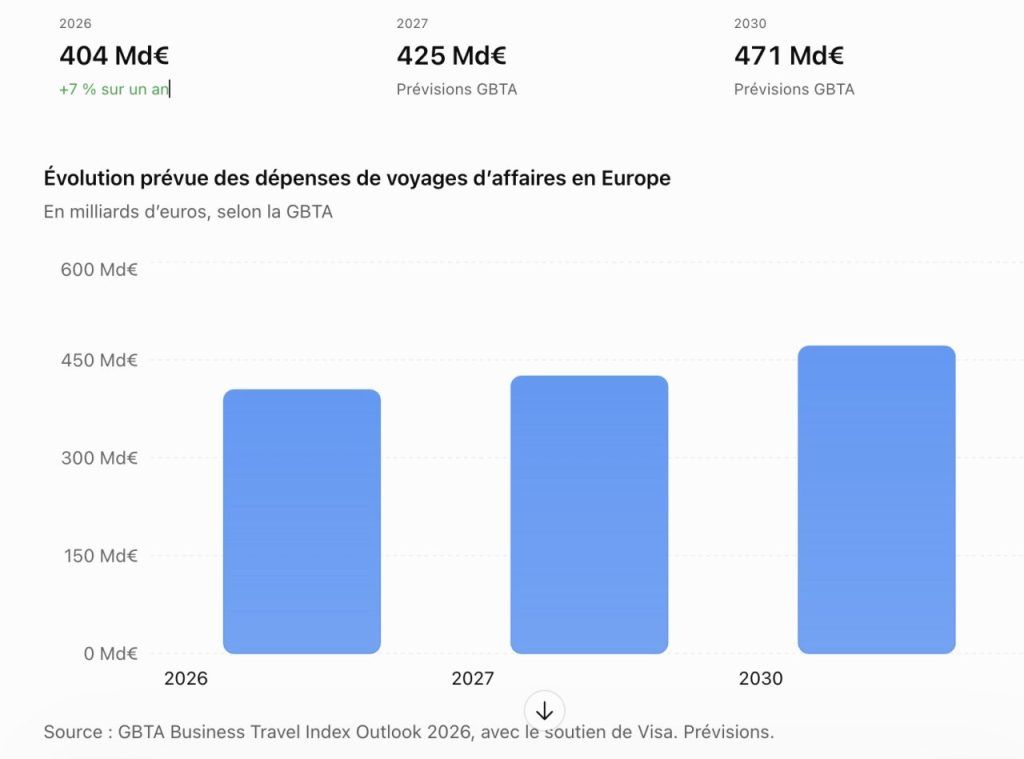
According to forecasts from the GBTA Business Travel Index Outlook 2026, supported by Visa, business travel spending in Europe is expected to reach €404 billion in 2026, representing a 7% increase compared with 2025.
Europe Is Therefore Expected to Account for More Than a Quarter of Global Business Travel Spending
However, this increase in expenditure contrasts with the much slower growth in trip volumes. European organisations are expected to generate approximately 600 million business trips in 2026, an increase of just 0.7% year on year.
The gap between expenditure growth and the increase in travel volumes is one of the study’s key findings.

It suggests higher average spending per trip, although the available figures do not establish precisely how much of this increase can be attributed to changes in prices, length of stay or the composition of business travel.
Hotels and MICE: Growth in Value Rather Than Volume
For hotel operators, these forecasts call for a differentiated assessment of the business travel recovery.
Higher travel budgets do not necessarily translate into an equivalent increase in room nights. They may reflect rising transport and accommodation costs, changes in destinations or adjustments to corporate travel policies.
For hotels serving corporate travellers and business meetings, several indicators therefore warrant particular attention: negotiated room-night volumes, average corporate room rates, length of stay and ancillary revenue generated by meetings and events.
The challenge for commercial directors and revenue managers will be to distinguish rate-driven growth from genuine increases in demand, in an environment where companies continue to scrutinise their expenditure.
Sustainability: Limited Progress in Corporate Travel Programmes
Held alongside the conference on 2 November, the GBTA Foundation Sustainability Summit brought together more than 800 sustainability, procurement and business travel professionals.
The findings of the Sustainability Acceleration Challenge 2026, based on data from 204 companies across 28 countries, indicate a modest improvement in the maturity of sustainable travel programmes.
The average score increased from 1.4 out of 5 in 2025 to 1.5 out of 5 in 2026.
Thirty companies were recognised for their sustainability initiatives.
These findings highlight the continuing difficulties of translating environmental commitments into measurable operational practices, against a backdrop of economic uncertainty and competing priorities.
For hotel groups, this development reinforces the growing importance of environmental data, emissions measurement and transparency in commercial relationships with major corporate accounts, even as the transformation of corporate travel programmes remains gradual.
Artificial Intelligence, New Performance Metrics and Innovation
The conference also featured 33 educational and discussion sessions addressing the main transformations affecting business travel: artificial intelligence integration, travel programme optimisation, emissions reduction, sustainable aviation fuels (SAF) and risk management.
The return of “The Big Idea” format provided an opportunity to question the relevance of traditional travel programme performance indicators in light of changing booking behaviour.
Meanwhile, the Europe VentureConnect programme, supported by Amadeus Cytric, brought together eight start-ups and nine investors and industry professionals.
Fintech company 1-CP, led by its founder and CEO Erik-Jan Krausch, won the competition with its solution designed to simplify procurement, payments, expense claims and reporting associated with business travel.
Finalists were eligible for prizes ranging from €1,500 to €5,000.
Finally, Dan Humby received the 2026 Jutta Luoma Award in recognition of his commitment to GBTA and the European business travel community.
Next European Conference Scheduled for Cologne in November 2027
The next GBTA + VDR Europe Conference will take place from 8 to 10 November 2027 in Cologne, Germany.
In the meantime, the forecasts presented in Vienna confirm an important trend for Europe’s hospitality ecosystem: the business travel market continues to grow in value, while trip volumes are increasing at a much slower pace.
This divergence could become a central consideration in the commercial strategies of urban hotels, conference properties and hotel groups with significant exposure to corporate demand.
At a Glance
Event: GBTA + VDR Europe Conference 2026, held in Vienna on 2–4 November.
Attendance: Nearly 1,400 delegates from 41 countries, a record for the event.
2026 spending forecast: €404 billion in European business travel expenditure, up 7% year on year.
Trip volume: Approximately 600 million business trips expected in 2026, up just 0.7%.
Long-term outlook: European business travel spending projected to reach €471 billion by 2030.
Next conference: Cologne, Germany, 8–10 November 2027.