


Centralisation, or the triumph of economies of scale
On paper, the reasoning was hard to argue with.
Why let each hotel negotiate individually for its guest amenities, linen, foodstuffs, cleaning products, equipment or certain services when dozens, hundreds or even thousands of properties can pool their volumes?

Hotel groups, brands and operators have gradually centralised their purchasing or entrusted it to specialist platforms. The integration of ERP and procurement tools accelerated the trend: approved catalogues, negotiated rates, digitised orders, invoice matching, budget control and volume consolidation.
Alongside negotiating power came the streamlining of organisations.
Why keep a storekeeper or purchasing manager in every property when the product, the supplier and sometimes even the price have already been determined upstream?
The growth of franchising and asset-light models added another dimension to this organisation. Depending on the networks and contracts, the purchasing ecosystem can generate volume discounts, commissions, rebates, supplier contributions or fees for procurement services.
The central purchasing office is therefore no longer merely a way of paying less. It can also contribute to a network’s overall economics.
By centralising purchasing, have we done away with the person who checked what was bought?
This rationalisation has, however, had a less visible consequence: the gradual disappearance of expertise within the properties themselves.
The storekeeper of old did not simply place orders.
He received goods. He weighed. He counted. He checked. He knew his suppliers, monitored his stocks, spotted a change in quality or weight per unit and could immediately detect an inconsistency between an order, a delivery note and the goods actually received.
Some of these functions have been automated. Others have been transferred to operational staff. Some have simply disappeared.
So a question deserves to be asked today: who physically checks what the hotel pays for?
A rate may well have been negotiated at the best possible level by a central purchasing office and yet, in the end, generate a higher cost than expected.
Different weight, incorrect quantity, substituted product reference, lower yield, fluctuating quality, miscounted linen, minimum order quantities creating overstock, incomplete delivery or invoicing error: the negotiated price represents only part of the equation.
From best price to best cost
This may be where the paradigm shift lies.
For years, purchasing performance was largely equated with the ability to negotiate the best price.
Yet the best price is not necessarily the best cost.
A food product that is 5% cheaper but causes greater waste, has a lower yield or requires a larger quantity to achieve the same result can ultimately cost more.
A cheaper item that comes with large minimum order quantities ties up stock and potentially increases waste.
A slightly more expensive supplier that can deliver more frequently, with fewer errors and consistent quality, can on the contrary reduce the overall cost borne by the property.
In other words, the issue is no longer just the purchase price, but what might be called the “cost delivered to the hotel”.
And this cannot always be assessed from a head office located hundreds or thousands of kilometres away.
The paradox of local sourcing
The question becomes all the more sensitive because the hotel industry has never been so vocal about its local roots.
Local products, short supply chains, craftspeople, producers, environmental footprint, contribution to the local economy: these commitments now feature prominently in the messaging of brands and properties.
But they can sometimes clash with the logic of supplier listing and volume consolidation.
Here again, it would be simplistic to pit central purchasing against local sourcing.
A central purchasing office has a clear advantage on standardised products and commodities, where volume is a powerful negotiating lever.
But is this logic relevant for every category?
Fresh produce, food and beverage, craftspeople, certain technical services or products that contribute directly to a property’s identity may justify a different approach.
The question is therefore probably not one of choosing between centralisation and independence, but of determining where to set the dial.
And what if AI shifted that dial?
This is where an unexpected player comes in: artificial intelligence.
Digitalisation helped to eliminate the storekeeper and centralise purchasing. AI could, paradoxically, favour the return of local expertise.
Why?
Because a large share of the administrative work that once made this function costly can now be automated: document processing, order–delivery–invoice matching, discrepancy detection, price monitoring, consumption analysis or supplier comparison.
The buyer can then devote their time to what the machine cannot do on its own: negotiating, sourcing, carrying out physical checks, interpreting data, challenging suppliers and anticipating.
Tomorrow’s purchasing manager could thus be very different from yesterday’s.
An augmented buyer: at once buyer, storekeeper, analyst and cost controller.
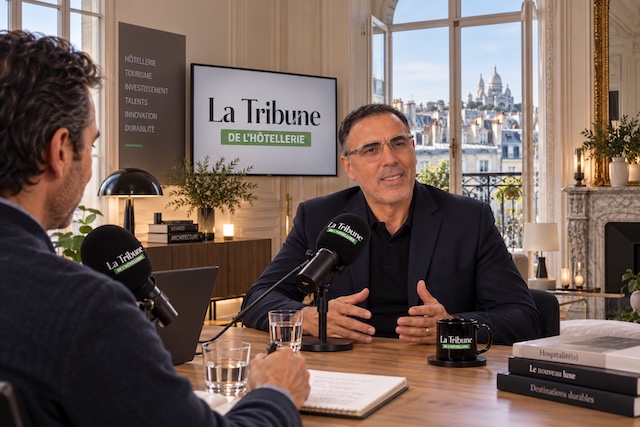
To test these developments against real-world conditions, The Hospitality Tribune spoke to Kacem Aoualli, a hands-on buyer and expert in the function with almost thirty years’ experience. Centralisation, cost control, supply checks, local autonomy and artificial intelligence: with him, we wanted to understand whether the purchasing manager had truly lost their place in the hotel or whether, on the contrary, current changes were preparing their return in a profoundly renewed form.
Interview
“Without a purchasing manager, do costs inevitably rise?”
LTH – Hello Kacem, and thank you for agreeing to this conversation with The Hospitality Tribune. Trained as an accountant, you gradually moved into purchasing. After more than thirty years in purchasing and control, you have seen the profound transformations of this function from the inside. Let’s start with a very practical question: can a rise in supply costs be observed when a property no longer has a purchasing manager or a storekeeper?

Kacem Aoualli – Inevitably, yes. Proximity to suppliers, knowledge of the market and the ability to react quickly all have value.
And AI is now considerably strengthening these capabilities. It makes it possible to compare offers, price movements or available alternatives much more quickly, and gives the buyer a view that was previously much harder to obtain.
The problem is therefore not only knowing at what price the central purchasing office negotiated a product. We also need to be able to check continually whether that price remains competitive and whether what is delivered really matches the agreed terms.
“When you buy a pen, check the ink level.”
LTH – You have worked in the hotel industry since 1990. With more than thirty years “on the clock” devoted to purchasing and control, what has that experience taught you about the role of the storekeeper?
Kacem Aoualli – It has taught me, above all, that savings are often made in the details. You can negotiate excellent terms with a supplier, but that never removes the need to check what actually arrives at the property.
Goods receipt is, in that respect, essential. The weight delivered is not always exactly the weight stated, quantities can show discrepancies and the quality received does not necessarily match what was expected. Taken individually, these discrepancies may seem insignificant. Repeated over hundreds or thousands of deliveries, however, they end up weighing on costs.
That is why I have always regarded the storekeeper as a genuine safeguard between purchasing, suppliers, stock and operational departments, notably the kitchen. The storekeeper’s mission is not only to order or receive goods: it is to ensure that what the hotel pays for matches what it actually receives and what it consumes.
I also remember something my director said to me when I started out: “When you buy a pen, check the ink level.”
It may seem anecdotal, but the phrase has stayed with me. It sums up a philosophy of management rather well: savings also begin with attention to small details.
After more than thirty years in the hotel industry and meetings with remarkable leaders such as Roland Wardini or Daniel Le Biavant, I am even more convinced: experience, vigilance and the rigour that goes with the storekeeper’s role remain indispensable. What has changed today is the tools we have to exercise that vigilance.
One last thing: I cannot separate stores management from purchasing. At an operational level, and in standard hotel units, the two functions are more than linked, and AI will only accelerate the merging of their skills.
“But won’t the buyer/storekeeper’s salary absorb the savings made?”
LTH – But might the difference gained through having a buyer or storekeeper not end up being absorbed by their salary cost?
Kacem Aoualli – That is precisely where we need to move away from a traditional conception of the job.

Depending on the size of the property, the function can be shared across sites or performed part-time. We do not necessarily need to think in terms of a full-time post in every hotel. Some deliveries can be checked by the department head (linen, supplies, etc.).
Above all, we need to measure what the function brings in or helps to avoid: negotiated savings, errors detected, overconsumption corrected, stock optimisation, improved yields, supplier disputes or better anticipation.
It is the relationship between the cost of the function and all of these gains that should be looked at.
“AI can enable the buyer to challenge the central purchasing office”
LTH – Can integrating AI into the buyer’s decision-making process take away some of the added value of ERPs and central purchasing offices?
Kacem Aoualli – Above all, it allows the buyer to challenge them better.
A buyer can connect their supplier environment to AI tools and obtain, almost in real time, comparisons of prices, products, terms and alternatives.
It then becomes much easier to compare price and quality and to present senior management with objective analyses that support an informed decision. The buyer’s knowledge of the local market can become an asset for a network if the information gathered is fed back up the chain.
The buyer becomes, in a sense, a buyer with augmented skills and, above all, by being closest to the ground, can prevent price drift or questionable practices that are often masked by volumes at group level! Economies of scale are only worth something through this permanent monitoring, not only of company X’s rates but also of delivery terms, product quality and so on, and extended to as many suppliers or other applicants for listing as possible.
“Cost control has disappeared in many properties”
LTH – Do you see this function coming back to hotels?
Kacem Aoualli – Yes, but in a different form, with a broader scope. At the level of a single hotel unit, the cost controller role is no longer a priority for many managers, apart from special cases such as large properties or establishments with substantial food and beverage operations representing at least 40% of revenue.
Indeed, beyond the financial and economic remit, which can now be automated or transferred, the new-generation cost controller becomes the guardian of indirect costs (overstocking, delays, quality defects, warranties and so on) and of the listing of new suppliers. Ultimately, the post is enriched and merges with the remit of the buyer-storekeeper. Just as the buyer now encompasses a storekeeper’s hands-on skills, stock management and variance analysis.
I would stress that we cannot preserve margins for ever by raising selling prices. That curve necessarily has a limit. The next source of performance will therefore also lie in operational efficiency and cost control.
As I mentioned earlier when talking about automation, AI frees the buyer from some of the administrative tasks and document checking so that they can concentrate on what genuinely creates value: anticipating, negotiating and controlling.
Checking deliveries is one example. In recent years I have seen more discrepancies: weights or quantities not exactly matching the order, questionable linen counts, differences between what is announced and what is actually delivered for perishables, supplies or groceries…
This is not about presuming any bad faith on the part of suppliers. Another explanation is possible: the skills shortage affecting the hotel industry also affects its suppliers. Errors can therefore occur on both sides of the chain.
“A cheaper product can end up costing more”
LTH – A central purchasing office negotiates a price, but who still checks the “cost delivered to the hotel”? Can transport, minimum order quantities, substitutions, losses, quality, material yield or overconsumption ultimately make a theoretically cheaper offer more expensive than a local solution?
Kacem Aoualli – Absolutely. It is even one of the limits of a view of purchasing based solely on the negotiated price. A product can be cheaper in a catalogue and end up costing the property more.
You have to look at cost as a whole. Take a food product: if I gain 5% on its purchase price but its quality or material yield is lower, I have more waste or I have to use more of it to get the same result, then I have saved nothing.
It is the same with minimum order quantities that increase stock, insufficient delivery frequencies or product substitutions.
A purchasing manager on the ground can measure these things. They know consumption levels, talk to the chef, the head housekeeper, maintenance or the operational teams, and can match the invoiced price against the product’s actual use.
That is also where AI becomes interesting: it can cross-reference, in a fraction of a second, prices with volumes consumed, losses, yield variations or supplier incidents.
We then move from the “best price” to the best real cost for the hotel. And it is not necessarily the same supplier that comes out on top.
“The central purchasing office should be a lever, not a constraint”
LTH – How far should autonomy be handed back to the property? Should some purchasing categories remain fully centralised, while F&B, fresh produce, certain services or purchases that contribute to the hotel’s identity enjoy greater local freedom?
Kacem Aoualli – We must above all not pit central purchasing against local purchasing.
A central purchasing office remains extremely effective for many product families. When you buy large volumes of standardised products, it makes sense to take advantage of the negotiating power of a group or platform.
However, applying that logic to 100% of purchasing can become counter-productive. A hotel is also rooted in a territory. In food service in particular, a local product can bring quality, freshness, differentiation and sometimes even better value for money.
The purchasing manager must therefore be given some room for manoeuvre. Their role is not to routinely step outside the listed range or their price list, but to be able to demonstrate that a local alternative is more relevant on certain criteria: price, quality, lead time, seasonality, environmental impact or guest experience.
What matters is that the decision is objectively grounded.
If the buyer can show, with figures to back it up, that a local solution performs better, why deny ourselves? The central purchasing office should be a performance lever, not a constraint that prevents the property from seizing a better opportunity.
“Tomorrow, the buyer will also have to be the guarantor of supplier data”
LTH – Shouldn’t tomorrow’s buyer also become the guarantor of supplier data? If AI automatically compares prices, quality, incident frequency, lead times, delivery compliance and changes in commercial terms, won’t the real value of the purchasing manager lie no longer just in negotiating, but in organising and interpreting this economic intelligence?
Kacem Aoualli – That is exactly the evolution I see.
Tomorrow, the buyer’s value will no longer lie in placing an order or manually checking hundreds of invoices. Automation and AI can already take on some of these tasks and will do so better and better.
However, AI can only be relevant if the information it is given is reliable. Someone therefore has to organise that data, check it and, above all, know how to interpret it.
A supplier may be 3% cheaper but accumulate delays, delivery errors or quality variations. Another may be slightly more expensive but extremely reliable and allow safety stocks to be reduced. How do you measure that difference? That is precisely where the buyer adds value.
With AI, they will be able to have, almost in real time, a genuine supplier dashboard: price movements, compliance with negotiated terms, delivery quality, frequency of anomalies, lead times, seasonality or available alternatives.
Their role will therefore become far more analytical and forward-looking. They will no longer be just the person who negotiates the price. They will need to be able to tell senior management: “Here is what we buy, here is what it really costs us, here are the risks and here is where our next savings levers lie.”
That is the sense in which I speak of an augmented buyer. AI does not remove their added value; on the contrary, it allows them to devote far more time to what their expertise is truly useful for: analysing, anticipating, negotiating and deciding.
LTH – Thank you, Kacem, for the quality and richness of this exchange, which offers a very practical perspective on a purchasing function undergoing profound change and, more broadly, on the new performance levers available to hoteliers today.
Kacem Aoualli – Thank you for shining a light on this profession, which for too long has been confined to the “back office” and yet is so strategic in a hotel environment where competition is ever fiercer. Mastering purchasing and costs is no longer just a support function: it contributes directly to the performance of the property.
And this may be precisely where the shift in perspective lies. Long regarded as a support function, purchasing could once again become one of the direct levers of hotel performance. Not by calling into question the gains of centralisation, but by reintroducing, at property level, expertise capable of measuring, checking and, where necessary, challenging its results.
After RevPAR, the return of cost control?
For years, part of hotel performance was sought on the topline: rising ADR, RevPAR optimisation, finer customer segmentation, ever more sophisticated revenue management.
But room rates cannot rise indefinitely.
When a few extra points of selling price become harder to obtain, the few margin points lost across purchasing, stock, consumption, leakage, breakage, misuse, delivery errors or yields become strategic once again.
Technology and centralisation had helped make the storekeeper less indispensable. A new generation of technology could paradoxically make their return possible.
Not in its historical form.
Tomorrow’s purchasing manager could become the local counterpoint to centralisation: the one who checks that the negotiated price genuinely delivers the announced saving, who detects that a supposedly cheaper supplier ends up costing more, and who knows when the group contract is the best solution and when a local alternative deserves to be examined. The one who will also make sure that good CSR practices are followed and that equipment is used properly, so as to contribute to sustainability.
AI will not spell the end of the buyer.
It could, on the contrary, make their return economically viable in many hotels where the role has disappeared.
And it could change the question put to senior management: no longer just “how much did we negotiate?” but “how much does it really cost us?”