
Faced with scarce land and slow permitting procedures, office-to-hotel conversion is establishing itself as a route into Seoul’s hotel market in its own right. Several international asset managers are now structuring deals around this model alone, rather than competing for the few hotels already in operation.
An office building can be converted into a hotel in about two years, against several years for a new-build project, which must go through land acquisition, permitting and construction. This difference in timing, combined with pressure on the prices of stabilised hotels, explains why conversion is capturing a growing share of the capital directed at hospitality in South Korea.
The economics remain narrow
Cushman & Wakefield Korea recently carried out twelve feasibility studies on new hotel projects in Seoul: only one proved viable. The scarcity and cost of land, rising financing and construction costs, and the technical constraints specific to office conversions are among the main obstacles identified by the firm.
Most developments currently in preparation take the form of mixed-use schemes, with delivery timelines spread over five to ten years. In this context, converting an existing office asset appears to be the fastest way of bringing new rooms to market, provided investors can pin down conversion costs and the operating revenues expected once the hotel opens.
LC Tower and Timewalk Myeongdong, two landmark projects
In June 2026, BlueCove Investment and the Canada Pension Plan Investment Board (CPPIB) signed an agreement to acquire LC Tower, an office tower near Hongik University station in the Hongdae district, with the intention of converting it entirely into a hotel of around 400 keys under the Tempo by Hilton brand. The transaction would be the first investment by the joint venture, worth around KRW 500 billion (about €315 million), formed by the two partners in early June, in which CPPIB holds a 95% stake against 5% for BlueCove.
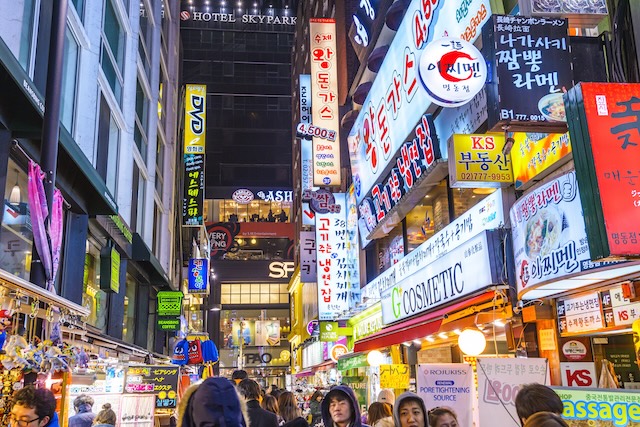
In Myeongdong, a consortium of Goldman Sachs and IGIS Asset Management was named preferred bidder last month for Timewalk Myeongdong, a mixed-use asset of 37,286 m² across nineteen above-ground floors, with a bid of around KRW 535 billion (about €338 million). The building already houses the 279-key ibis Ambassador Seoul Myeongdong on its upper floors; Goldman Sachs is reportedly studying the conversion of part of the mid-level office space into guest rooms, while also seeking to attract K-beauty and wellness brands.
The two consortiums, incidentally, went head to head on this deal before Goldman Sachs-IGIS won it, a sign of the fierce competition now under way between investors for this type of convertible asset.
A structural shortage fuelling the shift
This gradual – yet spectacular – shift towards conversion reflects a marked imbalance between supply and demand. South Korea welcomed 18.94 million foreign visitors in 2025, an all-time record, and the trend is continuing this year, with 10.71 million arrivals in the first half, up 21.3% year on year according to the Korea Tourism Organization.
Yet Seoul had only around 53,675 rooms last year, with openings limited to about 1,000 rooms a year since 2023, a quarter of the pre-pandemic pace, according to Cushman & Wakefield. The firm notes that 748 accommodation establishments closed in the capital between 2019 and 2026, against only 362 new openings over the same period, a contraction that has directly fed the current shortfall.
Operating indicators reflect this tension: average occupancy in Seoul hotels reached 79.2% in 2025, with international guests accounting for 71.2% of stays, for a RevPAR of around KRW 207,300 (about €131), up 67% on 2019. It is this scarcity that makes convertible assets – vacant or underused offices in tourist districts – particularly sought after.
A trend that extends beyond South Korea
Other conversion projects are currently under study in Seoul, according to the South Korean press: asset managers considering a hotel transformation are among the candidates to acquire Apro Square, put up for sale by JR Investment Management, while Pacific Asset Management and GIC are examining a hotel project in Seongsu-dong, and The Hyusik and K-Pax Asset Management are preparing a conversion in Yegwan-dong after acquiring a plot originally intended for an officetel.
The phenomenon is not unique to Asia. In Europe too, investors are accelerating the transformation of vacant offices into hotels, driven by solid tourist demand and an oversupplied office stock, confirming that conversion is emerging as a structural rather than cyclical response to the room shortage in major cities.
Our analysis – Office conversion gives investors faster access to a hotel market locked up by scarce land, but it shifts risk rather than removing it: on top of the usual hazards of hotel operation come the uncertainties specific to conversion works and permitting. The discipline with which investors cost these works, rather than revaluation potential alone, will determine which of these projects deliver on their promises.
At a glance by The Hospitality Tribune
Office-to-hotel conversion emerges as an asset class in Seoul
Only 1 of 12 recent feasibility studies for new hotel projects in Seoul proved viable, per Cushman & Wakefield Korea
BlueCove and CPPIB are converting Hongdae’s LC Tower into a 400-key hotel under Hilton’s Tempo brand
Goldman Sachs and IGIS Asset Management, preferred bidders for Timewalk Myeongdong (KRW 535 billion, about €338 million), plan a partial office-to-hotel conversion
Seoul hotel occupancy reached 79.2% in 2025, with RevPAR up 67% versus 2019
Office conversion takes about 2 years, versus several years for new-build hotel development