

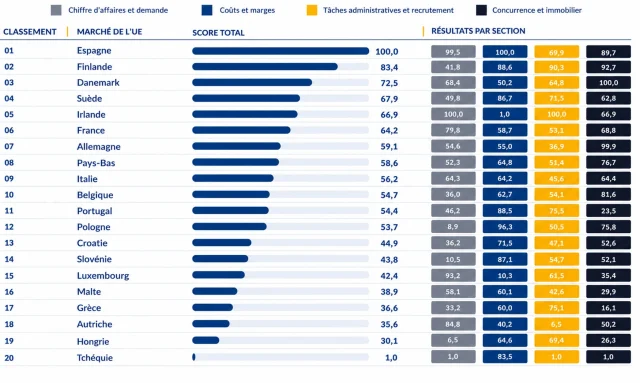


A ranking built on four pillars
The Restaurant Launch Report by Marketplace METRO assesses 20 European Union markets on nine factors. These are grouped into four sub-areas: revenue and demand, costs and margins, set-up and staffing, and competition and real estate.
Each factor and each sub-area carries equal weight in the overall score. The study thus provides reference values for comparing the baseline conditions for setting up from one country to another. The findings are not a substitute for a feasibility study or a site assessment.

Spain leads, driven by tourism demand
Spain achieves the maximum total score of 100. It combines strong demand, supported by both domestic consumption and tourism, with favourable cost factors. It scores 99.5 for demand and revenue and 100 for costs and margins.
According to the report, tourists spend more than €98 billion a year in Spain, the highest figure in the sample, ahead of France at €71 billion. The hospitality sector is among the main beneficiaries of this spending.
Finland ranks 2nd with a score of 83.4, ahead of Denmark (72.5), Sweden (67.9) and Ireland (66.9). Ireland’s profile is particularly uneven: the country achieves the maximum score for both demand and administrative procedures and recruitment, but only 1.0 for costs and margins.
🔗 Also on LTH Marriott International unveils “Future of Food 2027”: hotel dining refocuses on place
France, a mixed profile
France ranks 6th with a total score of 64.2. It scores 79.8 for demand and revenue, 58.7 for costs and margins, 53.1 for administrative procedures and recruitment, and 68.8 for competition and real estate.
Angélique Mhiri, Country Director of Marketplace METRO in France, summed up this position, explaining that France presents a mixed profile in the assessment: potential demand and revenue are stable, but performance on costs and margins is rather average. She noted that high rental pressure and recruitment constraints can slow down the launch of new concepts.

She added that the report puts these trade-offs into perspective across 20 European Union markets and provides a reliable starting point for assessing a business.
Energy and purchasing, a structural gap
In a highly energy-intensive sector, where margins depend heavily on purchasing strategy and cost control, lower spending levels are a structural advantage. According to Eurostat price data cited in the study, food and beverages are currently relatively inexpensive in Poland, Czechia, Hungary, Spain and the Netherlands.
The gaps are equally marked for electricity. The Nordic countries post prices of between €0.09 and €0.13 per kilowatt-hour, compared with around €0.16 in France. According to the report, these differences weigh directly on day-to-day operating costs and long-term profitability.
The case of Czechia shows, however, that controlled costs are not enough. The country scores 83.5 for costs and margins, yet finishes bottom of the ranking with a total score of 1.0, held back by its scores for demand, procedures and real estate.
Set-up and recruitment, two decisive variables
France and the Netherlands stand out for the simplicity of their set-up procedures. Entrepreneurs face lengthier processes in Germany, Luxembourg and Italy, however, where administrative constraints hinder market entry.
Recruitment reveals another divide. Vacant waiting staff positions are filled relatively quickly in Spain and Portugal, whereas labour shortages are considerably more pronounced in France, the Netherlands and Belgium. In these countries, new businesses may find it harder to build reliable operational teams.
Austria clearly illustrates the weight of these constraints. It scores highly for demand (84.8), but only 6.5 for administrative procedures and recruitment, and finishes in 18th place. Hungary (19th) and Czechia (20th) complete the bottom of the ranking.
A framework for operators
Analysis – For hotel groups and restaurant operators, this ranking shows that depth of demand alone does not guarantee a concept’s profitability. Energy costs, access to staff and real estate pressure weigh as heavily as customer volume when calculating the viability of an opening. Several markets followed by LTH bear this out, from the UAE restaurant barometer to Starbucks’ UK opening plan.
At a glance by The Hospitality Tribune
Marketplace METRO ranks the EU’s best markets to launch a restaurant
20 EU markets scored on nine factors: demand, costs, set-up and staffing, competition and real estate
Spain ranks first (score 100), ahead of Finland, Denmark, Sweden and Ireland
France ranks 6th (64.2), with strong demand held back by costs, rents and staff shortages
Tourists spend over €98bn a year in Spain, against €71bn in France
Electricity costs €0.09-0.13/kWh in the Nordics, against around €0.16/kWh in France