
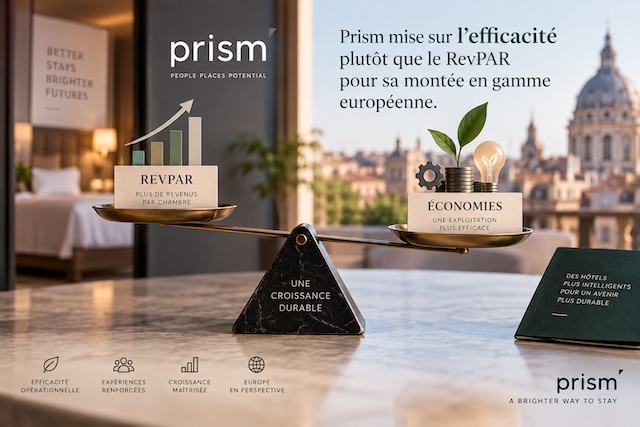


Prism, the Indian parent company of Oyo Hotels, formerly known as Oravel Stays, is not seeking growth through the performance of conventional hotel metrics. That is what its founder and CEO Ritesh Agarwal explained at the Annual Hotel Conference held in Manchester, where he presented the group’s strategy for moving upmarket in the UK and Europe.
A strategy built on efficiency rather than performance
According to Ritesh Agarwal, Prism is not aiming for a significant rise in RevPAR or pricing. Above all, the group is looking to absorb the complexity and high cost structures inherent to the upper segments, by focusing on greater operational efficiency, an exercise for which it considers the British market particularly well suited despite its current difficulties.

The executive stressed that the further up the scale a hotel sits, the greater the savings generated on each cost line. In his view, a company born as a technology start-up is particularly well placed to own, manage or distribute this type of property.
From Oyo to Prism: a multi-brand architecture taking shape
Prism now claims 28 brands covering the full spectrum of hospitality, from hotels to co-working spaces, via villas, furnished residences, and event and wedding organisation. The group changed its corporate identity in 2025, moving from Oyo to Prism, while retaining its original brand, positioned in the economy segment.
In December 2024, the group acquired G6 Hospitality, the parent company of the Motel 6 and Studio 6 brands, from Blackstone Real Estate for around €456.5 million ($525 million). Ritesh Agarwal noted that the group’s value proposition had gradually broadened: initially centred on distribution, then on revenue management and technology, it now includes the direct operation and management of properties, while relying on a single technology and operating platform.
It is in this spirit that Prism launched Sunday Hotels, its upscale four-star brand, which now has some 39 to 40 properties in the UK. The executive wants to develop partnerships there with institutional owner groups, with Prism then acting as brand manager and operator.
UK and Germany, anchor points of the European rollout
In the UK, Wales is the group’s largest market, with Cardiff its most important city, followed by Manchester. Prism also operates more than 30 Sunday Hotels properties in Germany.
Ritesh Agarwal confirmed that the group is now present in numerous markets where it positions itself as a partner, competitor and collaborator of traditional hospitality players, while stating that the group’s priority remains strengthening direct bookings.
Prism has recently strengthened its senior leadership teams in Europe to support this move upmarket in the upscale and upper-upscale segments, one of the group’s stated development priorities.
Relationships that differ by owner profile
The executive distinguished between two categories of owner with which Prism works: hotels and aparthotels on the one hand, and institutional and individual landlords on the other. In his view, the group has had more success with institutional owners, who value the strength of its balance sheet. Over the first nine months of the past financial year, Prism thus posted EBITDA of more than €174 million ($200 million).
Relationships with individual hoteliers take longer to build, but Ritesh Agarwal indicated that the group is also gaining ground there. Its partners in this segment are looking for operators able to sustain a pace that optimises the ratio between guest flow and cash flow, while also creating asset value.
The executive also noted that Prism has had to explain to owners in recent years that the group is no longer limited to the Oyo brand alone, a message he believes has been broadly well received given the group’s track record. He noted that the group’s mobile app had reached 100 million users, with several million bookings made every month, and highlighted how Prism’s trajectory runs counter to that of traditional hotel players: the group started from booking and technology and moved towards management and brand, rather than the other way round.
Artificial intelligence in the service of operations, not customer relations
Asked about artificial intelligence, Ritesh Agarwal said it could provide real help, while observing that a gap still remains between customers and the technology. He was more interested in its potential to improve hotel operations and make data more accessible.
In his view, AI approaches booking very differently from consumers, who focus on images, emotions and human contact. AI, by contrast, relies on structured data such as the last hundred guest reviews, the traveller’s profile, or the reasons that did or did not lead to a property being chosen.
At a glance by The Hospitality Tribune
Prism targets upscale growth in the UK and Europe through operational efficiency, not RevPAR gains
Prism (formerly Oravel Stays/Oyo) operates 28 brands spanning hotels, co-working, villas and events
Acquired G6 Hospitality (Motel 6, Studio 6) from Blackstone Real Estate for $525 million in December 2024
Sunday Hotels, its upscale brand, counts around 39-40 UK properties and 30+ in Germany
Wales (Cardiff) is Prism’s largest UK market, ahead of Manchester
Nine-month EBITDA topped $200 million, driving stronger traction with institutional owners