

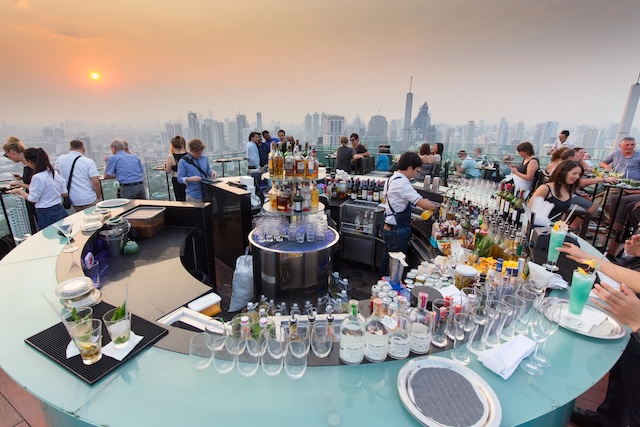


From hotel amenity to destination in its own right
Long regarded as a supplementary hotel facility, the rooftop has gradually become, in some properties, a genuine profit centre and sometimes a destination in its own right.
Panoramic views, music programmes, signature cocktails, dining and private events attract non-resident customers who may have no intention of staying at the hotel.

This transformation offers clear economic benefits. It enables operators to maximise the value of particularly attractive spaces, increase food and beverage revenue and strengthen the property’s profile among local customers.
However, success can quickly create its own constraints.
Seating capacity remains limited, the most desirable tables are in high demand, and some customers may occupy a space for extended periods while spending relatively little.
For operators, the challenge then becomes maximising the economic return from each available seat.
It is against this backdrop that minimum spending policies are becoming more common, particularly in the evenings, at weekends or during special events.
But this pursuit of profitability raises a question: should the rooftop be managed as an independent commercial operation or as an integral part of the hotel’s overall guest experience?
Minimum spending requirements: Permissible in France, subject to conditions
The issue was recently brought back into focus by an article published by Marmiton on 20 October 2026, examining the legality of minimum spending requirements in restaurants.
The publication highlighted the example of the Yalo rooftop in Ghent, Belgium, where a minimum spend of €65 per person is required for dinner in the covered section of the terrace. In return, guests may retain their table for the entire evening.
The objective is clear: to prevent highly sought-after tables from being occupied for several hours by customers ordering only a few drinks.
In France, the law does not establish a statutory minimum spending amount for restaurants.
According to an analysis by the legal department of UMIH, cited in the article, an establishment may impose a minimum spend in certain circumstances, particularly for group bookings, events, specific time slots or especially sought-after tables.
However, this possibility does not mean that restaurant operators enjoy unrestricted discretion.
The essential distinction lies in informing customers in advance and in the nature of the service being offered.
A minimum spend disclosed at the time of booking, clearly associated with a particular package or service and accepted by the customer, may constitute a contractual condition.
Conversely, demanding additional expenditure when presenting the bill in order to reach a threshold that was never disclosed beforehand is legally questionable.
Similarly, a general minimum spending requirement in a bar or café must be assessed against consumer information rules, commercial practices regulations and provisions governing refusal to sell without legitimate grounds.
For operators, the prudent approach is therefore to specify all applicable conditions before a booking is made: the amount per person or per table, relevant time slots, what is included in the minimum spend and any particular booking arrangements.
However, the legality of such a policy does not, in itself, establish its commercial relevance.
Revenue per available seat: An understandable economic rationale
In a busy rooftop venue, the scarcity of available seating is a major constraint.
Unlike a traditional restaurant, where the duration of a meal generally provides a relatively predictable table occupancy period, a rooftop may welcome customers who simply want to enjoy the view, have a drink or spend part of the evening there.
This diversity of uses complicates capacity management.
A table occupied for three hours by two customers each ordering one drink clearly does not generate the same revenue as a table accommodating four guests for a full dinner.
A minimum spend helps secure a certain level of revenue from the most sought-after reservations.
It can also facilitate service organisation, reduce prolonged table occupancy and improve revenue predictability.
However, this approach has limitations.
An excessively high threshold may discourage occasional customers, reduce spontaneous visits and give the venue an overly exclusive or transactional image.
More importantly, it may encourage operators to prioritise immediate revenue per table at the expense of customer satisfaction and loyalty.
A minimum spend is therefore a capacity management tool, not a revenue management strategy in its own right.
Business hotels: When customer groups no longer seek the same experience
The issue takes on particular significance when the rooftop forms part of a hotel.
In a four- or five-star business hotel, resident guests generally expect a coherent range of services: comfort, sleep quality, tranquillity, security, ease of movement throughout the property and high standards of service.
Leisure travellers and families may share these expectations while also wishing to enjoy the hotel’s dining and relaxation facilities.
Yet a rooftop that has become a lively entertainment destination may attract non-resident customers with very different motivations.
Amplified music, DJ sets, cocktails, a vibrant atmosphere and late-night activity may be among the venue’s principal selling points.
This is not about setting generations against one another or passing judgement on the behaviour of local customers.
The issue is the compatibility of different uses and expectations.
A festive atmosphere may be entirely consistent with the positioning of a lifestyle hotel. Conversely, it may conflict with the promise made by a traditional business hotel or a family-oriented property.
When these two environments overlap without effective operational planning, the consequences can extend well beyond the rooftop itself.
Noise disturbance in guestrooms, overcrowded lifts, congested lobbies, difficulties controlling access, queues and changes to the property’s overall atmosphere can all affect the experience of resident guests.
The hotel then faces a paradox: the success of an activity designed to increase revenue may undermine the quality of its core product: accommodation.

Resident guests sometimes excluded from an amenity that enhances the value of their stay
This contradiction becomes particularly apparent when hotel guests are unable to access the rooftop because no space is available.
In some properties, the panoramic terrace is a prominent feature of the hotel’s marketing communications.
It contributes to the property’s image, appeal and the perceived value of a stay.
A guest may therefore choose a hotel partly because of its rooftop, only to discover that the venue is primarily occupied by non-residents or subject to restrictive booking conditions.
Applying a minimum spend to resident guests then raises questions about commercial consistency.
Admittedly, paying for a room does not automatically confer an unrestricted right to access every food and beverage outlet within the hotel.
However, when the rooftop is presented as an important component of the hotel experience, accessibility becomes a matter of guest satisfaction and the credibility of the property’s commercial promise.
The situation may be particularly frustrating for a business traveller wishing to enjoy a drink after a working day, or for a family discovering that access to the terrace requires substantial minimum expenditure.
The hotel must therefore balance the interests of two customer groups whose economic contributions cannot be measured in the same way.
Non-resident customers primarily generate restaurant and bar revenue.
Resident guests contribute room revenue and potentially income from other services, while also influencing the property’s reputation and customer loyalty.
Comparing these two groups solely on the basis of their rooftop spending overlooks an essential part of hotel economics.
Segmenting uses rather than arbitrarily differentiating prices
The solution does not necessarily involve eliminating minimum spending requirements altogether.
Instead, it may involve more sophisticated management of space and booking conditions.
For example, a hotel could reserve certain time slots or seating allocations for resident guests, distinguish dining areas from spaces intended for lighter refreshments, or apply a minimum spend only to the most desirable tables.
Music programming could also vary according to the time of day, with quieter atmospheres earlier in the evening and a more festive offering during clearly identified periods.
In hotels with suitable infrastructure, separate access routes, dedicated lifts and acoustic treatment can help minimise interaction between different customer groups.
However, these solutions are not always feasible, particularly in older buildings or where vertical circulation routes are shared.
The real challenge is therefore to anticipate the operating model from the rooftop’s initial design stage.
A terrace designed to attract a festive, non-resident audience cannot be operated according to the same principles as a relaxation area intended primarily for hotel residents.
The risk of assessing financial performance solely at F&B department level
For general managers and hotel owners, one of the principal risks is assessing rooftop performance exclusively through its food and beverage results.
A rooftop may generate substantial revenue, achieve a healthy operating margin and attract consistently high footfall.
Yet these indicators do not capture its entire economic contribution to the property.
If its operation generates complaints, guest compensation, room changes, negative reviews or reduced loyalty, some of its apparent profitability may be offset by adverse effects on the accommodation business.
These consequences are often more difficult to quantify than the bar’s daily takings.
Nevertheless, they can have a lasting effect on perceptions of the hotel and potentially on its ability to maintain its pricing position.
A rooftop that is profitable at departmental level does not necessarily create value for the hotel asset as a whole.
This distinction is particularly important when the rooftop is operated by a third party or under an arrangement in which the bar’s commercial objectives and those of the hotel are not fully aligned.
Profitability must therefore be assessed at property level, not solely at rooftop level.
LTH Analysis | Does the rooftop serve the hotel, or does the hotel serve its rooftop?
Minimum spending requirements are an operational response to a genuine constraint: the scarcity of available seating in highly sought-after spaces.
However, they do not resolve the fundamental problem that a successful rooftop may create: the coexistence of customer groups with potentially incompatible expectations within the same hotel property.
In a lifestyle hotel that openly embraces a festive positioning, the rooftop can become a defining element of the brand identity and enhance the appeal of the entire property.
In a business hotel or a traditional upscale property, the same strategy may have the opposite effect if it compromises tranquillity, service efficiency or access to facilities for resident guests.
For owners and investors, performance should therefore not be assessed solely in terms of rooftop revenue or operating margin.
It should also take account of the rooftop’s contribution to the property’s overall value: commercial appeal, resident guest satisfaction, reputation, loyalty, accommodation performance and the management of disturbances.
This assessment also requires a distinction between a venue’s immediate commercial success and its long-term compatibility with the hotel’s positioning.
Music programming that attracts local customers may increase bar footfall while undermining the experience of a business traveller seeking rest.
A minimum spend may improve the revenue generated by a table while reinforcing a resident guest’s sense of exclusion from what they perceive as a hotel amenity.
The economic success of a rooftop cannot therefore be separated from its integration into the property’s overall guest experience.
Ultimately, the real trade-off is not between profitability and hospitality. It is about achieving profitability that remains consistent with the promise made to guests.
And the strategic question remains: is the rooftop designed to support the hotel’s positioning, or does the hotel ultimately become a victim of its rooftop’s success?
At a Glance
Trend: Hotel rooftops increasingly operate as standalone destinations attracting external customers.
Minimum spending: Possible in France under certain conditions, particularly where terms are clearly disclosed and agreed in advance.
Financial rationale: Managing limited seating capacity and protecting revenue per available seat.
Guest mix: Potential conflicts between festive local audiences and business, leisure or family hotel guests.
Operational challenges: Noise, shared circulation, access restrictions and guest dissatisfaction.
Hotel strategy: Differentiate uses, time slots and reservation conditions rather than relying solely on minimum spending.
Asset management: Evaluate the rooftop’s contribution to overall hotel profitability, not just F&B results.
LTH perspective: A successful rooftop must remain consistent with the hotel’s positioning and guest experience.