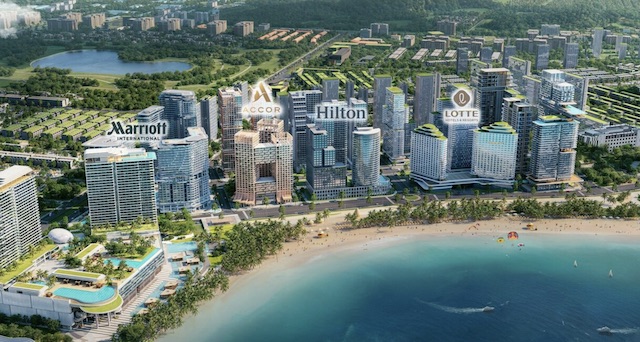


Seventeen hotel towers built simultaneously
On the Vietnamese island of Phu Quoc, the future hotel boulevard of Ruby Beach, also known as Red Earth Beach, is gradually taking shape in the immediate vicinity of the infrastructure planned to host APEC 2027.
According to the Vietnamese daily An ninh Thủ đô, in an article published on 20 October 2026, work is continuing around the clock, with a particularly ambitious pace of progress: one floor built every 3.5 days on some buildings.

Thousands of engineers, technicians and construction workers have been mobilised to keep to the schedule.
The programme comprises 17 hotel towers, whose delivery is intended to strengthen Phu Quoc’s accommodation capacity before the APEC international meetings take place.
The development sits close to the future convention and exhibition centre, as well as a multipurpose performance venue.
The aim is to create an integrated district bringing together accommodation, international meetings, cultural events and tourism activities.
Marriott International: JW Marriott Marquis and W Hotels lead the way
Among the most advanced projects are two properties set to operate under the JW Marriott Marquis and W Hotels brands, both part of the Marriott International portfolio.
The two brands address distinct positionings.
JW Marriott Marquis is associated with large-capacity upscale hospitality, particularly suited to international travellers and business clientele.
W Hotels favours a lifestyle approach built around design, food and beverage, entertainment and experiences.
Lotte Hotels: three towers to strengthen the Korean presence
South Korean group Lotte Hotels is also among the operators set to take part in the development of Ruby Beach.
Lotte Hotels’ presence reflects, in particular, the importance of the South Korean market for Phu Quoc.
According to data cited by An ninh Thủ đô, flights between Incheon and Phu Quoc recorded an average load factor of around 85.5% in July 2026.
Eastar Jet and Jeju Air reportedly posted load factors of 93.9% and 93.6% respectively on the route.
These figures illustrate the commercial appeal of the Korean market, although on their own they are not enough to establish the occupancy and profitability outlook for the future hotels.
Grand Hyatt, Conrad, Hilton, Le Méridien and SO/ also announced
Other international brands are mentioned among the projects under construction at Ruby Beach.
The programme notably includes buildings set to operate under the Grand Hyatt, Le Méridien, The Luxury Collection, Hilton, Conrad and SO/ brands, as well as a brand referred to as ‘Gallery’ in the Vietnamese article.
These properties are at different stages of construction.
The announced presence of brands from several major international groups reflects a desire to build a diversified hotel offering spanning luxury, upscale and lifestyle.
This concentration also raises a differentiation challenge.
Within a single district, several international hotels will need to develop sufficiently distinct commercial propositions to avoid competition based solely on price.
The split of clientele between leisure stays, business travel, events, groups and international delegations will therefore be an important factor in their future performance.
Seven thousand rooms in a first phase, with up to 20,000 envisaged
Once the 17 towers are complete, Ruby Beach is expected to offer around 7,000 rooms in its first phase.
Subsequent developments could bring the complex’s total capacity to nearly 20,000 rooms, according to projections reported by the Vietnamese outlet.
These figures place the programme on an unusual scale for a hotel development concentrated in a single geographical area.
The first phase alone would represent a theoretical capacity of 14,000 people, based on two occupants per room and excluding special configurations.
This rapid increase in supply is intended to meet the needs of APEC 2027, but also to support the development of leisure tourism and the meetings, conventions and events market.
It does, however, require transport infrastructure, services, public amenities and recruitment capacity to keep pace with the openings.

APEC 2027 as an investment accelerator
In 2027, Vietnam will host the Asia-Pacific Economic Cooperation meetings, bringing together 21 member economies.
The high-level week held in Phu Quoc is expected to attract between 10,000 and 12,000 delegates, according to the forecasts cited.
This deadline is a powerful accelerator for local infrastructure.
The immediate proximity of the hotels, the convention centre and the performance venues should make it easier to move around and to organise high-attendance international events.
The programme’s significance nonetheless extends beyond its capacity to accommodate delegations.
The authorities and investors are also seeking to equip Phu Quoc with infrastructure capable of strengthening its competitiveness in the regional market for conventions and major events.
The challenge will be to sustain this activity after 2027, once the exceptional demand generated by the summit has gone.
A tourism destination already growing strongly
The programme’s prospects rest on a significant rise in visitor numbers to Phu Quoc.
According to data reported by An ninh Thủ đô, the island welcomed more than 8.57 million visitors in the first nine months of 2026, up 30.5% year on year.
These included more than 1.92 million international visitors.
This momentum is a positive signal for investors.
It does not, however, guarantee that all the new hotel capacity can be absorbed immediately at the expected price levels.
Developments in air connectivity, seasonality, the purchasing power of source markets and the growth of MICE demand will be decisive.
The simultaneous opening of several thousand rooms could also trigger a period of particularly intense commercial competition between properties.
LTH Analysis | APEC 2027 can accelerate construction, but cannot guarantee profitability
The Ruby Beach development illustrates a hotel investment model in which a major international event serves as the catalyst for transforming a destination.
The APEC 2027 deadline imposes a precise timetable, mobilises investors and accelerates the delivery of infrastructure that might otherwise have been developed over a much longer period.
The logic is understandable: to host large delegations and compete with international convention destinations, Phu Quoc needs accommodation, transport and event facilities all at once.
But the success of the build does not determine the economic success of the hotels.
The first question concerns the absorption of supply.
With around 7,000 rooms expected in a first phase, followed by a potential capacity of close to 20,000 rooms in the longer term, the market will need to generate enough recurring demand to support occupancy rates and average daily rates.
APEC will be a one-off event. The financial performance of the assets, by contrast, will have to be secured over many years.
The second question concerns brand differentiation.
The coexistence of JW Marriott Marquis, W Hotels, Grand Hyatt, Lotte Hotels, Hilton, Conrad, Le Méridien and SO/ may strengthen the destination’s international visibility. But it also introduces direct competition between properties sharing the same environment and, potentially, some of the same customer segments.
The presence of major brands therefore does not remove the need for an individualised commercial strategy, particularly with regard to source markets, distribution channels, food and beverage, and events.
Finally, the third question relates to return on invested capital.
Construction speed is currently a highly visible indicator. For owners and investors, however, the real measures of success will be final development costs, ramp-up periods, operating profitability and the ability to sustain asset values over time.
Growth in the MICE market could contribute to this equation, provided Phu Quoc succeeds in regularly attracting international conventions, conferences and events after 2027.
APEC can create the conditions for a new international hotel destination. It cannot, on its own, secure its economic viability.
At a Glance
Location: Ruby Beach / Red Earth Beach, Phu Quoc, Vietnam.
Development: 17 hotel towers under simultaneous construction.
Initial capacity: Approximately 7,000 guestrooms.
Long-term potential: Nearly 20,000 guestrooms across subsequent phases.
Brands mentioned: JW Marriott Marquis, W Hotels, Grand Hyatt, Lotte Hotels, Hilton, Conrad, Le Méridien, The Luxury Collection and SO/.
Construction pace: Target of one floor every 3.5 days on parts of the project.
Major catalyst: APEC 2027, with an estimated 10,000–12,000 delegates.
Tourism demand: Over 8.57 million visitors to Phu Quoc during the first nine months of 2026, according to figures reported locally.
Strategic challenge: Absorbing substantial new hotel supply while building a sustainable MICE and leisure destination.
LTH perspective: Construction speed and global brand