

Quiz available at the end of the article
Beyond five stars: a blurred distinction
There is no universally accepted definition of a five-star hotel. From one country to another, and sometimes even between individual properties, the guest experience can vary considerably despite an identical classification.
Hotel groups partly address this issue by positioning their brands within categories such as “luxury”, “lifestyle” or “premium”. According to Euronews, however, these classifications do not necessarily guarantee a consistent standard, even between properties within the same segment.
France is something of an exception, with its Palace distinction, whose 2026 selection comprises 33 properties, including six newly awarded the designation. Elsewhere, operational execution makes a far greater difference than formal classification.
The 10 defining characteristics of ultra-luxury hospitality
Euronews identifies ten indicators that distinguish an ultra-luxury property:
- Seated check-in, in a lounge with a welcome drink, while luggage is taken directly to the room.
- Unpacking and packing services provided by a butler, particularly for guests staying in suites.
- A dedicated menu for each service: pillow selections, baths prepared on request and work equipment.
- Complimentary minibar and laundry services included in the room rate.
- Enhanced evening turndown service, incorporating thoughtful touches related to the day’s activities.
- Staff who know every guest’s name and preferences, including across repeat stays.
- Personalised items, from embroidered linen to stationery bearing the guest’s name.
- A hotel operating around the guest’s schedule, with flexible arrival, departure and dining times.
- Needs anticipated before guests have even expressed them.
- A hotel car available for guests’ journeys.
Service that anticipates rather than responds
For Dianne Apen-Sadler, service quality at the finest properties rests on two characteristics: it is discreet and does not wait to be requested. Staff remain constantly available without making their presence felt, often anticipating needs that guests have not yet articulated.
The journalist cites practical examples: an umbrella offered before a guest heads outside, mosquito repellent placed in the room, a tube of toothpaste replaced before it runs out, or aloe vera left in the bathroom after a member of staff overhears a guest mentioning sunburn.
A frictionless guest journey
Arrival illustrates this philosophy. At ultra-luxury properties, time spent at the reception desk is reduced to a minimum before guests are seated in a lounge for a simplified check-in procedure, accompanied by fresh juice or a glass of champagne depending on the time of day. Meanwhile, luggage is delivered directly to the room, and some hotels offer in-suite check-in.
Service can extend even further. St. Regis, which assigns butlers to guests staying in suites, offers unpacking and packing services. The journalist notes, however, that this particular service does not appeal to every type of traveller.
Personalisation as an operating system
Personalisation takes the form of an expanding range of service menus: pillow menus, baths prepared on request and even, at Four Seasons Resort Bali at Jimbaran Bay, a “work from hotel” menu allowing guests to borrow a keyboard or computer monitor.
In the evening, turndown service goes beyond closing blackout curtains and adjusting the lighting. The most exclusive brands add thoughtful touches connected to the day’s activities when these have been booked through the hotel. Following a visit to a tea plantation in Sri Lanka, Dianne Apen-Sadler was presented with tea and handcrafted cups.
Guest recognition is another pillar of this approach. From doormen to waiters, staff know the names of guests staying at the property, which can also eliminate the need to sign bills. Preferences, from a favourite coffee to a dislike of coriander, are passed on from one stay to the next. According to Euronews, some properties even consult guests’ social media profiles to personalise their welcome, including on a first visit.
Personalisation can also extend to physical objects. The Peninsula Beverly Hills offers pillows embroidered with guests’ names, as well as monogrammed towels for dogs. Rosewood, meanwhile, creates personalised stationery, including envelopes and business cards, for guests staying “in residence”. At Rosewood, this commitment to consistency is also reflected in its organisation: the group has recently structured its cross-functional leadership around operations, retail and wellness.
The guest’s timetable, not the hotel’s
Where a conventional hotel imposes fixed check-in, check-out and outlet opening times, ultra-luxury hospitality adapts to the guest’s schedule. At The Peninsula, guests can check in from 6 am and check out as late as 10 pm as standard.
According to Euronews, this flexibility depends on a deliberate operational decision: many high-end properties maintain occupancy levels significantly below 100%, allowing them to accommodate arrivals and departures at almost any time. Where this is not possible, day-use rooms are made available.
Dining follows the same principle. At Bvlgari Resort Bali, in-villa breakfast can be ordered at any time, once per day, from an extensive menu. Housekeeping also adapts to guests’ movements rather than following a rigid schedule, sometimes servicing rooms several times a day.
Inclusion rather than additional charges
Another distinguishing feature identified by Euronews is the inclusion of services that would traditionally incur additional charges. Several ultra-luxury properties include the minibar, such as ÀNI Thailand, which provides local products and fresh coconuts every day. At Bvlgari, laundry is included in the stay.
For the journalist, these decisions reflect a straightforward principle: a few additional euros make little difference to a hotel’s financial performance but can irritate guests who have already paid a substantial room rate. This trade-off is particularly significant given that hospitality remains the least profitable segment of the luxury industry.
Mobility as part of the experience
Some brands extend their service beyond the property by providing a hotel car. Aman New York offers complimentary drop-offs within a radius of approximately 32 kilometres, while The Peninsula London provides the same service within approximately 3 kilometres.
In London, Hotel Café Royal goes a step further by allowing guests to drive sports cars, such as a Porsche 911 Turbo or Ferrari 488, during their stay.
LTH Analysis | A demanding operational model
These service standards are not simply expressions of attentiveness towards guests. They require deliberate economic trade-offs: sacrificing some occupancy to preserve flexibility, absorbing services into the room rate that would be charged separately elsewhere, and investing in teams capable of developing a detailed understanding of each guest.
This approach is supported by strong demand. The Virtuoso network reported a 20.8% increase in sales in 2026, with an average daily rate (ADR) among partner hotels approaching €1,711 in June, indicating that ultra-high-net-worth travellers are prepared to pay for a genuinely differentiated experience.
One concern remains: collecting information about guests, particularly through social media, places personalisation close to the boundary of intrusion. For operators, the challenge is to remain discreet even in the way such data is used.
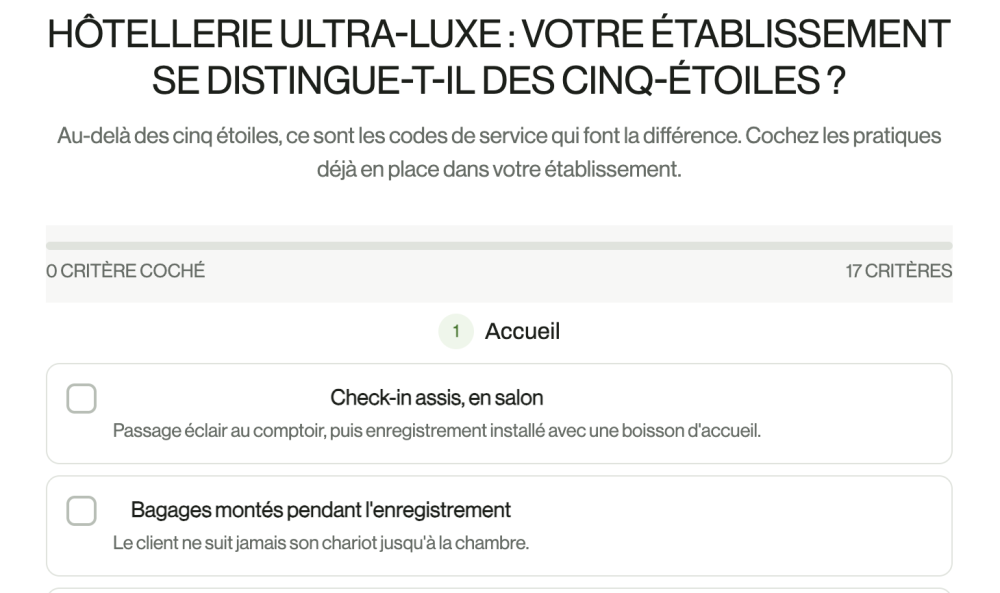
Auto-diagnostic LTHHôtellerie ultra-luxe : votre établissement se distingue-t-il des cinq-étoiles ?
Au-delà des cinq étoiles, ce sont les codes de service qui font la différence. Cochez les pratiques déjà en place dans votre établissement.
Quiz éditorial de La Tribune de l'Hôtellerie, inspiré des pratiques relevées par Euronews (3 novembre 2026) dans les établissements ultra-luxe. Ce test n'a aucune valeur de classement officiel. Lire l'article : les dix signes qui distinguent l'hôtellerie ultra-luxe des cinq-étoiles
Hôtellerie ultra-luxe : votre établissement se distingue-t-il des cinq-étoiles ?
Au-delà des cinq étoiles, ce sont les codes de service qui font la différence. Cochez les pratiques déjà en place dans votre établissement.
Quiz éditorial de La Tribune de l'Hôtellerie, inspiré des pratiques relevées par Euronews (3 novembre 2026) dans les établissements ultra-luxe. Ce test n'a aucune valeur de classement officiel. Lire l'article : les dix signes qui distinguent l'hôtellerie ultra-luxe des cinq-étoiles
At a Glance by The Hospitality Tribune
What sets ultra-luxury hotels apart beyond five stars
Service: Defined by discretion and anticipation rather than design or location alone.
Flexible timing: The Peninsula offers 6 am check-in and 10 pm check-out as standard.
Occupancy strategy: Many high-end properties maintain occupancy well below 100% to accommodate flexible arrival and departure times.
Inclusive benefits: Complimentary minibar at ÀNI Thailand and laundry included at Bvlgari.
Hotel cars: Complimentary drop-offs within approximately 20 miles at Aman New York and 2 miles at The Peninsula London.