
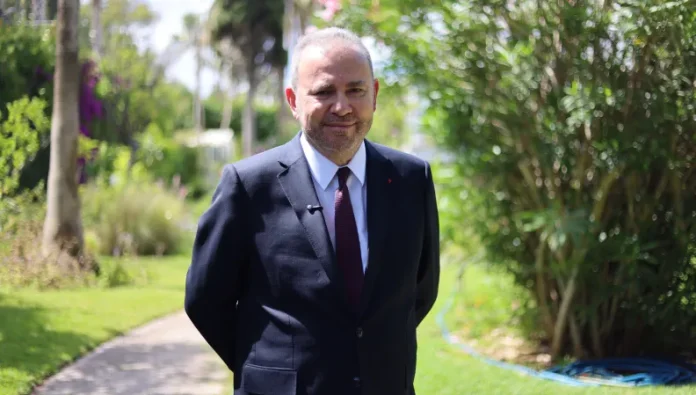


On 11 May 2026, Christophe Lecourtier took up his role as chief executive of the AFD group, succeeding Rémy Rioux, who had held the post since 2016. The appointment, put forward by the President of the Republic and confirmed by a large majority of parliamentarians, comes at a time of geopolitical upheaval and deepening interdependence between France, Europe and the rest of the world.
Addressing Parliament, the new chief executive set out a narrower vision of the institution’s role, stating that in today’s world he believes the AFD is more necessary than ever to defend a certain idea of France, project its values and promote the mutual interests binding it to the rest of the world, while adding that the agency must be selective, transparent and exemplary — describing the AFD’s ambition as being a major French agency rather than a small World Bank. [Flag: rendered as reported speech pending verification of an official English-language original]

This strategic shift is being translated into a concentration of resources on the geographies and sectors where impact is most tangible, closer alignment with French foreign policy, and streamlined procedures. Christophe Lecourtier completed his leadership team over the course of summer 2026: Quiterie Pincent was appointed Executive Director for Mobilisation, Partnerships and Communication on 6 July, Mathieu Vasseur became Executive Director for Geographies on 13 July, and Laurence Breton-Moyet was named Executive Director of the AFD Group Campus on 24 August. These three appointments, all internal to the AFD group, brought female representation on the executive committee to 40%.
The reshuffle continued in September with two appointments to communications and economic mobilisation leadership. Benoît Verdeaux took over as the group’s Communications Director on 1 September, following five years in French diplomacy, including as First Counsellor at the French Embassy in Côte d’Ivoire. On 10 September, Vincent Toussaint was appointed Deputy Executive Director for Mobilisation, Partnerships and Communication, with particular responsibility for economic diplomacy; with more than twenty-five years in France’s international economic action, he had headed the Regional Economic Service at the French Embassy in Morocco since 2023, where he oversaw major infrastructure projects. According to the AFD, his appointment is intended to strengthen the mobilisation of French businesses in support of the group’s strategic repositioning.
Beyond this governance reshuffle, the AFD group’s funding history reveals a less visible constant: for more than fifteen years, tourism assets and tourism-related training programmes have regularly featured among the projects the institution supports, across several continents. These interventions, mostly dating back some years, trace a geography in which hotels, tourism transport infrastructure and vocational training are treated as fully-fledged levers of economic development, on a par with health or education.
Morocco: Taghazout Bay, an integrated resort backed by a €20 million loan
The first example of this discreet but sustained pattern dates to December 2014, when the AFD granted a €20 million loan to the Company d’Aménagement et de Promotion de la Station de Taghazout (SAPST) to partially finance Taghazout Bay, a 615-hectare beachfront resort north of Agadir. [Flag: internal link points to LTH French URL; no confirmed THT English equivalent found]
The site, structured as a public-private partnership (75% public, 25% private), includes tourism and residential infrastructure, a medina and an argan-oil cooperative. The first establishments opened in 2015, including a hotel with an affiliated golf academy and a surf village. The total cost of the programme stands at 10 billion dirhams, or roughly €917 million (rate as of 15 September 2026: €1 = MAD 10.90), of which 6 billion dirhams (around €550 million) was borne directly by SAPST.

SAPST was the first structure worldwide to obtain “HQE aménagement” (high environmental quality) certification, limiting the actually built-up share of the site to 10%. The AFD estimates the project has generated 20,000 direct and indirect jobs in the Agadir region. [Flag: unverified figure carried through from source]
A hotel school born from a repurposed hotel in the Dominican Republic
In the Dominican Republic, the AFD granted a sovereign loan of €3.9 million in June 2013 to the Instituto de Formación Técnico Profesional (INFOTEP) to establish a hospitality and catering training centre in Higüey, in the east of the country — a region that receives half of the Dominican Republic’s tourists. [Flag: internal link points to LTH French URL; no confirmed THT English equivalent found]
The centre was established in a repurposed hotel and offers initial and continuing training, developed in partnership with the École Hôtelière d’Avignon. The financing also enabled an upgrade of the bakery training unit at INFOTEP’s Santo Domingo centre. INFOTEP, a public body founded in 1980, operates 205 centres and has trained more than 2 million people since its creation, with an annual intake of 350,000 trainees.
The project addresses a competitiveness challenge for the destination: the Dominican Republic’s unemployment rate stood at around 14% when the programme was launched. [Flag: unverified figure carried through from source] The AFD expects it to improve young people’s access to better-paid jobs in hospitality and catering, while strengthening the country’s tourism competitiveness.
Tourism, a quiet lever in the AFD’s strategy
Analysis — Neither Taghazout Bay nor the Higüey training centre are recent announcements: they are commitments initiated in 2014 and 2013 respectively, whose effects play out over the long term. They nonetheless illustrate a less visible dimension of the AFD’s work, at a time when the new leadership is championing the ambition of a more selective and more transparent agency.
For international hospitality players, such public financing represents a potential channel in markets where access to conventional bank credit remains constrained, particularly for tourism development infrastructure or vocational training schemes. It remains to be seen whether the strategic repositioning launched by Christophe Lecourtier will keep tourism among the sectors deemed high-impact, or relegate it to the margins of a mandate refocused on health, education, climate and security.
At a glance by The Hospitality Tribune
How France’s development agency quietly finances hotel and tourism projects
Christophe Lecourtier became AFD’s CEO on 11 May 2026, succeeding Rémy Rioux, with a strategic shift toward selectivity and tangible impact
AFD granted a €20 million loan (2014) to Morocco’s Taghazout Bay, a 615-hectare beach resort near Agadir including a hotel, golf academy and surf village
Taghazout Bay’s total investment reaches roughly €917 million, expected to generate 20,000 direct and indirect jobs
A €3.9 million sovereign loan (2013) funded a hospitality training school in Higüey, Dominican Republic, built in a repurposed hotel with France’s École hôtelière d’Avignon
AFD’s executive committee was renewed in summer 2026, raising female representation to 40%