

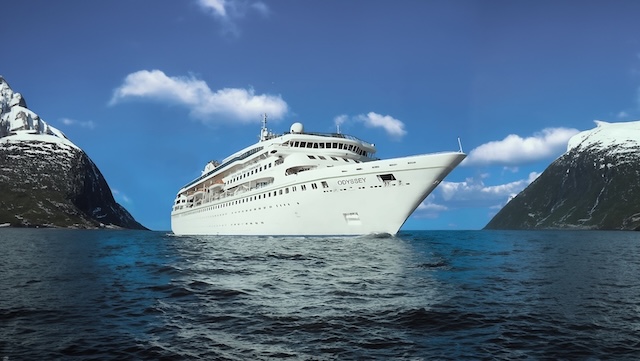


Permanent residence, an endless voyage around the world, monthly fees guaranteed on a ship not yet in service: the sirens’ song was hard to resist. But not everyone can be Odysseus. Homer’s hero had himself bound to the mast so that he could listen without yielding; the Odyssey’s residents, for their part, lent an ear and reached for their chequebooks. In fairness, the ship had no mast.
They might have pondered another episode of the tale. Calypso offered Odysseus immortality to keep him on her island, and he chose to go home. Promised eternal life at sea, the Odyssey’s residents ended up on a quay in Sihanoukville, suitcases in hand, with seven hours to find their Ithaca.
Odyssey: an epic voyage comes unstuck
The name promised an epic voyage. Instead, it ended on a Cambodian quayside. Odyssey had docked on 23 October at the Autonomous Port of Sihanoukville, Cambodia’s largest port, carrying 203 passengers and 156 crew members, for a five-day stopover before a scheduled departure for Vietnam.

On the morning of 27 October, an internal notice gave residents until 2 p.m., approximately seven hours, to pack their belongings and leave the ship, according to Cambodianess. Some have since flown out of the country, while others have remained in the city awaiting a solution.
Villa Vie Residences, a Florida-based company, says it is coordinating the disembarkation and seeking temporary accommodation. It has announced plans to restructure and recapitalise within the next 60 days, while acknowledging that no financing has been finalised and no outcome is guaranteed.
Fuel prices trigger a crisis that had been building
The operator cites “exceptional increases” in fuel prices linked to the conflict in the Middle East and the war in Iran. According to the company, average monthly fuel expenditure per cabin has risen from approximately €1,615 to an estimated range of €5,380 to €7,180 in certain parts of Asia.
Villa Vie says it slowed its itinerary and extended port calls to reduce consumption, but was unable to offset the increase. The company explains that it cannot pass a cost increase of this magnitude on to residents and considers the resulting deficit to have made its operating model financially unsustainable.

Yet the difficulties appear to have predated the latest crisis. According to specialist publication Cruise News, residents had already been asked in August to contribute towards financing 650 tonnes of fuel. The same source reports that a meeting held in September sought to raise the equivalent of approximately €900,000 to enable the ship to leave Ha Long Bay.
An enticing promise, with the consequences borne by travellers
Launched from Belfast in autumn 2024, Odyssey offered a hybrid model combining hospitality and residential property: the purchase or long-term rental of a cabin, accompanied by monthly fees covering onboard services, for a continuous round-the-world voyage completed every three and a half years. The 195-metre vessel, formerly Fred. Olsen Cruise Lines’ Braemar and built in the early 1990s, can accommodate 650 people.
Options ranged from an inside cabin priced at approximately €108,000 to “villa suites” costing close to €395,000, with monthly fees potentially reaching almost €9,900. The Endless Horizons programme, meanwhile, promised permanent residence aboard the ship in exchange for a single payment, initially set at approximately €314,000.
In late July 2026, three months before the suspension, Villa Vie announced a second vessel, Legacy, for early 2029, claiming that more than 85% of Odyssey’s residences had been sold. Holders of the lifetime programme were to be eligible for transfer to the new ship at no additional cost, while 24 new buyers were guaranteed that Odyssey’s monthly fees would be maintained aboard Legacy, despite projected costs being approximately 30% higher.
The concept of living at sea is also attracting luxury operators such as Four Seasons, which will introduce Yacht Residential Suites aboard Four Seasons II in 2028. However, those offerings are based on paid stays rather than a perpetual right of occupancy purchased through a single payment.
LTH In-Depth Analysis | From Fluctuat nec mergitur to Tranquillus et mergitur
Analysis – “Tossed by the waves, but never sunk”: the motto of Paris could have been Odyssey’s own throughout its two years of sailing around the world. The paradox is that the vessel did not succumb to a storm. It foundered alongside the quay, in calm seas. Tranquillus et mergitur: motionless, yet overwhelmed by its costs.
The story goes beyond the difficulties of a financially vulnerable ship operator. A service sold at a fixed price, without limits on duration or quantity, should in principle leave the provider bearing the risk of rising costs. In practice, when the operator can no longer absorb those costs, it is the customer who ultimately pays.
Lifetime packages, unlimited subscriptions, all-inclusive holidays and all-you-can-eat buffets: these offers appeal through their simplicity. Yet they rest on a fragile equation, because the price is fixed at the outset while the costs of supplies, energy, labour and maintenance continue to change over time.
When costs spiral, the available adjustments are familiar, and all ultimately affect the customer: reduced services, deteriorating quality, restricted access or demands for additional contributions. In the worst case, customers lose the service altogether and the money they have already paid is placed at risk. All-inclusive resorts exposed to the squeeze caused by rising fuel costs face the same underlying mechanism, albeit on a smaller scale.
Odyssey represents an extreme example. A vessel more than 30 years old, operating at approximately one-third of its passenger capacity when services were suspended, depended on a resource whose price was beyond its control. Some industry observers have also pointed to an apparent absence of fuel-price hedging, a practice commonly used by major cruise operators and airlines.
For hoteliers and investors, the lesson is clear. A “lifetime” or “unlimited” offering is sustainable only when supported by strong financial resources, explicit price-indexation clauses and protection against the most volatile costs. Without these safeguards, even a ship in the calmest waters can sink.
At a Glance
Development: A historic building on Piazza della Loggia in Brescia will be converted into a five-star boutique hotel.
Capacity: Approximately 45 rooms and suites.
Owner and investor: The Fasoli family, behind Gioielleria Fasoli SpA.
Operator: LHM, led by CEO Cristina Paini, selected following an advisory process conducted by Savills.
Brand affiliation: Design Hotels, part of Marriott International’s portfolio.
LTH view: Fixed-price, unlimited offers put cost risk on the operator in theory, but on the customer once the operator can no longer absorb it.