



In China, robots move from experimentation to day-to-day operations
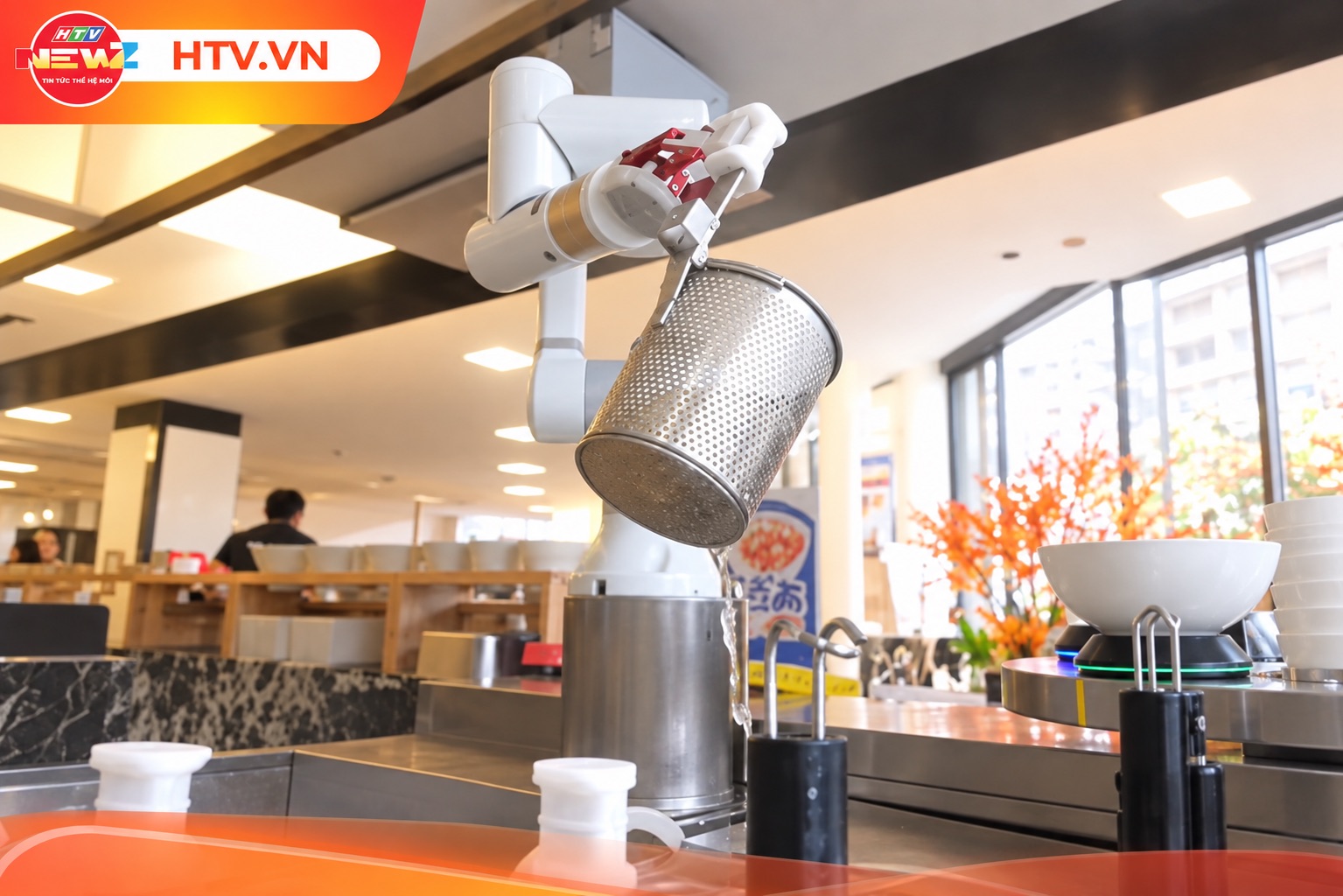
Boiling noodles, searing vegetables, portioning ingredients, monitoring temperatures and plating dishes: cooking robots are gradually taking over tasks previously carried out by kitchen brigades.
According to a report broadcast on 25 October 2026 by CCTV Finance, citing the China Hospitality Association (中国饭店协会), the penetration rate of cooking robots is said to have reached 30% in Chinese fast-food chains and mainstream casual dining.
The estimate has also been attributed to Jin Yong (金勇), vice-president of the association.

The figure should nevertheless be treated with caution: it does not cover all restaurants in China, and the detailed calculation methodology is not specified in the publications consulted.
It does, however, point to a change of scale in the use of automated equipment across commercial food service.
Kitchens capable of automating several production stages
In Hangzhou, in Zhejiang province, some establishments use robotic systems capable of coordinating several successive operations.
The equipment handles tasks including boiling noodles, draining them, adding ingredients, seasoning and preparing stir-fried dishes.

Other installations incorporate plating or service functions.
In Beijing, robots are also used to prepare drinks and deliver dishes to tables.
Some programmable cooking machines can prepare more than 100 recipes, combining different techniques: boiling, stir-frying, deep-frying and reheating.
School canteens represent another outlet for this equipment, which is particularly well suited to environments requiring the regular production of large volumes.
The integration of cameras, sensors and artificial intelligence systems also makes it possible to monitor certain preparation parameters, notably the condition of ingredients and cooking temperature.
These technologies do not, however, mean that every function of a professional kitchen can be automated without human intervention.
A response to labour pressures and productivity demands
The economic appeal of this equipment goes beyond simply reducing preparation time.
In a professional kitchen, repetitive tasks absorb a significant share of human resources: standardised cooking, ingredient handling, temperature monitoring and the production of recurring recipes.
Automation can free up part of this time for tasks that call for greater judgement and skill.
The China Hospitality Association notably highlights the value of these systems in limiting staff exposure to hot and physically demanding environments.
Chefs can thus devote more time to recipe development, quality control and product improvement.
The aim is therefore not necessarily to replace the cook, but to change the division of tasks between teams and equipment.
This shift takes on particular significance in establishments facing recruitment difficulties, high staff turnover or substantial production requirements.
An industrial market driven by professional demand
The development of cooking robots is also boosting Chinese food-service equipment manufacturers.
According to the report broadcast by Chinese media, a manufacturer based in Dongguan, in Guangdong province, is said to have recorded growth of more than 200% in sales of its smart cooking equipment over the first nine months of 2026.
This growth concerns one manufacturer cited in the report and should not be taken as representative of the Chinese market as a whole.
Manufacturers nevertheless anticipate that rising production volumes could help reduce equipment costs.
Such a development would make the equipment more accessible to food-service operators, particularly multi-site groups.
The development of professional standards is also accompanying this momentum.
In March 2026, the China Hospitality Association launched a standardisation project covering cooking-robot equipment and services in food service.
This initiative underlines the growing importance of safety, reliability, operational and maintenance issues.
What opportunities for hotel food and beverage?
While fast food and canteens are natural markets for cooking robots, some applications could also be of interest to hotel operators.
Large-capacity properties often run several food and beverage outlets: breakfast, staff dining, room service, banqueting, buffets and event catering.
Part of this activity relies on recurring preparations and relatively predictable volumes.
In this context, automated equipment could help secure certain production lines, reduce dependence on hard-to-fill positions and improve service consistency.
Banqueting, buffets and staff dining: the most immediate applications
Large hotels and properties with substantial conference or banqueting business have characteristics that make them particularly well suited to automation.
Repeated recipes, high-volume preparation and the need to meet precise service times may justify exploring robotic solutions.
Potential applications include side dishes, certain standardised cooking processes, hot preparations for buffets and staff meals.
Fine-dining kitchens and restaurants built on a high degree of dish customisation, on the other hand, face different constraints.
There, automation could be applied to preparatory tasks without necessarily altering the chef’s central role in creating and finishing dishes.
The relevance of robotisation will therefore depend more on the nature of production than on the establishment’s market positioning alone.
CAPEX, maintenance and profitability: the decisive questions for operators
The widespread adoption of kitchen robots will not depend solely on their technical performance.
For owners and operators, the investment decision will need to rest on rigorous economic analysis.
Several parameters must be taken into account: acquisition cost, installation, adaptation of premises, energy consumption, maintenance, staff training and equipment lifespan.
The expected gains will also need to be measured: labour hours reallocated, volumes produced, fewer errors, reduced food waste and improved consistency.
Equipment that performs well in a central kitchen producing several hundred meals a day will not necessarily offer the same value in a low-volume hotel restaurant.
The question of utilisation rate will be particularly important.
A robot only becomes economically viable if the savings and operational gains it generates justify the capital tied up and the additional running costs.
The information available does not, at this stage, allow a representative payback period to be established for the equipment used in China.
Towards a transformation of culinary skills?
Automation could also change the profiles sought within kitchen brigades.
Mastery of recipes and culinary techniques would remain essential, but could be complemented by new skills: equipment programming, supervision of production cycles, monitoring of cooking parameters and first-line maintenance.
The chef’s role could thus evolve towards greater emphasis on design, management and quality control in certain activities.
This transformation does not spell the end of traditional trades.
On the contrary, it could sharpen the distinction between standardisable tasks, which lend themselves to automation, and those relying on creativity, adaptability and human experience.
For hotel groups, staff training and change management would then become essential conditions for success.
LTH Analysis | Could robotisation become a structural response to the chef shortage?
The 30% figure put forward by the China Hospitality Association is an interesting signal, even if its scope and methodology call for caution.
It suggests that kitchen automation is no longer confined to a handful of technology showcases.
In certain segments of Chinese food service, it now appears to be part of standard operating practice.
For international hotel groups, the issue deserves particular attention.
Recruitment difficulties in kitchen roles, wage pressures and the need to maintain consistent quality are leading operators to look for new production models.
Robotisation could be one of the answers to these constraints, provided that task automation is not confused with replacing culinary expertise.
The distinction is essential.
In standardised food service, productivity gains can be pursued through the repetition and precision of processes.
In fine dining, value rests more on creativity, technical mastery, product selection and the chef’s interpretation.
Between these two models, a large part of hotel food and beverage could explore hybrid solutions combining human know-how with automated equipment.
The other question concerns the structure of investment.
At a time when owners already have to arbitrate between room renovations, kitchen upgrades, energy efficiency and improvements to the guest experience, robotisation will need to demonstrate its real contribution to operating profit.
For general management and F&B directors, the reasoning should therefore focus less on the technology itself than on its application to clearly identified production posts.
The strategic question is not whether robots will replace chefs, but which tasks still require scarce culinary skills and which can be entrusted to automated equipment.
China could thus prove a particularly instructive testing ground for the evolution of food-service models, including in international hospitality.
At a Glance
Market: China.
Reported adoption: 30% penetration of cooking robots in Chinese fast-food chains and mainstream casual dining.
Source: China Hospitality Association, cited by CCTV Finance in October 2026.
Methodological limitation: Detailed survey methodology and establishment sample not disclosed.
Applications: Boiling, stir-frying, ingredient dosing, temperature monitoring and selected plating operations.
Production capacity: Some programmable systems can prepare more than 100 dishes.
Industrial development: One Dongguan manufacturer reported sales growth exceeding 200% in the first nine months of 2026.
Hospitality applications: Banqueting, buffets, staff dining, high-volume food production and selected room-service operations.
Key investment considerations: CAPEX, equipment utilisation, maintenance, labour productivity and payback period.
LTH perspective: Kitchen automation could help operators address staffing constraints and standardise repetitive production while preserving chefs’ expertise in culinary creation and quality control.