



Amendment No. 36 officially extended
Signed on 4 June 2026 by the social partners in France’s hotel, café and restaurant sector, Amendment No. 36 concerning pay rates was awaiting formal extension before becoming mandatory for all businesses concerned.
That stage has now been completed.
The order dated 12 October 2026, published in the Official Journal of the French Republic on 15 October, makes the provisions of this amendment binding on all employers and employees falling within the scope of the national collective agreement for hotels, cafés and restaurants of 30 April 1997 (IDCC 1979).

The Groupement des Hôtelleries & Restaurations de France (GHR) confirms that the new pay scale will take effect on 1 November 2026, in accordance with the agreement’s provisions specifying implementation on the first day of the calendar month following its extension.
This deadline applies to all businesses covered by the sectoral agreement, whether or not they belong to an employers’ organisation that signed the amendment.
New HCR minimum pay scale applicable from 1 November 2026
The collectively agreed minimum rates are structured around five classification levels, each comprising three steps. The amounts represent gross hourly pay rates, expressed in euros.
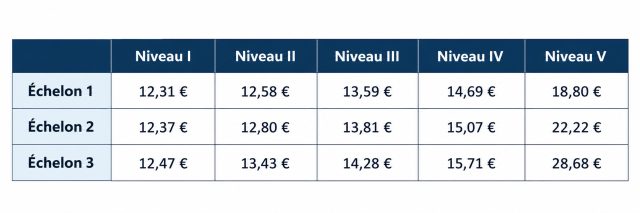
The scale starts at €12.31 gross per hour for Level I, Step 1. At the upper end, the collectively agreed minimum for Level V, Step 3 reaches €28.68 gross per hour.

These amounts are collectively agreed minimum thresholds, not standardised salaries imposed on all employees.
Businesses must also comply with the statutory minimum wage (SMIC) in force. Where a collectively agreed minimum falls below the statutory minimum, the more favourable statutory rate applies.
What are the implications for employers and payroll departments?
The introduction of the new pay scale requires businesses to verify that the remuneration paid to their employees complies with the applicable minimum rates.
The first step is to review the classification of each position under the collective agreement, based on the level and step specified in employment contracts and payroll records.
HR departments must then compare existing pay rates with the new collectively agreed minimums.
Where an employee’s pay falls below the minimum corresponding to their classification, the employer must adjust it with effect from 1 November 2026.
Conversely, employees whose remuneration already meets the new minimum are not automatically entitled to a pay increase solely because the amendment has been extended.
Particular attention should be paid to employees whose pay is close to the minimum thresholds, as well as situations in which working hours, overtime or remuneration components make comparisons more complex.
Employers will need, in particular, to distinguish basic pay from overtime premiums and other remuneration components, in accordance with the applicable rules.
An impact to incorporate into year-end budgets
For hotel operators and restaurant businesses, this development comes as operating budgets for 2027 are being prepared.
The financial impact will depend directly on workforce composition, the distribution of employees across the various collective agreement classifications and existing remuneration policies.
Properties where a significant proportion of employees are paid close to the minimum rates will need to assess any resulting adjustments to their payroll costs.
Beyond employees directly affected, management teams may also need to review pay differentials between functions, levels of responsibility and lengths of service.
This issue is particularly sensitive in organisations where salary progression is closely linked to classification under the collective agreement.
For operators, the challenge is therefore twofold: ensuring legal compliance with remuneration requirements and anticipating the budgetary consequences of the new pay scale.
Mandatory implementation from November payroll
The timetable leaves businesses little time to complete their compliance checks.
Publication of the extension order on 15 October means that, under the provisions of the amendment and as clarified by the GHR, the new pay scale applies from 1 November.
Properties must therefore incorporate the new minimum rates into their payroll settings with effect from that date.
HR managers and payroll administrators will need to verify employee classifications, gross hourly rates and any adjustments required.
These compliance requirements also apply to independent properties without a dedicated HR department, including those that outsource payroll administration to an accountancy firm or specialist provider.
LTH Analysis | Higher minimum pay thresholds require a property-by-property assessment
The extension of Amendment No. 36 represents, above all, a labour-law compliance deadline for businesses covered by the HCR collective agreement. Its economic impact cannot be assessed solely by reference to the figures in the pay scale: it depends on the actual distribution of remuneration within each establishment. For hotels and restaurants where salaries already exceed the new minimums, the direct effect may be limited. For others, the necessary adjustments will increase payroll costs and must be incorporated into operating forecasts. Beyond the immediate expense, this development also provides an opportunity for management teams to examine the consistency of their remuneration policies, particularly pay differentials between levels of qualification and responsibility.
At a Glance
Sector: French hotels, cafés and restaurants (HCR collective agreement).
Agreement: Amendment No. 36, signed on 4 June 2026.
Legal development: Extension order dated 12 October 2026, published in the French Official Journal on 15 October.
Effective date: New collectively agreed minimum pay rates apply from 1 November 2026.
Hourly minimum rates: From €12.31 at Level I, Step 1, to €28.68 at Level V, Step 3.
Employer implications: Payroll compliance checks, salary adjustments where necessary and labour-cost forecasting.