


An eighteenth consecutive record quarter
On 21 October 2026, IHCL, India’s largest hotel group by market capitalisation, announced another improvement in its financial performance.
The second quarter of FY2027, covering July to September 2026, marked its eighteenth consecutive record quarter, according to the group.
The principal indicators demonstrate sustained growth.

| Metric | Q2 FY2027 | Year-on-year change |
|---|---|---|
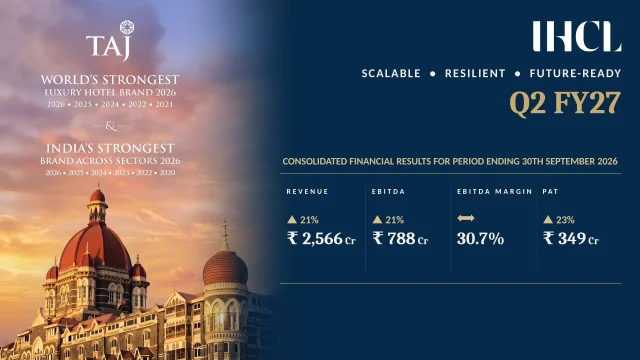
| Consolidated revenue | INR 2,566 crore | +21% |
| Consolidated EBITDA | INR 788 crore | +21% |
| Consolidated EBITDA margin | 30.7% | — |
| Profit after tax (PAT) | INR 349 crore | +23% |
| Domestic same-store hotel RevPAR | — | +25% |
| Management fee income | — | +25% |
| Select Service business revenue | — | +25% |
One crore is equivalent to 10 million Indian rupees. Revenue of INR 2,566 crore therefore represents INR 25.66 billion.
Business growth was driven by several factors: improved performance at existing hotels, new openings, higher management fee income and contributions from recent acquisitions.
Puneet Chhatwal, Managing Director & CEO of IHCL, emphasised the ability of the group’s diversified operating model to sustain growth while protecting margins.
The group reported a 22% increase in operating revenue and a 24% rise in operating EBITDA, with the corresponding margin improving by 50 basis points.

IHCL raises FY2027 revenue growth guidance by three percentage points
Strong first-half performance has prompted IHCL to revise its outlook for the financial year ending 31 March 2027.
The group now expects consolidated revenue growth of 15% to 17%, compared with its previous forecast of 12% to 14%.
| FY2027 growth guidance | Previous guidance | Updated guidance |
|---|---|---|
| Consolidated revenue | +12% to +14% | +15% to +17% |
| Hotel segment revenue | Not specified in the announcement | +17% to +19% |
This 300-basis-point upward revision is supported in particular by favourable prospects for the coming quarters, which are traditionally stronger for the Indian hospitality industry.
IHCL cites sustained demand for private events, weddings, social gatherings and the MICE segment (meetings, incentives, conferences and exhibitions).
The group also anticipates a significant contribution from properties recently added to its portfolio.
The revised guidance therefore reflects more than an improvement in the performance of existing hotels: it also incorporates changes in the group’s operating perimeter and network development.
Domestic RevPAR rises by 25%
One of the quarter’s most striking figures concerns the Indian market.
IHCL reported a 25% increase in domestic same-store hotel RevPAR.
Across comparable full-service hotels within IHCL’s standalone entity, the increase reached 28%.
According to Ankur Dalwani, Executive Vice President and Chief Financial Officer, performance benefited in particular from major events held in India’s capital and contributions from renovated properties in Goa, Delhi, Bengaluru and Udaipur.
The standalone entity delivered particularly strong results:
- INR 1,336 crore in operating revenue, up 26%.
- INR 520 crore in operating EBITDA, up 40%.
- 38.9% operating EBITDA margin, an improvement of four percentage points.
- INR 393 crore in profit after tax, up 36%.
These figures relate to the standalone entity and should not be confused with the group’s consolidated accounts.
Nevertheless, they illustrate the strength of demand across several key Indian hospitality markets.
Already 670 hotels in the portfolio: The 2030 target is approaching rapidly
Beyond its financial performance, the acceleration of IHCL’s development is attracting particular attention.
Under its Accelerate 2030 strategic programme, the group had set a target of reaching 700 hotels by 2030.
However, by the end of September 2026, IHCL already reported a portfolio of 670 properties, comprising:
| IHCL portfolio | Number of hotels |
|---|---|
| Operating hotels, calculated by difference | Approximately 390 |
| Hotels in development | 280 |
| Total portfolio, operating and in development | 670 |
| Accelerate 2030 target | 700 |
The current portfolio therefore represents almost 96% of the target announced for 2030.
IHCL stated that it had signed 47 new hotels during the first half of FY2027.
The pace of signings has led the group to consider achieving its original target several years ahead of schedule.
This is precisely the discrepancy highlighted by Skift in its analysis of 22 October 2026: the speed of the group’s development could make it necessary to establish a new medium-term ambition.
It is important, however, to remember that the 670 properties represent the total portfolio of operating and planned hotels. The target of 700 therefore does not mean that IHCL is preparing to operate 700 hotels as early as 2027.
Ginger and brand diversification accelerate the group’s transformation
The development of IHCL no longer relies exclusively on its historic Taj brand, associated with luxury hospitality.
The group now operates a brand architecture covering several customer and investment segments.
Its brands include Taj, Claridges Collection, Brij, Atmantan, SeleQtions, Clarks, Gateway, Vivanta, Tree of Life and Ginger.
This diversification enables IHCL to serve multiple segments, from luxury and premium experiences to midscale hospitality.
Ginger occupies a particular position within this strategy. Operating in the midscale segment, the brand helps extend IHCL’s geographical reach and appeal to customers who place greater emphasis on value for money.
The analysis published by Skift draws particular attention to the brand’s rapid development.
For IHCL, the challenge is now to translate portfolio growth into a coherent operating network capable of maintaining service standards and profitability as the number of properties increases.
Brij and Atmantan: Acquisitions broaden the group’s positioning
IHCL also highlights the contribution of its recent acquisitions, Brij and Atmantan, to revenue growth.
These two brands strengthen its presence in complementary categories.
Brij focuses on experiential stays and leisure destinations, while Atmantan is developing around integrated wellness.
The group is therefore seeking to capture several forms of demand: business travel, leisure, experiential stays, events and wellness tourism.
While this diversification can support growth, it also increases the complexity of brand management and operational standards.
The challenge will be to preserve a clearly identifiable value proposition for each brand without diluting the overall portfolio’s commercial coherence.
A strong financial position and a proposed corporate simplification
At the end of September 2026, IHCL reported consolidated gross cash of INR 4,369 crore, equivalent to INR 43.69 billion.
The group therefore has substantial financial resources to support its projects and commitments.
IHCL has also announced a proposed merger of OHL with IHCL, intended to simplify its ownership structure and develop asset management opportunities.
The proposal has been filed with the stock exchanges, with a proposed effective date of 1 April 2027.
According to the group’s finance management, the transaction is also expected to support long-term revenue growth.
However, the announcement does not detail the merger’s projected financial effects or its definitive completion timetable.
LTH Analysis | IHCL’s challenge is no longer simply to grow, but to manage its growth
IHCL’s trajectory illustrates the accelerating development of branded hospitality in India.
With 670 hotels either operating or in development, the group is already approaching its target of 700 properties by 2030, while revenue has increased by 21% and domestic same-store RevPAR has surged by 25%.
This combination reflects buoyant demand and the group’s ability to attract owners and developers.
However, scaling up presents several challenges: the pace of openings, workforce availability, quality control, franchisee performance and the coherence of the brand portfolio.
Ginger’s rapid development makes these issues particularly important in the midscale segment, where product consistency and cost control are essential.
For investors, the question is therefore no longer simply when IHCL will reach 700 hotels, but what level of profitability and operational quality will accompany that development.
The group’s next strategic target should be assessed as much by the performance of operating hotels as by the volume of new contracts signed.
At a Glance
Company: The Indian Hotels Company Limited (IHCL), Tata Group.
Reporting period: Q2 FY2027, ended 30 September 2026.
Consolidated revenue: INR 2,566 crore, up 21%.
Consolidated EBITDA: INR 788 crore, up 21%.
Consolidated EBITDA margin: 30.7%.
Profit after tax: INR 349 crore, up 23%.
Domestic same-store RevPAR: +25%.
Management fee income: +25%.
FY2027 revenue growth guidance: Raised to 15–17% from 12–14%.
FY2027 hotel segment revenue guidance: +17–19%.
Total hotel portfolio: 670 properties, including 280 in the pipeline.
H1 FY2027 signings: 47 hotels.
Accelerate 2030 target: 700 hotels.
Key brands: Taj, Ginger, Vivanta, SeleQtions, Gateway, Brij and Atmantan, among others.
Consolidated gross cash: INR 4,369 crore.
CEO: Puneet Chhatwal.
LTH perspective: Accelerated growth increases the importance of operational consistency, brand differentiation and owner-level returns.