


Conversions are no longer limited to independent hotels
The development of major hotel groups has traditionally relied on three growth drivers: new-build projects, the affiliation of independent hotels and the rebranding of properties already operating within another hotel network.
At IHG Hotels & Resorts, the third of these appears to be gaining increasing importance.

During the presentation of the group’s third-quarter 2026 results, Elie Maalouf, IHG’s Chief Executive Officer, indicated that most conversions now involve hotels previously affiliated with other hotel groups, both in the United States and internationally.

“Most are coming from other brands, in the US and around the world,” he explained, according to reported remarks.
The CEO described a shift towards quality, from which IHG believes it is benefiting.
His comments shed new light on the group’s development strategy: part of its growth now comes from hotels switching between competing brands, rather than exclusively from additional rooms entering the market.
In the United States, conversions account for 60% of signings
IHG’s published figures confirm the growing importance of this strategy.
Since the beginning of 2026, conversions have represented approximately:
| US metric | Share attributable to conversions |
|---|---|
| Hotel openings | 50% |
| New hotel signings | 60% |
These proportions demonstrate that existing hotel assets are playing an increasingly significant role in the group’s development.
During the third quarter, IHG opened 39 hotels representing approximately 4,000 rooms in the Americas region and signed a further 65 properties.
Signings included projects under the Holiday Inn brands, extended-stay brands and brands specifically suited to conversions.
This momentum benefits brands such as voco, Vignette Collection, Garner and Noted Collection, whose models allow existing hotels to be repositioned with varying degrees of transformation.
For owners, changing brands can offer an alternative to substantial property investment or developing a new hotel.
It can also provide an opportunity to improve commercial performance without fundamentally changing the nature of the asset.
Direct competition for franchise agreements
This trend highlights a change in the nature of competition between hotel groups.
Traditionally, securing additional hotels was largely associated with property development and the ability to persuade independent owners to join a brand.
Today, major hotel franchisors are also competing for properties already affiliated with another network.
This competition is based on several criteria:
- The brand’s ability to generate bookings and RevPAR.
- The strength of its loyalty programmes and distribution channels.
- The level of franchise fees and costs imposed on owners.
- The investment required to comply with brand standards.
- The prospects for profitability and asset valuation.
An owner may therefore reconsider a brand affiliation when a contract approaches expiry, when a refurbishment programme becomes too expensive or when the brand’s commercial performance no longer appears to justify its financial obligations.
However, it is important to distinguish these potential motivations from the reasons actually observed in IHG’s conversions. The group has not provided a detailed breakdown by previous brand or an analysis of owners’ reasons for switching.
Net network growth becomes an indicator of competitiveness
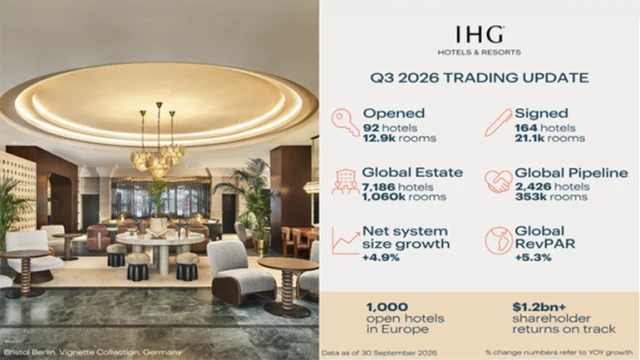
IHG reported 4.9% net system growth over the twelve months to the end of September 2026.
The group now operates 7,186 hotels and nearly 1.06 million rooms.
Its development pipeline comprises 2,426 hotels and approximately 353,000 rooms, equivalent to around one-third of its existing room portfolio.
Since January, IHG has signed 516 hotels and opened 289 properties.
According to information reported during the quarterly presentation, analyst consensus now anticipates 4.8% net room growth in 2026, compared with a previous estimate of 4.2%.
This estimate should be distinguished from the figures published by the group: it represents a market forecast, not a newly announced numerical target from IHG.
Net system growth is a particularly relevant indicator in this context.
It measures not only the rooms added to a network but also those that leave it.
A group capable of attracting hotels from competing brands while limiting departures among its own franchisees therefore enjoys a dual advantage.
An economic consideration for hotel owners
The rise in conversions raises an essential question: why does a hotel owner decide to leave one brand for another?
Brand selection generally involves balancing costs against expected revenue.
Affiliation with a major hotel group can provide access to international customers, sophisticated reservation systems, revenue management tools and a substantial loyalty programme.
In return, it entails franchise fees, marketing contributions and investment obligations.
The economic value of a franchise agreement therefore depends on the brand’s actual contribution to the property’s performance.
For an owner, the decisive measure is not simply the revenue generated by the brand but the net profitability of the affiliation, after accounting for fees, investment requirements and operational constraints.
This explains why competition between franchisors can become particularly intense during contract renewals or hotel repositioning exercises.
LTH Analysis | The battle between brands is increasingly being fought over existing hotels
Elie Maalouf’s comments reveal a central aspect of competition between hotel groups: network growth increasingly depends on attracting assets already operating under franchise agreements.
For IHG, conversions have accounted for approximately 60% of US signings since January, underlining their importance to future development.
This trend can accelerate a group’s growth without necessarily producing an equivalent increase in total hotel room supply.
It also shifts the balance of power towards owners, who can compare the performance, costs and requirements of competing brands.
For franchisors, winning a hotel from a competitor is not enough: they must also retain their existing properties.
The true measure of a brand’s competitiveness is increasingly its ability to deliver sustainable improvements in hotel asset profitability, beyond the distribution strength of its network alone.
At a Glance
Company: IHG Hotels & Resorts.
CEO: Elie Maalouf.
Strategic development: Increasing conversions from competing hotel brands.
US openings from conversions: Approximately 50% year-to-date.
US signings from conversions: Approximately 60% year-to-date.
Source of conversions: According to the CEO, predominantly hotels previously operating under other brands.
Global network: 7,186 hotels and approximately 1.06 million rooms.
Net system growth: +4.9% year-on-year.
2026 consensus net room growth: Approximately 4.8%, reportedly revised from 4.2%.
Development pipeline: Approximately 353,000 rooms.
Conversion-focused brands: voco, Vignette Collection, Garner and Noted Collection.
LTH perspective: Hotel brand competition increasingly centres on winning and retaining existing franchised assets.