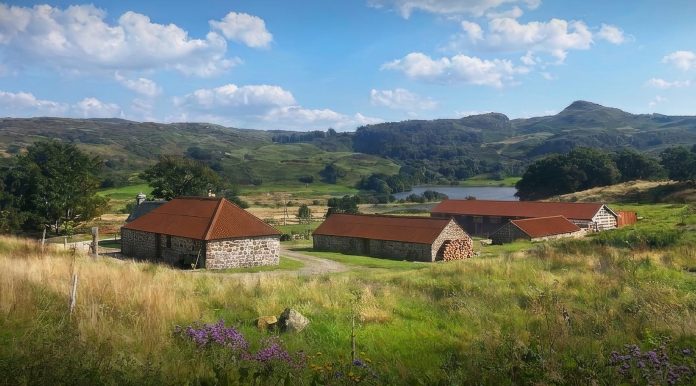


The Inverlonan estate in the west of Scotland is about to take a new step in its development. In November 2026, the site will open a landscape hotel with nine bedrooms alongside a 24-cover restaurant, set on the shores of Loch Nell, around 6.5 kilometres east of Oban.
The term landscape hotel refers to accommodation designed to recede into its surroundings rather than dominate them: few rooms, low-rise or restored buildings using existing structures, local materials, and an experience built around the landscape – trails, waterways, wildlife – rather than conventional hotel infrastructure. It is in this spirit that Inverlonan’s project is conceived, built around the restoration of the historic Ballygowan farmstead.

The project adds to Inverlonan’s existing offering, which until now has centred on three off-grid bothies launched in 2020 – individual cabins inspired by traditional Scottish shelters, running fully self-sufficiently on solar power, spring or rainwater, and composting toilets, with no connection to public utilities. This expansion reflects a broader trend in the Scottish market, where several operators are betting on immersive nature-based accommodation, as seen with Hope by WildLand, which opened in the Highlands in 2026.
At a glance: what is Inverlonan?
A family estate turned agricultural hospitality venture
– A 1,000-acre (roughly 405-hectare) farming estate in Glen Lonan, near Oban
– Founded by Lupi Moll, a former lawyer, on land that had belonged to his family before he bought it back
– Positioned around “slow living” and eco-hospitality, built around three off-grid bothies opened in 2020
– A business model underpinned by the estate’s farming operation rather than a standalone hotel
Restoring Ballygowan Farm
The historic Ballygowan farmstead will be restored and converted to house the whole of the new hospitality programme. Architect Kirsten Mackenzie, formerly of RMJM, is leading the project, which retains the existing stone buildings, adapted using local materials and craftsmanship in line with sustainable building techniques.
The original farmhouse will hold three bedrooms, while five more will occupy the former byre (the Byre). A restored stone bothy, the Blackhouse, will become a standalone suite. Every room has a super king-size bed and en-suite bathroom; three of the Byre rooms feature stone baths and limecrete wet rooms. Two of the farmhouse rooms can also accommodate children’s beds, bringing total exclusive-use capacity to ten guests.
Materials used include hemp insulation, wood-fibre panels, lime plaster, Caithness stone flags and local timber. Underfloor heating will be supplied by three boreholes and two ground-source heat pumps. The interior design draws on Scottish artists and craftspeople, along with works by John Bellany and Allan Davie, complemented by locally worked oak and elm pieces, hand-woven willow baskets, ceramics and textiles made from the estate’s own organic wool.
A food offering rooted in the Scottish landscape
Chef Tim Kensett will head the new 24-cover restaurant, giving a permanent home to the dining offering Inverlonan has until now run on a more informal basis. His career includes stints at The River Cafe in London, Storico in New York, GoldenEye in Jamaica, The Star at Alfriston, and The Fife Arms in Braemar.

This model reflects a wider trend elsewhere in Europe, where hotels are increasingly built directly alongside an active farming operation, as is being prepared at La Maregagne in the Vexin, a hybrid hotel paired with a working farm.
A certified organic farming model
Following a three-year conversion process, Inverlonan gained organic certification from the Scottish Organic Producers Association on 10 September 2026, with livestock sold from that date onward certified organic. The estate’s kitchen garden is also being expanded to supply the restaurant, supported by 150 fruit trees and eight productive beehives.
This agricultural strand is part of a wider ecological restoration programme across the 1,000-acre estate. Some 190,000 broadleaf trees, mainly oak, beech and birch, were planted across 220 acres (roughly 89 hectares) of Ballygowan Hill in 2018. The estate has recorded the return of black grouse to its woodland areas, alongside hen harrier, white-tailed eagle, merlin and red-throated diver. The site is also home to the Strontoiller stone circle, dated to around 2000 BC, and the four-metre-high Clach na Caraig standing stone.
An expanded accommodation offering
The three existing off-grid bothies will continue operating alongside the new establishment. The landscape hotel’s amenities will include honesty bars, a wine cellar, and in-room provisions boxes in place of a conventional minibar, along with a shared sauna on the Loch Nell shoreline and access to wild swimming.
Kayaks, canoes, paddleboards and fishing equipment will be available, with fishing possible on Loch Nell, the River Lonan and Lochan Barr a’Claighinn. Electric bikes and walking trails provide access to Glen Lonan and the estate’s woodland areas. The whole property can also be booked for exclusive use, with capacity for up to 30 guests.
The November opening will thus mark a new stage in Inverlonan’s development, bringing together accommodation, dining, farming and land management within the restored Ballygowan farmstead.
At a glance by The Hospitality Tribune
Inverlonan opens a nine-bedroom landscape hotel on Loch Nell, Scotland
Opening: November 2026, near Oban, Argyll
Nine bedrooms plus a standalone suite; 24-cover restaurant led by chef Tim Kensett
Built around the restoration of the historic Ballygowan Farm steading
Certified organic farm (10 September 2026) supplying over 90% of the restaurant’s produce
Exclusive-use capacity for up to 30 guests across the estate
Part of a wider 1,000-acre farming and ecological restoration programme