

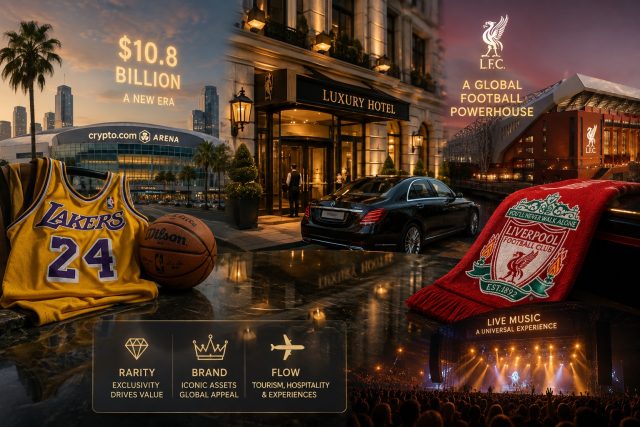

The sale of the Los Angeles Lakers was sealed in a single weekend. Josh Kushner, brother of Jared Kushner, and former Disney executive Bob Iger acquired the majority stake held by Mark Walter for €10.8 billion, or $12.5 billion. Subject to approval by the NBA’s Board of Governors, this stands as the most expensive sports franchise sale on record, ahead of the €5.27 billion paid for the Boston Celtics in 2025 and the €8.3 billion paid for the Seattle Seahawks the previous month.
Just days earlier, Fenway Sports Group had announced the sale of a minority stake in Liverpool FC to a consortium named 1892 Holdings, which includes Jeff Bezos alongside Amit Bhatia, the Mittal family and the Saverin couple. The deal values the English club at between £5 billion and £6 billion (€5.8–7 billion), up from £300 million when FSG acquired it in 2010. Mike Gordon, President of Fenway Sports Group, said the club’s long-term strategy continued to attract investors and business leaders from around the world.

Professional sport, the new trophy asset for the ultra-wealthy
Both transactions confirm a trend that has been building for several years: major sports franchises are now treated by family offices and high-net-worth individuals as an asset class in their own right, on a par with ultra-luxury hotels or branded residences. Structural scarcity, recurring revenue from TV rights and sponsorship, and the potential for rapid appreciation — the investment logic overlaps heavily, as if each sector were watching the other in a mirror.
This underlying shift is also reshaping the hotel sector, where institutional capital is redeploying on a large scale towards assets seen as resilient. Blackstone, for instance, closed an $8 billion real estate debt fund dedicated to hospitality, a sector viewed as more flexible than offices or other commercial asset classes. The same logic of wealth diversification is now driving investors into sports franchise ownership.
Sport and music: two mirrored engines of event tourism
Sport is no longer the only sector generating this kind of value flow into hospitality. Live music now follows an almost identical mechanism: a major international tour produces the same drawing power for a destination as a large sporting event, concentrating substantial hotel and air travel demand into just a few days.
An Opodo survey measured a 26% rise in flight searches to Paris during Drake’s European tour, driven in particular by American and French audiences willing to travel specifically for the event. Parisian hospitality professionals see this as a genuine profitability lever outside the peak season. Sport and music thus function as two sides of the same phenomenon: event tourism capable of giving a destination’s hotel performance a temporary but significant lift.

Stadiums, arenas and hospitality: a shared destination economy
Economically speaking, a club, a sports franchise or a music tour functions as a generator of tourist flows comparable to a hotel or a destination itself. Event days boost local food and beverage, accommodation and retail, but the appeal of a leading club or artist extends well beyond the event calendar, feeding more sustainable urban tourism.
Major hotel groups have long understood this, building brand ecosystems around entertainment and live events. Caesars Entertainment, for example, transformed The Cromwell into The Vanderpump Hotel, drawing on an entertainment personality to strengthen its hospitality offering on the Strip. This kind of partnership illustrates the growing overlap between hospitality, sport, music and consumer brands.
Los Angeles and Liverpool: two hotel markets under pressure
Los Angeles is preparing to host the 2028 Olympic Games, a prospect already fuelling hotel development and the upscaling of the city’s existing stock. The arrival of new Lakers owners, who are also active investors more broadly, fits into this wider revaluation of the Californian market.
In Liverpool, the steady rise in tourist numbers linked to the Premier League and the club’s international appeal has supported local hotel demand for several years. More broadly, the UK remains one of Europe’s most dynamic markets for hotel openings, as shown by recent openings in London, such as the Locke aparthotel at Canary Wharf.
What these deals signal for hotel investors
For hospitality executives and investors, these sports sales are far more than economic news items. They confirm that the same logic of scarcity, brand and yield that governs luxury hospitality now applies, with equal intensity, to sport and live music — three sectors increasingly competing for the same capital, the same investor profiles and, ultimately, the same destinations.
This convergence is also visible in the consolidation under way among major American hospitality and casino-entertainment groups, illustrated by discussions around a possible sale of Caesars Entertainment. Across all three worlds — sport, music and hospitality — the same question shapes decision-making: whether premium assets can generate stable cash flow in a still-high interest-rate environment.
At a glance by The Hospitality Tribune
The Los Angeles Lakers were sold for $12.5bn (€10.8bn), the largest sports team transaction on record, agreed within days by Josh Kushner and Bob Iger
Jeff Bezos joined Liverpool FC’s ownership via the 1892 Holdings consortium alongside Fenway Sports Group, valuing the club at £5-6bn (€5.8-7bn)
Both deals highlight capital rotation from sports franchises toward the broader hospitality and tourism economies of their host cities
Live music tours show a mirroring effect: Drake’s European tour drove a 26% rise in flight searches to Paris, per an Opodo survey
Institutional and family-office capital increasingly treats trophy sports assets with the same logic applied to ultra-luxury hotel real estate
Los Angeles and Liverpool both face rising hotel demand tied to major sporting calendars, from the 2028 Olympics to Premier League fixtures