

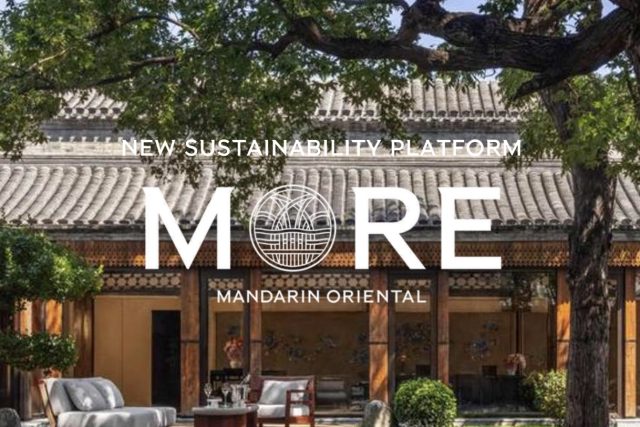


MO.RE: Making sustainability an integral part of the business model
With the launch of MO.RE, Mandarin Oriental is seeking to transform its approach to sustainability.
The group is not presenting the initiative as simply another environmental programme, but as a platform intended to guide decisions throughout the lifecycle of its properties.
Its scope therefore encompasses investment, real estate development, hotel design, operations and the guest experience.

This approach builds on initiatives undertaken over the past fifteen years.
Mandarin Oriental reports having achieved a 33% reduction in its Scope 1 and 2 carbon emissions and mobilised employees to contribute more than 80,000 volunteering hours.
However, the announcement does not specify the baseline period used to calculate the emissions reduction.
MO.RE now aims to take the next step by making sustainability a driver of economic resilience and differentiation within luxury hospitality.

For Laurent Kleitman, Group Chief Executive of Mandarin Oriental, this development should strengthen the company’s resilience to future risks, improve operational performance and preserve the destinations that contribute to the identity of its properties.
Three pillars: Resilience, Reconnection and Regeneration
The MO.RE platform is structured around three complementary pillars.
| Pillar | Objective | Key initiatives |
|---|---|---|
| REsilience | Adapt hotels and destinations to climate-related risks | Property-specific climate risk assessments, a net-zero pathway for 2050 and improved understanding of Scope 3 emissions |
| REconnection | Strengthen relationships between guests, employees and destinations | Biodiversity Kids Club, MO Family Days, and locally rooted culinary and wellness experiences |
| REgeneration | Contribute to the preservation and development of local communities and destinations | Biodiversity, vocational training, craftsmanship, cultural heritage and charitable initiatives |
This structure reflects a broader understanding of sustainability that extends beyond energy consumption and direct emissions.
It also incorporates relationships with local communities, the transmission of traditional skills and the protection of natural and cultural resources.
Resilience: Anticipating climate risks at individual hotel level
The first pillar of MO.RE focuses on adapting properties to the consequences of climate change.
Mandarin Oriental plans to develop a climate risk profile for every hotel.
These assessments are intended to identify vulnerabilities specific to each destination and the corresponding adaptation priorities.
Risks can vary considerably depending on asset location, including extreme heat, water availability, severe weather events, coastal exposure and pressure on infrastructure.
The group has also announced a new decarbonisation pathway targeting net-zero carbon emissions by 2050.
It also intends to improve its understanding of Scope 3 emissions, which encompass indirect emissions throughout its value chain.
For an international hotel operator, these emissions may arise from procurement, construction and refurbishment work, equipment, outsourced services and other indirect activities.
However, the announcement does not yet provide a detailed emissions reduction timetable by scope, an investment budget or a comprehensive methodology for monitoring the new commitments.
Reconnection: Integrating sustainability into the luxury experience
The second pillar adopts an approach more directly focused on guests and employees.
Mandarin Oriental intends to develop experiences that bring visitors closer to nature, culture and the distinctive characteristics of each destination.
Among the announced initiatives is a Biodiversity Kids Club concept, designed to introduce younger guests to biodiversity and its protection.
The group also plans to introduce annual MO Family Days, intended to encourage interaction between employees and families.
Culinary experiences and wellness programmes are expected to strengthen connections between hotels and their local environments.
This direction reflects an important commercial consideration for luxury hospitality: offering sufficiently distinctive experiences to go beyond the quality of facilities or service alone.
Sustainability could therefore become a differentiating feature of the guest offering, provided the announced commitments translate into tangible experiences consistent with customer expectations.
Regeneration: Moving beyond reducing negative impacts
The third pillar arguably represents the most significant conceptual development within MO.RE.
Through Regeneration, Mandarin Oriental intends to move beyond an approach primarily focused on limiting the negative effects of hotel operations.
The group aims to make a positive contribution to the destinations in which it operates.
Several areas of action have been announced:
- Biodiversity conservation: Protecting and restoring priority habitats.
- Vocational education: Expanding access to hospitality skills and career opportunities.
- Arts and craftsmanship: Supporting local creators and living cultural heritage.
- Celebrity Fans charitable programme: Mobilising the group’s ambassadors in support of community causes.
For destinations, these initiatives could help strengthen relationships between luxury hotels, local communities and ecosystems.
However, their impact will depend on the resources actually committed, the partnerships established and the measurable results achieved in each location.
A strategy led by Laurent Kleitman and Kandé Camara
The new platform is presented as a cross-functional initiative involving operational management, development teams and the group’s partners.
Kandé Camara, Chief of Staff and Group Director of Sustainability, emphasises the need to make sustainability both a business priority and a positive experience for guests.
This approach seeks to align corporate decisions with what Mandarin Oriental sees as changing customer expectations: greater authenticity, stronger connections with destinations and a positive contribution to the places visited.
Nevertheless, the programme’s governance will need to ensure that these ambitions are reflected in investment decisions, design standards and hotels’ daily operating practices.
This is particularly important for a group continuing its international development.
Implications for hotel owners and investors
MO.RE is distinctive in its ambition to influence decisions from the earliest stages of investment and real estate development.
For hotel asset owners, this raises several practical questions.
Climate risk assessments can influence acquisition decisions, refurbishment programmes, technical investment and insurance costs.
Similarly, a decarbonisation pathway requires advance planning for expenditure on improving energy efficiency and upgrading certain equipment.
These commitments can therefore have direct implications for CAPEX/OPEX decisions, operating profitability and long-term asset valuations.
At this stage, Mandarin Oriental has not quantified the investment required to implement MO.RE.
The group’s ability to engage owners and partners in this strategy will consequently be a determining factor in its implementation.
A visual identity inspired by the Chinese philosophy of Wuxing
Mandarin Oriental has also developed a dedicated visual identity for MO.RE.
The logo draws inspiration from Wuxing, a traditional Chinese concept based on five dynamic and interdependent elements.
The group uses this reference to express balance, interconnectedness and transformation.
The continuous form of the symbol represents the connections between MO.RE’s three pillars, while its central point embodies the transition from incremental improvements to more structural transformation.
This cultural reference also enables Mandarin Oriental to connect the programme with its Asian heritage.
LTH Analysis | Sustainability is becoming an asset management issue
With MO.RE, Mandarin Oriental is seeking to reposition sustainability beyond environmental performance indicators alone.
Integrating climate risks from the investment and hotel design stages is particularly significant, embedding resilience within long-term asset management.
For owners, this approach could influence CAPEX decisions, operating costs and the future attractiveness of their properties.
The Regeneration pillar also extends the hotel’s responsibility to preserving the ecosystems and communities that contribute to its luxury experience.
The challenge now is to translate this ambition into verifiable commitments.
MO.RE’s credibility will depend less on its manifesto than on the publication of interim targets, budgets and indicators capable of measuring its impact on hotels and their destinations.
At a Glance
Group: Mandarin Oriental Hotel Group.
Announcement date: 20 October 2026.
Initiative: MO.RE sustainability platform and manifesto.
Three pillars: Resilience, Reconnection and Regeneration.
Scope: Investment, development, design, operations and guest experience.
Reported Scope 1 and 2 emissions reduction: 33%, with baseline not specified in the announcement.
Employee volunteering: More than 80,000 hours contributed.
Climate commitment: New pathway towards net zero by 2050.
Planned initiatives: Hotel-specific climate risk profiles and greater Scope 3 emissions visibility.
Guest and community programmes: Biodiversity Kids Club, MO Family Days, local culinary and wellness experiences, biodiversity protection and vocational education.
Operating portfolio: 47 hotels, 16 residences and 43 exceptional homes in 30 countries and territories.
Group Chief Executive: Laurent Kleitman.
Chief of Staff and Group Director of Sustainability: Kandé Camara.
LTH perspective: Sustainability is increasingly positioned as an asset resilience, operational performance and destination value issue for luxury hospitality.