

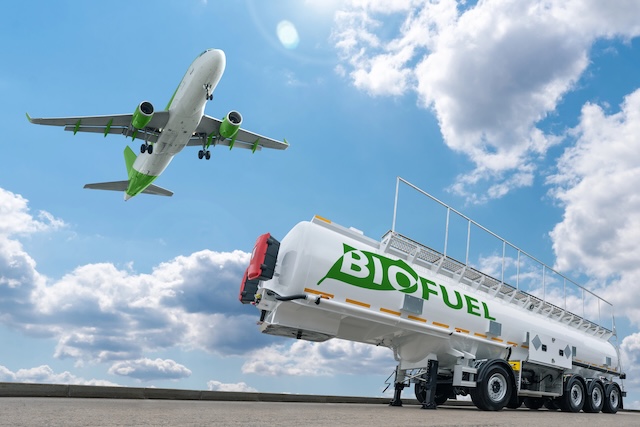


British company Nova Pangaea Technologies has successfully completed endurance trials at its Teesside demonstration site, validating the stability of its REFNOVA process for converting residual biomass into sustainable aviation fuel (SAF). The trials demonstrated continuous operation over production cycles of up to 72 hours, with yields exceeding set targets.
This milestone comes as the company launches a fundraising round to build its first commercial-scale plant, in an aviation sector seeking alternative feedstock sources to used cooking oil, currently the only SAF pathway operating at scale.
A technical milestone for the REFNOVA process
The trials conducted at the Teesside site focused on wood residues from timber processing. Several campaigns were carried out, processing up to 3 tonnes of feedstock per day, under stable, continuous operating conditions.

These results follow initial smaller-scale trials conducted in early 2025, which demonstrated the process’s viability beyond the laboratory setting. New campaigns are planned next year to refine the design of the first commercial-scale plant.
From residual biomass to sustainable fuel
The REFNOVA process converts biomass waste and residues such as wood chips, sawdust and wheat straw into ethanol, which can be upgraded into SAF or renewable diesel. It also produces a high-value co-product, biochar, which durably sequesters carbon.
This feature makes the entire process carbon-negative: it removes more CO2 from the atmosphere than it emits across the full cycle.
Diversifying supply as SAF mandates ramp up
UK and EU regulations require airlines to blend a growing share of SAF into their fuel, set to rise from 2% currently to 70% by 2050. Yet almost all SAF produced today comes from used cooking oil, a resource available in limited quantities and insufficient to meet future demand.

According to the International Air Transport Association (IATA), Europe, including the UK, will have sufficient residual biomass reserves by 2030 to produce around 30 million tonnes of SAF, a volume equivalent to the European targets set for 2050.
🔗 Also on LTH: Roissy-CDG’s €8.2 billion expansion, an opportunity for airport hospitality
Project Speedbird: an alliance with British Airways and LanzaJet
Nova Pangaea is participating in Project Speedbird, a programme run with British Airways and LanzaJet and backed by the UK government, aimed at producing carbon-negative aviation fuel from local residual biomass. As part of this programme, Nova Pangaea is set to build four facilities in the UK to produce bioethanol from local waste, subsequently upgraded into SAF.
A fundraising round to build the first commercial plant
Nova Pangaea has raised more than £21 million (approximately €24.5 million) to date from investors, including International Airlines Group (IAG), PXN Ventures, Mercia Ventures and the Northern Powerhouse Investment Fund, as well as public grants awarded under the UK’s Advanced Fuels Fund scheme.

Stewart Stewart, Chief Executive of Nova Pangaea, said: “These latest trials have validated our technology and should strengthen investor confidence in our path towards building our first commercial plant. The SAF industry is at a critical juncture. Demand is rising and supply shocks, such as those seen in the Middle East, show the need to find an alternative to fossil fuels, as aviation remains reliant on a single SAF pathway that will not be enough to meet growing demand.”
He added: “Our technology, now proven, offers a genuine alternative. By harnessing abundant reserves of residual biomass, we can scale up SAF production, strengthen our energy security and build a new domestic industrial sector that creates jobs and revenue, while reducing emissions linked to fossil fuels.”
A material issue for the hotel ecosystem and business travel
While the announcement primarily concerns the aviation industry, it is of direct interest to hospitality and business travel stakeholders. The availability and cost of SAF will, in time, shape airlines’ decarbonisation strategies, which are themselves coming under increasing scrutiny from corporate clients when setting travel policies, with potential knock-on effects for business travel flows into hotels.
🔗 Also on LTH: Business travel is once again driving private aviation
At a glance by The Hospitality Tribune
Nova Pangaea validates SAF technology through endurance trials
UK-based Nova Pangaea Technologies completed 72-hour continuous production trials at its Teesside demonstration plant, exceeding target yields
Its REFNOVA process converts waste biomass (wood chips, sawdust, wheat straw) into ethanol for SAF and renewable diesel, with biochar as a carbon-negative co-product
The company is now raising funds to build its first commercial-scale plant
Nova Pangaea is a partner in Project Speedbird with British Airways and LanzaJet, UK government-backed, to build four UK bioethanol facilities
Over £21m (approx. €24.5m) raised to date, including from International Airlines Group, PXN Ventures, Mercia Ventures and the Northern Powerhouse Investment Fund
IATA estimates Europe, including the UK, could produce around 30 million tonnes of SAF from waste biomass by 2030