

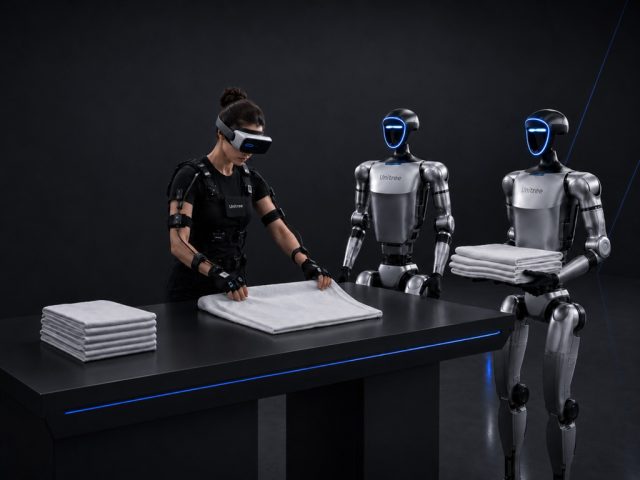


In Singapore, housekeeping professionals become trainers for future robots
On 20 October 2026, YYForce Inc., a Singapore-based company listed on Nasdaq under the ticker YFOR, announced the acquisition of twenty wearable data collection devices for its humanoid robotics development programme.
The company plans to deploy the equipment as part of an initiative involving the housekeeping teams at Novotel Singapore on Stevens.
The principle is relatively straightforward: record the movements of experienced professionals to build datasets that can be used to train future robots.

The equipment includes head-mounted cameras, enabling operations to be observed from the employee’s perspective, and synchronised wrist-mounted cameras designed to capture hand movements and interactions with objects in detail.
The initiative will initially focus on three categories of tasks:
- Bed-making: Handling bed linen, making beds and arranging pillows.
- Room preparation: Folding towels, arranging guest amenities and replenishing supplies.
- Selected cleaning operations: Wiping surfaces and handling cleaning equipment and products.
The recorded sequences will subsequently undergo selection, annotation and computer processing.
They may be used in research involving Vision-Language-Action (VLA) models, which combine visual perception, understanding of instructions and the execution of physical movements.

This is therefore not yet a case of robots working inside guestrooms, but a preparatory stage intended to transfer professional skills to future machines.
From programmed movements to learning through observation
The technological significance of YYForce’s initiative lies in its approach to learning.
Traditional robotics relies heavily on programmed operations and relatively predictable environments. By contrast, AI-powered humanoid robots are gradually being developed to learn from human demonstrations and adapt their movements to the situations they encounter.
This approach could be particularly relevant to hotel housekeeping.
Making a bed is not simply a matter of repeating a sequence of movements. It involves handling deformable textiles, adjusting sheets, moving pillows, navigating around furniture and adapting to different room configurations.
The difficulty lies precisely in this variability.
As discussed in our previous article on Figure and Helix 2.5, an artificial intelligence system developed to enable humanoid robots to perform domestic tasks in unfamiliar environments, advances in robotic learning could gradually open up applications within hotel environments.
YYForce’s initiative adds an essential dimension: the data would be collected directly from hospitality professionals working in an operational hotel.
Mike Fu, Chief Executive Officer of YYForce, emphasises that access to real operational environments and experienced teams is an important component of the group’s robotics strategy.
The company first intends to assess the systems’ ability to reproduce individual tasks before considering commercial applications.
Why France could be a particularly favourable market
Beyond technological performance, the automation of hotel housekeeping could find favourable economic conditions for adoption in France.
The country faces several structural constraints that directly affect rooms division operations.
A workforce that is difficult to recruit and retain
Room attendant positions are among the operational roles facing recruitment and retention difficulties.
Working hours, repetitive tasks, physical demands and remuneration conditions can make these positions less attractive.
For operators, these difficulties can result in vacancies, replacement staffing requirements, greater reliance on outsourcing and pressure on day-to-day organisation.
Automating certain tasks could therefore offer benefits extending beyond cost reduction alone: securing the operational capacity of the rooms division.
The rising total cost of employment
Labour costs represent a second factor.
Beyond wages and employer social security contributions, the actual cost of cleaning a room also depends on absences, replacement staff, training, supervision and organisational constraints.
Occupational accidents and work-related illnesses represent an additional concern, particularly in activities involving manual handling and repetitive movements.
In France, employer contributions for occupational accidents and diseases (AT/MP) can be significantly affected by a company’s claims experience, depending on its workforce size and the applicable contribution assessment rules.
The recognition of certain occupational illnesses can therefore have economic consequences extending well beyond the immediate cost of an employee’s absence.
The paradox of investment in ergonomics
For several years, hoteliers have sought to reduce the physical demands of housekeeping through improved equipment and adaptations to guestrooms.
Developments have included wall-mounted furniture to facilitate floor cleaning, easier-to-maintain surfaces, lighter bedding, electric bed-lifting systems, handling equipment and motorised trolleys.
These investments improve working conditions and can help prevent musculoskeletal disorders.
Nevertheless, certain physical demands remain inherent to the profession. Handling linen, servicing stayover rooms and preparing rooms after check-out involve lifting and carrying loads of varying weights, while cleaning floors, bathrooms and shower cubicles requires repetitive movements and frequent bending.
Additional constraints arise from fitness-for-work restrictions and workplace adjustments prescribed by occupational health physicians. Such measures may require changes to work rates, task allocation or team organisation.
These decisions respond to a legitimate obligation to protect employee health. However, they can affect operational productivity and increase the unit cost of cleaning each room.
The paradox is clear: despite investment in ergonomics, some physical and economic constraints remain difficult to eliminate in an operating model relying exclusively on human labour.
We previously examined this issue in our analysis of the operational constraints of hotel housekeeping and the potential acceleration of hospitality robotics.
For investors, the question is no longer purely technological
If humanoid robots become capable of performing a significant proportion of cleaning operations, their adoption could become a major consideration for hotel owners, investors and asset managers.
The implications would extend beyond reducing payroll expenses.
It will be necessary to assess the effects on operational continuity, service quality, room availability, occupational risk prevention and cost stability.
For a hotel investor, access to additional operational capacity that is less exposed to recruitment difficulties and fluctuations in staff availability could represent a significant operational advantage.
Robotics could also introduce greater predictability into certain operating expenses, provided manufacturers’ contracts guarantee satisfactory levels of performance and availability.
In large hotels, sharing a fleet of robots could create further opportunities for optimisation.
However, the robots would need to be sufficiently reliable, fast and autonomous.
Conversely, a machine requiring constant human intervention or capable of completing only a small proportion of tasks could add another operational burden without significantly improving efficiency.
The true performance indicator will therefore not be the number of robots installed, but their ability to deliver a defined volume of services consistently and at a predictable cost.
Robot-as-a-Service: Rental could take precedence over outright purchase
The commercialisation of humanoid robots for hospitality could favour a service-based rental model known as Robot-as-a-Service (RaaS).
This hypothesis appears consistent with the nature of the technology.
Humanoid robots are likely to require specialist maintenance, software updates, technical interventions and potentially the replacement of components.
In a sector where technology is evolving rapidly, purchasing equipment outright could also expose operators to the risk of obsolescence.
Depending on its terms, a rental agreement could allow these risks to be shared with the supplier while limiting the initial capital investment.
Such an agreement could include the provision of the robot, maintenance, updates and certain availability commitments.
For hotel groups, this model could also facilitate comparisons between properties and the gradual deployment of a robotic fleet.
However, rental would convert a technology investment into a recurring contractual expense. Investors would therefore need to examine performance guarantees, maintenance conditions and responsibilities in the event of equipment downtime.
The central economic question: How much will it cost to rent a humanoid robot?
For hotel investors and operators, the decisive issue will be the commercial model offered by manufacturers.
The commercialisation of humanoid housekeeping robots could favour a service-based rental arrangement, such as Robot-as-a-Service (RaaS).
This approach would limit initial investment while potentially including maintenance, software updates and technical support, depending on contractual terms. It could also reduce operators’ exposure to the rapid obsolescence of equipment.
However, at this stage, YYForce has announced neither rental pricing nor any demonstrated commercial performance figures.
It would therefore be premature to suggest a monthly rental cost or a cost per room serviced.
Productivity and reliability will be decisive
Beyond the monthly rental fee, several parameters will determine the economic appeal of future robots: their ability to service a significant number of rooms each day, their degree of autonomy, technical availability and capacity to meet individual hotels’ quality standards.
It will also be necessary to establish whether these machines can perform the full range of housekeeping operations or only certain repetitive tasks.
For owners and investors, the challenge will be to obtain verifiable contractual commitments covering equipment availability, maintenance and performance.
In large hotels, standardised room layouts and the ability to deploy several robots together could facilitate adoption.
Conversely, complex layouts and the specific requirements of certain properties could limit their effectiveness.
The real turning point will come when manufacturers can offer a clearly defined monthly rental fee backed by demonstrated operational capacity under real hotel operating conditions.
For the French hotel industry, facing recruitment difficulties, physically demanding working conditions and rising operating costs, this development could generate considerable interest.
But the central question remains unanswered: at what monthly price will it be possible to rent a humanoid robot genuinely capable of contributing to daily room servicing?
Large upscale hotels could be among the first markets
Properties with substantial room inventories and relatively standardised layouts could provide favourable conditions for the first commercial applications.
Economy and midscale hotels, airport properties, large urban hotels and certain resorts have characteristics that could facilitate task standardisation.
Conversely, luxury hotels, historic properties and establishments with highly differentiated guestrooms could require more complex adaptations.
Investors will also need to assess equipment availability, contract duration, maintenance guarantees, opportunities to share robots between properties and any necessary building modifications.
In a French market facing persistent recruitment difficulties, physically demanding working conditions and constraints on housekeeping team organisation, robotics could offer strategic value even without completely replacing employees.
In particular, it could help stabilise daily room servicing capacity, reduce exposure to certain physically demanding tasks and limit dependence on a difficult recruitment market.
The real breakthrough will come when manufacturers can offer contracts combining predictable rental costs with verifiable performance and availability commitments.
France could become a major adoption market, without necessarily manufacturing the robots
YYForce’s Singapore initiative confirms that the automation of housekeeping is increasingly progressing through the capture and formalisation of human expertise.
For France, the implications are twofold.
On the one hand, labour shortages, employment costs, occupational risk prevention and productivity constraints could strengthen operators’ interest in automated solutions.
On the other, owners and investors could gain access to a new means of controlling expenses and safeguarding operational continuity.
However, this prospect also raises an industrial question.
As we highlighted in our analysis, “Europe, the world’s leading hospitality market, is absent from the robotics industry that will equip it”, European operators could become major customers for technologies developed primarily outside the continent.
The risk would extend beyond purchasing foreign-made equipment. It would also involve dependence on software, data, maintenance and the commercial terms imposed by suppliers.
Control over training data will also be a significant issue. The movements recorded at Novotel reflect professional skills acquired by housekeeping teams. Transforming that expertise into data usable by artificial intelligence raises questions about consent, confidentiality and how the value of this professional know-how is recognised.
Finally, robotics will not necessarily eliminate the need for human employees. Instead, some responsibilities could shift towards quality control, equipment supervision, exception management and guest services.
France could therefore become a particularly receptive market for automated housekeeping, although this remains far from an established industrial or economic certainty.
Everything will depend on manufacturers’ ability to achieve three milestones: demonstrate genuine autonomy, guarantee quality compatible with hotel standards and offer a competitive rental model.
For investors and operators alike, one question will ultimately outweigh all others:
At what monthly price will it be possible to rent a humanoid robot capable of servicing a significant number of rooms every day, with guaranteed autonomy and reliability?
Only then will robotics move beyond the status of a spectacular innovation to become a genuine driver of hotel operating performance.
At a Glance
Company: YYForce Inc. (Nasdaq: YFOR).
Hotel: Novotel Singapore on Stevens.
Announcement: 20 October 2026.
Equipment: 20 wearable data collection systems.
Target tasks: Bed-making, linen handling, towel folding, amenities and selected cleaning activities.
Technology: Vision-Language-Action models and learning from human demonstrations.
Development stage: Research and data collection; no commercial humanoid deployment announced.
French market outlook: Potential demand driven by recruitment constraints, labour costs and workplace ergonomics.
Economic model: Robot-as-a-Service considered as a possible future model, not a confirmed YYForce offering.
LTH illustrative scenario: €3,100 monthly cost and 312 rooms processed, equivalent to €9.94 per room, assuming full task coverage.