

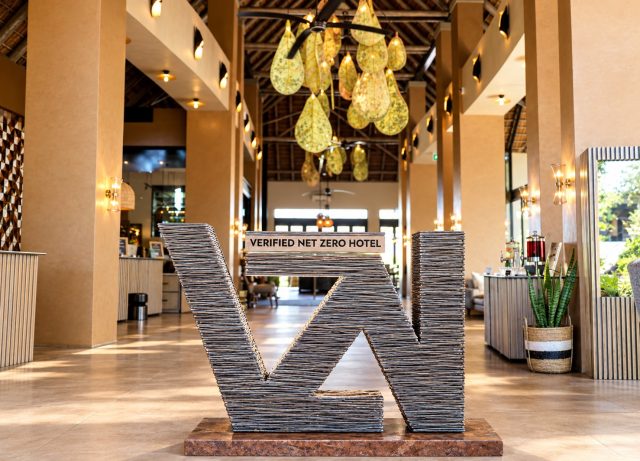


A first African property for the Verified Net Zero programme
Radisson Hotel Group has reached another milestone in the implementation of its Verified Net Zero (VNZ) environmental programme with the Radisson Safari Hotel Hoedspruit, located near Kruger National Park and Blyde River Canyon in South Africa.
The property comprises 138 rooms and suites, some with private pools. It also features several dining venues, a spa and meeting and events facilities.
According to Radisson, it is the first hotel in Africa to achieve Verified Net Zero recognition under the group’s programme.

Already implemented in the United Kingdom and Nordic countries, the initiative is intended to expand progressively into other markets, with a target of 100 properties by 2030.
What distinguishes the South African project is its application to an existing hotel, whose facilities and operating procedures have been adapted.
Renewable electricity and the electrification of operations
The energy strategy at Radisson Safari Hotel Hoedspruit is based on several complementary measures.
The hotel uses on-site solar generation alongside renewable electricity purchased with guarantees of origin.

From 2027, these arrangements are expected to be supplemented by a solar wheeling agreement, a mechanism enabling a producer to feed solar electricity into the national grid and contractually allocate an equivalent volume to the hotel’s consumption.
This development is intended to strengthen the property’s renewable electricity supply.
Electrification also extends to operational equipment.
The kitchens make extensive use of electric appliances, while domestic hot water is produced using heat pumps.
Internal transport is provided in part by electric buggies and three-wheeled utility vehicles.
The objective is to minimise direct reliance on fossil fuels.
This transformation is accompanied by consumption monitoring, preventive maintenance programmes and staff training.
Water, waste and procurement: decarbonisation beyond energy
The Verified Net Zero programme extends beyond energy consumption.
In Hoedspruit, the hotel reports that it recycles 100% of its wastewater through its own treatment facility.
Waste management is based on sorting, recycling and the recovery of organic materials.
Local partners are involved in these activities, including Shodulla Recycling for plastics, glass and paper, and Egg Brothers for composting and vermicomposting food waste.
In guestrooms, amenities supplied in larger dispensers replace some individually packaged products.
The group states that these containers are returned to the supplier through a closed-loop recycling system.
Glass water bottles, the provision of certain amenities on request and towel reuse options complete the measures.
A digital concierge application, STAY, is also intended to reduce printed materials and facilitate communication between guests and hotel teams.
Food and beverage included in carbon footprint calculations
One of the programme’s most noteworthy aspects concerns food and beverage operations.
In partnership with specialist platform Klimato, the hotel is introducing menus displaying information about the carbon footprint of individual dishes.
This information is intended to help culinary teams compare ingredients, adapt certain recipes and prioritise dishes with a lower carbon footprint.
The approach also extends to buffets and food procurement.
Reuse initiatives complement these measures, including the conversion of used coffee sacks into reusable bags by a community sewing workshop.
This approach illustrates an important development: hotel decarbonisation is no longer solely the responsibility of engineering departments, but directly involves food and beverage, procurement, rooms and operations teams.
Independent verification by TÜV Rheinland
The Verified Net Zero programme covers all three emissions scopes defined by the Greenhouse Gas Protocol.
Scope 1 concerns direct emissions arising from the property’s activities.
Scope 2 covers emissions associated with purchased energy.
Scope 3 encompasses indirect value-chain emissions, particularly those associated with procurement, food, waste and certain outsourced services.
Radisson states that its programme aims for the near-elimination of Scope 1 and 2 emissions and significant reductions in Scope 3 emissions.
Residual emissions are addressed through carbon removal credits purchased via Greentrade, as part of the South African GRASS project.
The property’s compliance with the Net Zero Methodology for Hotels is verified by independent organisation TÜV Rheinland.
This verification is an important element of credibility, although it does not mean that the hotel no longer generates any emissions.
Verified Net Zero recognition is based on a combination of operational emissions reductions, renewable energy procurement and measures addressing residual emissions.
However, the announcement does not provide baseline or residual emissions volumes, nor a quantitative breakdown of the reductions achieved across the three scopes.
A target of 100 hotels by 2030
For Radisson Hotel Group, the Hoedspruit project is intended to serve as an operational reference for hotel owners and operators across Africa.
Tim Cordon, Chief Operating Officer, Middle East, Africa and South East Asia Pacific, emphasises that the property demonstrates how investments in renewable electricity, electrification and changes to everyday operating practices can reduce the environmental impact of an existing hotel.
Inge Huijbrechts, Chief Sustainability & Security Officer, highlights the need to address emissions across both operations and the supply chain, rather than focusing solely on electricity consumption.
The group’s ambition is to reach 100 Verified Net Zero hotels by 2030.
However, the programme’s expansion will need to account for differences between markets, particularly in access to renewable electricity, equipment availability and the maturity of local recycling infrastructure.
LTH Analysis | Decarbonising existing hotels: the CAPEX and return-on-investment question
The Radisson Safari Hotel Hoedspruit case is particularly relevant to hotel owners and investors.
Rather than a newly built hotel designed from the outset around specific environmental requirements, it is an existing property whose operating model has been adapted.
This distinction is essential.
The decarbonisation of the global hotel portfolio will depend largely on owners’ ability to transform their existing assets without undermining their financial viability.
Electrifying kitchens, installing heat pumps, generating solar electricity, treating wastewater and adapting equipment can all require significant capital investment.
These expenditures must be assessed against several factors: expected energy savings, payback periods, maintenance requirements, supplier availability and operational impact.
However, Radisson has not disclosed the CAPEX invested in Hoedspruit, the operating savings generated or the investment payback period.
Such information would be essential to assessing the model’s economic replicability.
Another consideration is the distinction between actual emissions reductions and measures addressing residual emissions.
Guarantees of origin, renewable electricity supply agreements and carbon credits operate through different mechanisms from the physical elimination of emissions at the property itself.
For owners, investors and corporate clients, transparency about these different mechanisms will be crucial.
The project also highlights the importance of Scope 3.
At a hotel offering restaurants, spa facilities and leisure activities, part of the environmental footprint depends on suppliers and purchased services. Managing these emissions therefore requires changes to commercial and operational practices beyond technical equipment alone.
Finally, in a destination such as Hoedspruit, where the natural environment is central to the visitor experience, resource conservation can also contribute to the property’s commercial positioning.
The real test of the Verified Net Zero programme will be its ability to reconcile three requirements: measurable emissions reductions, maintained service quality and financial viability for owners.
The target of 100 hotels by 2030 will provide an initial indication of Radisson’s ability to scale this approach across markets with very different energy and economic constraints.
At a Glance
Hotel: Radisson Safari Hotel Hoedspruit.
Location: Limpopo Province, South Africa, near Kruger National Park.
Capacity: 138 rooms and suites.
Milestone: First Verified Net Zero hotel in Africa, according to Radisson Hotel Group.
Verification: TÜV Rheinland.
Energy: On-site solar power, renewable electricity procurement and planned solar wheeling from 2027.
Operations: Electrified kitchens, heat pumps and electric utility vehicles.
Water: 100% of wastewater recycled through an on-site treatment plant.
Food and beverage: Carbon-labelled menus developed with Klimato.
Emissions: Near-elimination of Scopes 1 and 2, reductions in Scope 3 and carbon removal credits for residual emissions.
Group target: 100 Verified Net Zero hotels by 2030.
CAPEX and financial returns: Not disclosed.
LTH perspective: The economic scalability of net-zero retrofits will depend on measurable emissions reductions, investment requirements and operating savings.